As Canadian wildfires send hazardous smoke across the United States, political blame is replacing the cooperation that once defines the relationship between both nations. This opinion examines climate policy, wildfire research cuts, tourism, and why friendship, science, and cross-border assistance must prevail over tariffs and confrontation.
For weeks, Canada has been battling one of the most destructive wildfire seasons in its history. Hundreds of fires have burned across several provinces, forcing entire communities to evacuate, destroying homes, and blanketing much of North America in smoke. Air quality alerts have been issued across large parts of the United States, affecting more than 100 million Americans from the Midwest to the East Coast. What began as a Canadian disaster quickly became a North American emergency. It is against this backdrop that an unexpected political dispute has emerged between two countries that have stood side by side for generations in times of crisis.
Wildfire smoke does not stop at a border crossing.
Neither does climate change. Neither should friendship.
For generations, the relationship between the United States and Canada has been one of the world’s finest examples of what good neighbors can accomplish together. The world’s longest undefended border became far more than a geographical line—it became a symbol of trust, mutual respect, and shared prosperity. Millions of Americans and Canadians crossed it every year, not as strangers but as friends.
How Tourism helped build that friendship between US and Canada
From Alaska cruises linking British Columbia with the United States, to family vacations, business travel, conventions, ski holidays, sporting events, and cultural exchanges, tourism has always demonstrated that peace is built one visitor at a time. The travel industry has long understood a simple truth: people who know each other rarely become enemies.
Today, however, that remarkable relationship is being tested.
As Canada battles another devastating wildfire season, smoke has drifted south, affecting millions of Americans. One might have expected such a continental emergency to strengthen cooperation between neighbors. Instead, it has too often become another political battleground.
Canadian Wildland Fire Information System / Système canadien d’information sur les feux de végétation
Canadian Wildland Fire Information System / Système canadien d’information
on the fires of vegetation
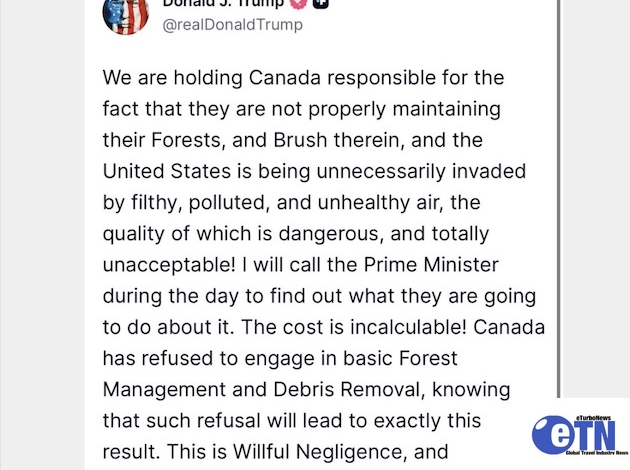
President Donald Trump publicly blamed Canada for the smoke affecting the United States, accusing Canada of “willful negligence” in forest management while threatening additional tariffs as hundreds of wildfires continued to burn. The remarks came while entire Canadian communities were being evacuated, Indigenous communities lost their homes, and more than one hundred million Americans lived under air-quality alerts.
The timing couldn’t have been more unfortunate.
For more than forty years, American and Canadian firefighters have crossed the border whenever disaster struck. Thousands of US firefighters have assisted Canada during record-breaking fire seasons. Canada has responded just as readily when devastating fires swept through California, Colorado, and other western states. This is not charity—it is one of the world’s most successful mutual aid partnerships, built on decades of trust and professionalism.
Perhaps no story better illustrates that friendship than that of Canadian helicopter pilot Nicholas Dale, who lost his life while fighting a wildfire in Colorado. As his body was transported home, Americans lined the highway waving flags in tribute. Nicholas Dale never asked whether the fire he was fighting was on Canadian or American soil. He simply answered the call.
That is the North America many of us recognize.
Unfortunately, today’s political climate increasingly reflects confrontation instead of cooperation. Since returning to office, the Trump administration has pursued a more confrontational approach toward Canada, reopening tariff disputes, questioning long-standing trade arrangements, suggesting Canada should become America’s “51st state,” and using rhetoric toward one of America’s closest allies that would have been unimaginable only a decade ago. Whether one supports or opposes these policies politically, there is little doubt they have strained one of the world’s strongest bilateral relationships.
The extends divides beyond trade.
Climate Change: How the US and Canada see it?
It also reflects fundamentally different approaches to climate change.
Canada continues to recognize climate change as one of the defining public policy challenges of our time, requiring scientific research and international cooperation. The Trump administration has taken a markedly different course. It has again withdrawn the United States from international climate commitments while reducing support for climate and environmental research. According to reports, key wildfire research stations, air-quality monitoring programs, and federal scientific initiatives that help predict smoke movement, assess health risks, and improve wildfire response are being downsized or eliminated. The irony is striking: while blaming Canada for smoke crossing the border, the administration has simultaneously reduced funding for some of the very research that helps Americans understand and respond to that smoke.
Climate change is not a political slogan.
It is becoming the defining challenge facing global tourism.
Whether it is wildfires in Canada and California, hurricanes across the Caribbean and the Gulf Coast, floods in Europe, drought in Africa, or extreme heat affecting destinations worldwide, the visitor economy increasingly depends upon science, international cooperation, and long-term planning.
- Reducing research funding does not reduce the risks.
- Ignoring climate science doesn’t stop wildfires.
- Blaming neighbors certainly does not extinguish them.
- Tourism has always offered a different path.
It is an industry built on friendship, understanding, and mutual respect. It demonstrates every day that cooperation creates prosperity while isolation diminishes opportunity. The world’s travelers do not see borders as walls; they see them as gateways to new friendships and shared experiences.
Sports have always understood what politics sometimes forget.
The FIFA World Cup demonstrated that North America can still work together. The United States, Canada, and Mexico jointly welcomed millions of visitors, proving that cooperation remains stronger than political headlines. Fans crossed borders without hesitation. Stadiums became gathering places rather than dividing lines.
That spirit deserves to survive long after the final whistle.
History offers similar lessons.
When Zimbabwe and Zambia jointly hosted the UN World Tourism Organization (UNWTO) General Assembly at Victoria Falls, the two countries temporarily opened their border, allowing delegates to move between nations. Tourism became an instrument of diplomacy, demonstrating that cooperation creates opportunity while barriers create isolation.
North America has long been a model for that philosophy.
It should remain one.
The atmosphere recognizes neither customs checkpoints nor immigration offices.
Wildfire smoke carries no passport. Neither does carbon.
Scientists overwhelmingly agree that warmer temperatures, prolonged drought, and changing weather patterns are intensifying wildfire seasons across North America. Better forest management is undoubtedly part of the solution, but no single nation can solve a continental environmental crisis alone.
The tourism industry has always shown governments the way.
- Every visitor crossing the border builds trust.
- Every convention creates dialogue.
- Every airline route connects families.
- Every sporting event strengthens friendships.
- Every hotel stay supports communities.
- Travel has never been merely an economic activity.
It remains one of humanity’s greatest diplomatic achievements. Canada and the United States have proven this for generations.
- Governments change.
- Presidents come and go.
- Trade disputes eventually fade into history.
- But geography doesn’t matter.
Canada and the United States will remain neighbors long after today’s political arguments are forgotten.
That is why this moment matters.
The smoke hanging over North America should remind us that our futures are inseparable. The greatest threat is not one country or another. It is our collective inability to confront climate change with the urgency it demands.
We can either blame one another while forests burn. Or we can remember what has always made this continent strong.
- Send firefighters before criticism.
- Fund scientists before dismantling research.
- Invest in climate resilience before paying for disaster recovery.
- Send tourists before tariffs.
- Choose cooperation before confrontation.
Because when the smoke finally clears, history will not remember who posted the sharpest message on social media. It will remember who showed up.
That has always been the strength of the United States and Canada.
It should remain their future.
For the global travel and tourism industry, there is no alternative.
Friendship, cooperation, scientific understanding, respect for facts, and stewardship of our shared planet remain the strongest foundations for peace and prosperity.
They always will.