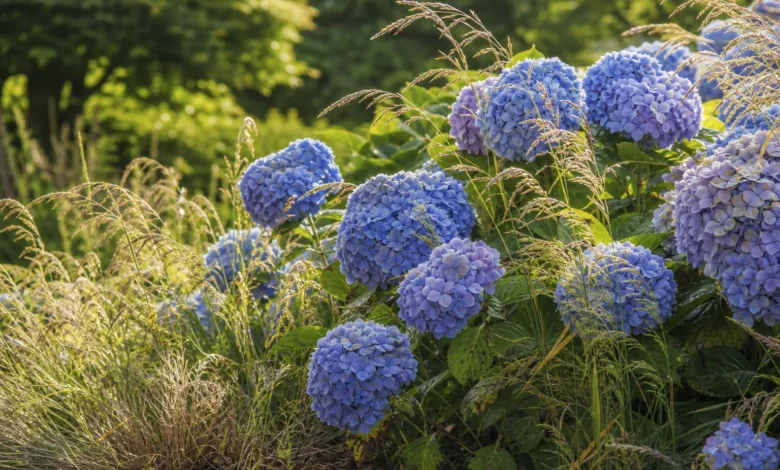

A group of hydrangeas looks magnificent in June – and yet often appears heavy and static in the bed as soon as the thick flower balls sit alone between bare earth. Ornamental grasses solve this in just a few simple steps: their fine stalks bring movement, height and a slight contrast to the area. If you want to combine hydrangeas and ornamental grasses, you don’t need an elaborate concept, but rather the right choice of partner for your own location. Blue fescue in front of a blue farmer’s hydrangea creates a completely different picture than two meters of miscanthus behind a white ‘Limelight’ – both work, but in very different places.
In short
- Contrast as a principle – Voluminous hydrangea flowers and delicate blades of grass complement each other in shape, texture and season.
- Location decides – Panicle hydrangeas tolerate a lot of sun, farmer hydrangeas like partial shade; the grasses adapt accordingly.
- Three adjusting screws – Soil pH, elevation and water requirements determine whether the combination is sustainable.
- Five scenes – From the sunny driveway to the XXL late summer bed, there is a suitable pair for every bed situation.
Why hydrangeas and ornamental grasses make a strong team
The appeal lies in the contrast. Hydrangeas create large, rich areas of color – round umbels in the farmer’s hydrangea, conical panicles in the panicle hydrangea. Grasses respond with the exact opposite: narrow stalks, fine seed heads, a silhouette that trembles with every breath of wind. Next to each other, neither plant looks like a solitary plant that demands too much attention.
Then there is the calendar. Hydrangeas make their big appearance from June to early autumn. It is precisely when their flowers slowly fade that the grasses come into their own: their stalks turn from straw gold to bronze, and the seed heads catch hoar frost and low light in winter. This means the bed remains attractive even in November and December, when other perennials have long since moved in. Which types of grass generally suit hydrangeas depends primarily on height and water requirements – more on that in a moment.
The basic rules before planting
Before you pick up the shovel, it’s worth taking a look at three points that determine success or frustration. The first is the floor. A slightly acidic pH value between 5.5 and 6.5 allows blue hydrangeas to bloom particularly vigorously. If your garden soil is calcareous, add compost or rhododendron soil when planting – most grasses don’t mind this.
The second point is the height. Stagger from front to back: low grasses such as blue fescue or sedge at the edge of the bed, medium-high partners in the second row, tall hydrangeas and miscanthus in the background. This way nothing obscures anything else and the eye gets depth.
The third and often underestimated point is water. Hydrangeas want to be evenly moist; many ornamental grasses cope much better with short dry periods. Therefore, do not place a thirsty hydrangea right next to a grass that actually wants to rest in the summer. A layer of mulch around the hydrangea compensates for a lot – especially in hot summers, which will cause drought stress again in 2026. How to properly support hydrangeas during heat stress is a topic in itself.
Pro tips
- Mulching: A layer of shredded bark or compost around the hydrangeas keeps the soil moist, while the grasses next to them get by with less.
- Water carefully: During hot periods, water the hydrangeas thoroughly in the morning, and the drought-tolerant grasses only if the drought persists.
- Pruning timing: Only cut hardy grasses in late winter so that the stalks provide structure until then; Depending on the species, hydrangeas in early spring.
- Leave structure standing: Do not remove spent umbels and seed heads in autumn – they carry hoarfrost and light through the cold season.
If you want to save yourself the hassle of cutting, choose easy-care ornamental grasses that you don’t have to cut back and combine them with a robust panicle hydrangea.
5 garden scenes with hydrangeas and ornamental grasses
The following five situations cover the most common bed locations. Each one names a tried and tested pair of plants and varieties – and you can replant them one-to-one or use them as a starting point for your own variations.
Driveway and front yard: vertical structure
Things can be upright at the sunny entrance. Columnar conifers such as slender thuja or columnar cypresses provide the evergreen framework, in front of which reed grass ‘Karl Foerster’ (Calamagrostis) with its tightly upright golden stalks for a second vertical accent. A panicle hydrangea can easily keep up here because it can tolerate full sun. A fluffy Pennisetum grass on the edge highlights the strict lines.

Seating area: calming contrast
Peace and quiet is what counts around the terrace. Blue farmer’s hydrangeas and a stripe of lavender play through the cool tones, while a rhododendron in the back provides the dark green, evergreen wall behind it. Pay attention to the location of lavender: it would like it to be sunnier and drier than the hydrangea, so it is better to place it at the front, well-draining edge of the bed. There are other companion plants for hydrangeas in the garden for semi-shady corners.

Raised bed: color focus with a clear edge
In the raised bed, the flower color is in the spotlight because you determine the substrate yourself. You can control the blue or pink of the farmer’s hydrangea using slightly acidic soil. Carex morrowii ‘Ice Dance’ is suitable as a lively edge: a low sedge with narrow, white-edged leaves that neatly border the edge. Below, large-leaved hostas and pink astilbes complement the texture – both like it similarly moist as the hydrangea.

Modern gravel bed: reduced and easy to care for
The contemporary look thrives on restraint. A compact farmer’s hydrangea forms one strong point of color, with fine angel hair grass waving around it (Stipa tenuissima), and thin stems of Verbena bonariensis purple umbrellas of flowers pull up. Low Günsel (Ajuga) or a sedge close the gravel towards the ground. The light-colored gravel layer retains warmth, suppresses weeds and fits the minimalist front garden.

What’s Hot

Garden and plants
Hydrangea weakens in the heat: 5 myths fact-checked
Late summer bed: XXL effect
If there is space, the larger varieties can go. Panicle hydrangeas such as ‘Limelight’, ‘Vanille Fraise’ or ‘Pinky Winky’ open their cone-shaped flowers from white to pink at just the right time. Miscanthus is piled up behind it (Miscanthus sinensis ‘Gracillimus’) at 1.5 to 2 meters and gives the scene an overhanging, silvery shimmering backdrop. A few dabs of coneflower or sage add a warm color accent. This bed reaches its peak in August and September, when many other corners are already breaking down.

Frequently asked questions
Which ornamental grasses go with which type of hydrangea?
As a rule of thumb: scale beats taste. Tall grasses such as miscanthus or pampas grass, which support the inflorescences, go well with large panicle hydrangeas. The robust snowball hydrangea (Hydrangea arborescens ‘Annabelle’) with its heavy white balls appears lighter next to delicate feather grass because the fine grass optically absorbs the mass. And at the foot of a climbing hydrangea on the wall, clumpy grasses that do not require a climbing aid look good.
Can hydrangeas and grasses also be combined in a pot?
Yes, if the vessel is large enough – at least 40 to 50 centimeters in diameter. Hydrangeas have a lot of root pressure, so choose a forgiving partner like blue fescue and don’t plant too closely. Remember: The soil dries out more quickly in the pot than in the bed, and daily watering is often mandatory in hot weeks.
How much planting distance do hydrangeas and ornamental grasses need from each other?
Adjust the spacing based on the final size of the plants. Between a fully grown farmer’s hydrangea and a medium-high grass, around 60 to 80 centimeters makes sense, for large panicle hydrangeas next to miscanthus it is more like 100 to 120. Low edge grasses can move significantly closer at 30 to 40 centimeters without getting in each other’s way.