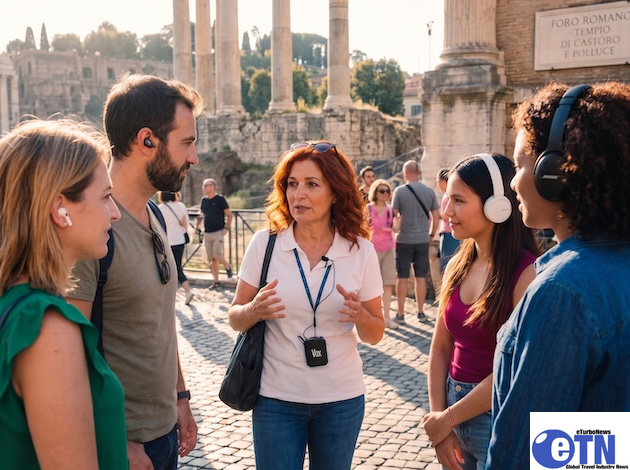
Vox is bringing Bluetooth connectivity to each one of its tour-guiding radios, allowing travelers to listen through their own wireless earbuds or Bluetooth-enabled hearing aids. The September 2026 launch marks a significant accessibility and usability upgrade for guided tours, museums, cruise excursions, and sightseeing experiences worldwide.
LONDON — One of the small frustrations of joining a guided tour may soon disappear.
For decades, visitors arriving for city walks, museum visits, shore excursions and cultural tours have routinely been handed a wired headset before following a guide through crowded streets or historic landmarks. The system works, but it has remained largely unchanged while the rest of consumer audio technology has gone wireless.
Vox, one of the world’s largest providers of professional tour-guiding technology, believes the industry has reached a turning point.
Beginning in September 2026, every Vox radio used by tour operators worldwide will be compatible with Bluetooth through Vox BTallowing visitors to listen using their own wireless earbuds or Bluetooth-enabled hearing aids instead of traditional tour headphones.
While seemingly a modest upgrade, the development reflects broader changes in traveler expectations and accessibility.

Vox BT | Bluetooth Tour Guide Adapter | VoxGroup
Vox BT connects any Vox radio receiver to guests’ own Bluetooth earphones or hearing aids via a compact jack-to-USB-C adapter.
According to Vox, its technology supports more than 30 million travelers annually through 5,600 travel and tourism partners operating in over 150 countriesmaking it one of the most widely deployed professional guiding systems in the global tourism industry. The company has expanded from its original radio guide systems into AI-powered translation, destination management, self-guided experiences, and multilingual content for museums, cruise lines, attractions and tour operators.
A Consumer Technology Finally Reaches Tourism
Wireless earbuds have become almost universal among travelers. At the same time, modern hearing aids increasingly connect directly via Bluetooth, allowing users to receive audio without wearing additional equipment.
Until now, guided tours largely required everyone to use the same dedicated receiver and headset.
Vox says travelers repeatedly asked a simple question:
“Can I just use my own?” The company’s answer is Vox BT.
Guests joining a tour can now hear the guide through devices they already wear every day, reducing the need to adapt to unfamiliar equipment.
“What I love about Vox BT is how natural it feels for the guests,” said Fabio Primerano, CEO of Vox.
“Picture a group in a busy cathedral. One person is listening through their own earbuds, another is hearing the guide stream straight into their hearing aids, and everyone is following the same tour, each in the way that suits them best. We didn’t build anything complicated. We listened to what our guests asked for, and then we went a little further.”
Accessibility Becomes Mainstream
The significance may be greatest for travelers with hearing loss.
Instead of placing large headphones over hearing aids—or trying to hear commentary above traffic, crowds and city noise—visitors using Bluetooth-compatible hearing aids can receive the guide’s voice directly into their hearing devices.
As destinations around the world invest more heavily in accessible tourism, technology that removes barriers without changing how tours operate is increasingly attracting attention. Industry organizations have encouraged operators to improve accessibility not only through physical infrastructure but also through communication technologies that allow more visitors to participate comfortably.
Unlike specialized accessibility equipment that must be requested in advance, Bluetooth capability becomes available to every guest using the same guiding system.
Less equipment, less waste
The launch also reflects a gradual shift towards “bring your own device” travel.
Although Vox already operates an equipment collection and recycling program for its reusable headsets, allowing guests to use personal earbuds reduces the number of accessories that tour operators must distribute, sanitize, collect, and transport after every excursion.
For operators managing thousands of guests each week, particularly cruise excursions and large sightseeing programs, even small operational efficiencies can translate into meaningful savings.
Part of a Broader Technology Strategy
Vox BT arrives less than a year after the company introduced Vox auraan AI-powered transmitter designed for professional guides.
Aura provides live multilingual interpretation in up to 200 languages while also supporting live subtitles and AI-assisted responses to visitor questions. The technology can continue functioning without an internet connection by delivering pre-loaded multilingual content directly from the transmitter, an important consideration for archaeological sites, historic districts, and destinations with inconsistent mobile coverage.
Together, Aura and Vox BT illustrate how tourism technology is increasingly moving away from simply amplifying a guide’s voice toward creating personalized visitor experiences, where different guests can receive commentary in different languages—or through different listening devices—while participating in the same tour.

We Are Global Leaders For Guiding Solutions | VoxGroup
Vox Group: Smart Transmitter, group and self-guiding and AI live translation for tour operators, cruise lines, museums and DMOs in 150+ countries.
For travelers, the change may be almost invisible.
Instead of reaching for unfamiliar headphones, they simply keep using the earbuds or hearing aids already in their ears.
Sometimes, the most significant travel innovations are the ones visitors hardly notice at all. Vox BT will become available worldwide in September 2026.