

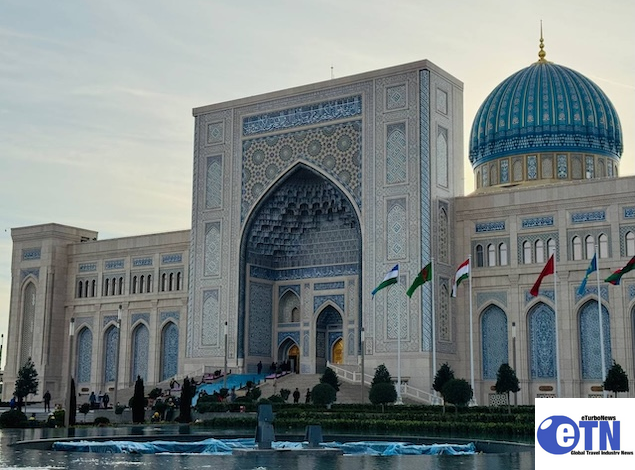
Uzbekistan is rapidly transforming into a major Silk Road tourism destination through aggressive aviation expansion, airport modernization and visa liberalization. Rising visitor numbers, new airline routes and infrastructure investments are boosting growth, but challenges remain including service quality, aircraft shortages and regional competition as the country pursues ambitious tourism targets.
For centuries, Uzbekistan sat at the crossroads of civilizations. The ancient caravan cities of Samarkand, Bukhara, and Khiva once thrived as jewels of the Silk Road, linking China, Persia, the Middle East, and Europe. Today, the Central Asian nation is attempting a modern reinvention: transforming itself from a relatively isolated post-Soviet state into one of Eurasia’s fastest-growing tourism markets.
At the center of that strategy lies aviation.
The government of President Shavkat Mirziyoyev has spent the past decade liberalizing visas, modernizing airports, expanding airline competition and marketing Uzbekistan as a gateway between East and West. The effort is already producing measurable results. International arrivals surged from roughly one million visitors in 2016 to around eight million in 2024, according to international trade data.
Yet despite rapid growth, Uzbekistan’s tourism ambitions still face substantial obstacles: infrastructure bottlenecks, uneven service standards, aircraft shortages and fierce regional competition from Gulf hubs and neighboring Central Asian states.
From Soviet Isolation to Silk Road Revival
Under Soviet rule, tourism in Uzbekistan was tightly controlled and largely confined to organized domestic travel. Historic cities were preserved more as cultural showcases than as globally marketed destinations. After independence in 1991, the country struggled with restrictive visa policies, limited foreign investment, and poor international connectivity.
The turning point came after 2016, when sweeping economic reforms opened the country to foreign visitors. Uzbekistan introduced visa-free access for dozens of countries and simplified electronic visa procedures. Tourism became a strategic pillar of economic diversification.
The strategy worked. Global awareness of Uzbekistan expanded rapidly through international media campaigns, influencer marketing, and UNESCO-driven heritage tourism promotion. The country’s architectural icons — especially Registan Square in Samarkand — became central to its branding efforts.
But policymakers quickly realized that tourism growth depended on something more practical than marketing slogans: air access.
Aviation as the Engine of Tourism
Uzbekistan’s geography makes aviation indispensable. Landlocked and distant from major global markets tourism, the country depends heavily on air connectivity to attract visitors.
Researchers examining the relationship between aviation and tourism in Uzbekistan argue that the two sectors are “mutually dependent,” with air transport serving as the critical catalyst for international visitor growth.
For years, however, Uzbekistan’s aviation sector was dominated by the state carrier Uzbekistan Airways, which controlled most international traffic. Critics often described the market as expensive, limited and insufficiently competitive.
That is now changing.
The government has gradually liberalized the aviation sector, encouraging new airlines and opening airports to foreign carriers. Samarkand International Airport became a centerpiece of that strategy after a major reconstruction project completed in 2022 tripled its passenger handling capacity. An “open skies” regime introduced later that year aimed at attracting more international airlines and stimulating competition in tourism.
At the same time, Uzbekistan is seeing the emergence of private and low-cost carriers. Silk Avia was launched to strengthen domestic tourism and regional connectivity, while Centrum Air represents the country’s growing private aviation sector.
The national airline itself has also expanded aggressively. Uzbekistan Airways modernized its fleet with Boeing 787 Dreamliners and Airbus A321neo aircraft while adding new international routes across Asia, the Middle East and Europe.
Building a Central Asian Hub
Uzbekistan’s long-term ambition extends beyond tourism alone. Officials increasingly view the country as a potential regional aviation hub connecting Europe, Asia, and the Middle East.
That vision explains the heavy investment in airport infrastructure. Tashkent International Airport continues to undergo modernization, while Samarkand is being positioned as both a tourism gateway and a regional transit point.
The government is also aggressively expanding bilateral air agreements. China and Uzbekistan recently agreed to increase weekly flights from 46 to 60, while Russia and Uzbekistan announced plans to dramatically expand air frequencies.
New international links are also emerging elsewhere in the region. Oman Air announced new Muscat–Tashkent services beginning in 2026, reflecting growing Gulf interest in Central Asia tourism and transit markets.
Tourism planners hope these connections will diversify visitor flows beyond traditional Russian and CIS markets, especially towards China, the Gulf states, South Korea and Europe.
The Challenges Beneath the Growth Story
Despite the optimism, Uzbekistan’s tourism boom remains fragile.
One persistent problem is service quality. Analysts warned that the country risks prioritizing visitor volume over sustainable tourism standards. Hospitality training, multilingual services, and premium tourism infrastructure remain inconsistent outside major cities.
Aviation constraints are another major concern. Although passenger numbers are rising rapidly, airlines face aircraft shortages and delayed deliveries. Even Uzbekistan Airways has acknowledged that demand is outpacing capacity.
Airport congestion, particularly in Tashkent, also threatens future expansion. Earlier research emphasized the need for larger, more technologically advanced airport facilities capable of supporting a true open-skies environment.
Competition is intensifying as well. Kazakhstan is expanding Almaty and Astana as regional hubs, while Gulf carriers continue to dominate long-haul transit traffic between Europe and Asia. Uzbekistan must compete not only as a destination, but as a connector market.
There are also broader geopolitical risks. Central Asia’s tourism industry remains sensitive to regional instability, currency fluctuations, and shifts in Russian outbound travel demand.
Future Plans: Beyond Heritage Tourism
Uzbekistan’s next phase of tourism development aims to move beyond classical Silk Road itineraries.
Government strategies increasingly emphasize ecotourism, mountain tourism, gastronomy, religious pilgrimage and luxury travel. Ski resorts such as Amirsoy, developed with international investment, are designed to attract higher-spending regional visitors year-round.
Officials have set ambitious targets under the Uzbekistan-2030 development strategy: 15 million foreign tourists annually and tourism export revenues of $5 billion.
Achieving those goals will depend heavily on whether aviation reforms continue. Industry observers say the country’s future competitiveness hinges on deeper liberalization, stronger airline competition and more efficient airports.
The broader vision is clear. Uzbekistan no longer wants to be viewed simply as an ancient Silk Road museum. It wants to become Central Asia’s modern tourism and aviation crossroads — a bridge between continents as much as cultures.
Whether that transformation succeeds may ultimately depend on how effectively the country connects its glorious past with the logistical realities of global travel in the 21st century.