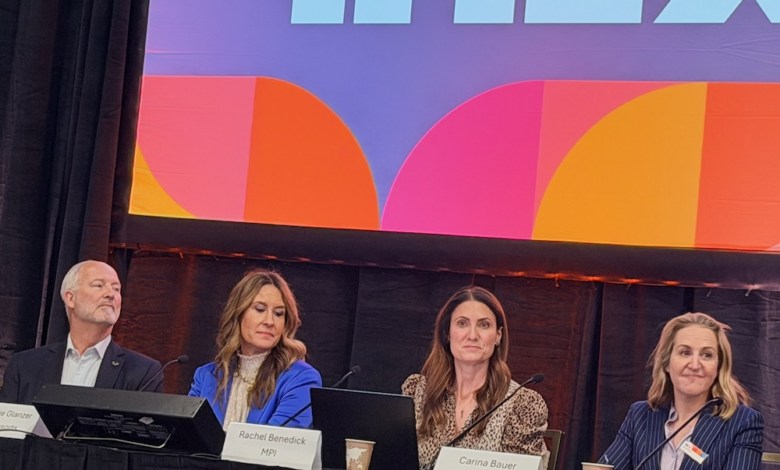
At IMEX Frankfurt 2026, the global meetings industry celebrated record demand while navigating a world shaped by conflict, sanctions and geopolitical fragmentation. As international trade shows expand, the MICE sector is transforming from a hospitality business into a strategic platform for diplomacy, resilience and global influence in an increasingly divided world.
At 8:15 at the Frankfurt Exhibition Halls, the escalators enter IMEX Frankfurt 2026 were already jammed with delegates wearing badges from Riyadh, Singapore, Las Vegas, Kigali, Seoul, and Warsaw. Buyers rushed toward appointments with destination marketing executives promising “certainty,” “connectivity,” and “stability” — three words that had quietly replaced “innovation” as the most valuable currency in the international MICE industry.
The irony was impossible to ignore.
Inside the halls of Messe Frankfurt, the global meetings industry was celebrating growth. IMEX organizers reported surging buyer participation and strong international demand, with exhibitors from more than 100 countries filling expanded floor space. Yet outside the venue, the world economy was fragmenting under sanctions, trade wars, visa barriers, energy shocks, and escalating geopolitical conflict stretching from the Middle East to the South China Sea.
This is the contradiction defining the modern MICE business: the industry grows strongest precisely when the world grows most unstable.
For decades, global business events sold optimism. Congresses were symbols of openness. Incentive programs reward prosperity. Trade shows represented globalization made physically — thousands of strangers crossing borders to shake hands beneath giant LED screens.
Now, every handshake carries political risk.
At IMEX, executives whispered about insurance clauses before discussing event design. Hosted buyers from Asia worried about visa unpredictability. European planners spoke privately about cyber threats, airspace closures, and exposure to sanctions. American corporations demanded contingency plans for destinations that six months earlier had been considered “safe.” The language of hospitality increasingly resembled the language of intelligence briefings.
And yet the halls were full.
This paradox is supported by industry data. While geopolitical instability is now considered the top external risk affecting business travel and meetings, international demand for face-to-face events continues to rise. The same survey data that warns about global disruption also reveals that companies continue investing heavily in live engagement because digital substitutes failed to replace trust, negotiation and human connection.
The MICE industry has become less about celebration and more about strategic necessity.
That is why shows like IBTM World, IMEX America, ITB Berlin, and Arabian Travel Market continue expanding despite political turbulence. Nations no longer participate merely to attract conventions; they participate to secure influence.
Convention centers have become soft-power infrastructure.
Saudi Arabia markets giga-projects and futuristic venues as aggressively as it markets oil diversification. Singapore positions itself as a neutral ground between East and West. Dubai sells itself as the safe transfer hub for a divided world. African destinations arriving at IMEX in record numbers are not simply chasing tourism revenue; they are competing for diplomatic visibility in a fragmented global economy.
Meanwhile, Europe’s role is becoming more fragile.
Frankfurt still projects efficiency, but beneath the polished exhibition floors lies anxiety. Rising energy costs, inflation, regulatory complexity, and deteriorating relations between major powers threaten the free movement that built the European meetings economy. The industry that once depended on frictionless globalization must now navigate selective globalization — a world where travel permissions, trade alliances, and political affiliations increasingly determine who attends, who sponsors, and who speaks.
The pressure is visible in operational realities. According to a new global survey led by the International Association of Professional Congress Organizers, nearly 74 percent of respondents say geopolitical conflict is directly affecting their ability to organize international meetings.
Attendance volatility, rising insurance costs, and travel complications are becoming permanent features of event planning rather than temporary crises
Still, the industry refuses to retreat.
Why? Because in an age of distrust, physical presence has become more valuable than ever.
Governments distrust governments. Corporations distrust supply chains. Audiences distrust algorithms and virtual relationships. The more unstable the digital and political environment becomes, the more valuable physical gatherings become as instruments of reassurance.
The MICE industry survives because people still need rooms where deals can be closed without screens, where rivals can speak privately, and where partnerships can be tested face to face.
In that sense, IMEX Frankfurt is no longer just a trade show.
It is a geopolitical weather station.
Every larger booth from Asia signals confidence. Every missing delegation signals a diplomatic fracture. Every rerouted incentive program reflects shifting alliances. Every security briefing reveals how deeply politics has penetrated global mobility.
The international meetings industry once measured success in delegate numbers and hotel nights. Now it measures resilience.
And resilience may become the defining business model of the next decade.
Because the real story inside the crowded halls of Frankfurt is not simply that global demand for meetings remains strong. The real story is that the business events industry has become one of the last functioning systems of international human connection in a world increasingly organized around division.
The danger is that the industry may miss resilience for immunity.
Trade shows cannot escape the forces reshaping the global order. If sanctions deepen, if air routes fragment further, if visa nationalism accelerates, or if geopolitical blocs harden into economic walls, the very premise of international meetings — open movement between nations — begins to erode.
The escalators at IMEX were still moving upwards this year. The question haunting the industry is how long the world outside will allow them to keep moving at all.