Researchers have developed a rotating device that can harvest energy from waves. It adjusts itself depending on the waves.
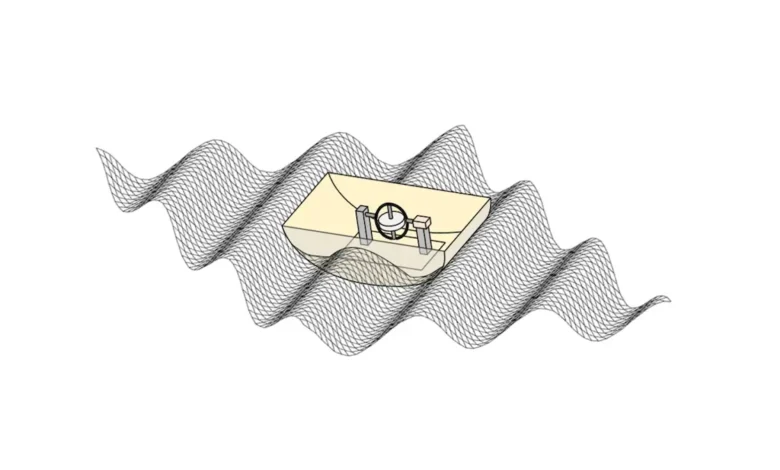
Ocean waves could provide a productive and reliable source of renewable energy. Researchers at Osaka University are investigating a method to use this energy more efficiently using the gyroscopic wave energy converter (GWEC). The system converts the constant movement of the sea into clean electricity using a rotating flywheel within a floating platform.
The principle of gyroscopic precession drives the mechanical energy generation of the system. This phenomenon can be compared to a toy top or a rotating bicycle tire. When an external force acts on such an object, it moves to the side in a controlled manner instead of tipping over.
Energy from waves: mechanics of wave conversion
The integrated flywheel in the ocean reacts similarly when waves cause the platform to move up and down. The flywheel then changes its orientation in space. A generator ultimately uses this mechanical force and uses it to generate electrical power.
Precise control actively adapts the system to the rhythm of the waves. This means that the converter absorbs a maximum of energy even in irregular sea conditions. This approach differs significantly from traditional methods, which often only work under very specific conditions.
Classic systems such as point absorbers or pendulum WECs rely on selective resonance. They only work efficiently if the waves oscillate in a very specific rhythm. This dependence on a single resonance condition severely limits their performance in the volatile ocean.
Advantages over conventional systems
As soon as the wave frequency deviates from this ideal value, the energy absorption of these systems drops massively. The GWEC, on the other hand, promises broadband efficiency over a wide frequency spectrum. However, the system only shows its full strength when it harmonizes perfectly with the rhythm of the waves.
The system maintains the maximum energy absorption efficiency of fifty percent almost independent of the wave frequency. In wave energy theory, this value marks the fundamental physical maximum. The flywheel therefore constantly captures half of the incoming energy.
Researcher Takahito Iida demonstrates this performance using linear wave theory. In the study he analyzes the complex interactions between the waves and mechanics. Iida specifically determined the ideal speeds for the flywheel and the operation of the generator.
Cost question: How efficient is wave power?
Numerical simulations in the time and frequency domains support the theoretical assumptions regarding broadband capability. The time domain simulations were critical in order to test the system’s response to non-linear wave patterns. By assessing non-linear effects, the researchers identified real physical limitations of the system at an early stage.
Despite technical advances, economic implementation remains a critical factor for success. Critics emphasize that the costs per kilowatt hour ultimately determine whether a technology is ready for the market. Engineering alone is not enough if production remains too expensive compared to other green energies.
The study by Osaka University therefore evaluates the suitability of the system for large-scale electricity generation. Efficient operation over wide frequency ranges could reduce overall costs because the systems are down less often. Whether the GWEC makes the leap from the laboratory to industrial use depends on further practical tests.
Also interesting: