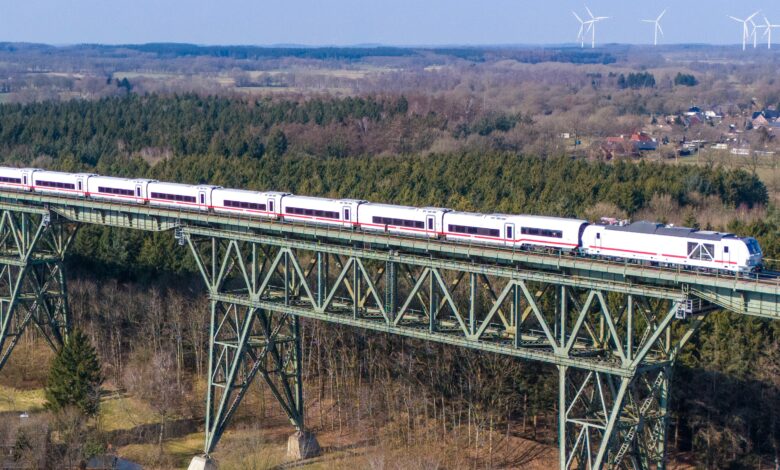
The ICE L with diesel engine is on the way. On April 19, 2026, the train as ICE 2374 traveled with passengers from Hamburg to Sylt for the first time, as can be seen, among other things, from some social media postings and from the train sequence plan from vagonweb.cz. It also shows future use. For the time being, the ICE L only runs between Hamburg and Sylt. Deployment from Frankfurt am Main is planned for July. Interestingly, the locomotive will then be changed in Itzehoe.
A purely electric Siemens Vectron of the 193 series is then planned between Frankfurt and Itzehoe, to be replaced in Itzehoe by a series 248, the Vectron Dual Mode with pantograph and diesel generator. A stay of 17 minutes is planned for this in Itzehoe.
However, it remains to be seen whether this will actually be done in practice. We currently cannot understand whether the locomotive was changed on the way to the premiere. You may already be doing this to practice first.
It would definitely make sense to use another locomotive south of Hamburg, because more than 160 km/h is possible there. This is the maximum of the Vectron Dual Mode. The regular Vectron in the ICE-L combination can reach 200 km/h. The ICE L itself, if the appropriate Spanish locomotive from Talgo of the 105 series is approved, will have a top speed of 230 km/h. However, the railway hardly communicates in this regard. She avoids mentioning actual speeds and has not answered questions about them in the past.
To our knowledge, there was no press release regarding the start of the ICE L to Sylt. This is quite interesting, because since the discontinued ICE TD, there have been no more ICEs with diesel engines as planned. April 19th was an important technical premiere for Deutsche Bahn.
The ICE-L route to Sylt
The ICE L to Sylt does not run as a high-speed train, but rather as a slow intercity train. The ICE L can still travel at 160 km/h under contact wire to Elmshorn. After that, according to Openrailwaymap, he has to drive a little slower and gets to Itzehoe at 120 km/h. The big innovation could then be used there. The Vectron Dual Mode from Siemens retracts its current collector and starts the diesel generator to generate electricity. A time-consuming replacement of locomotives could be eliminated, even if the timetable currently appears to allow for this.
There is no change in top speed, but performance is reduced slightly. Then only 2,000 instead of 2,400 kW are possible on the bike. The remaining distance of the ICE L is predominantly driven at 140 km/h. The last stretch over the famous Hindenburg Dam continues at 100 km/h.
By the way, the diesel-electric ICE L runs on green electricity because it is classified as long-distance transport. But this happens by moving numbers around, as the Bayerischer Rundfunk fact fox has already explained in 2021. It should be obvious that the exhaust gases from the diesel generator are not exactly healthy, even if mathematically only clean air comes out of the exhaust.
Clean operations would definitely be possible in the future. Siemens recently announced a dual-mode Vectron with a large 2 MWh battery instead of the diesel generator. However, it will take some time before the locomotive is put into use and so far only one order from the lessor Akiem is known.
Everything else about the ICE L with diesel drive can be found in our background article: DB: The return of the diesel ICE – with 160 km/h.