
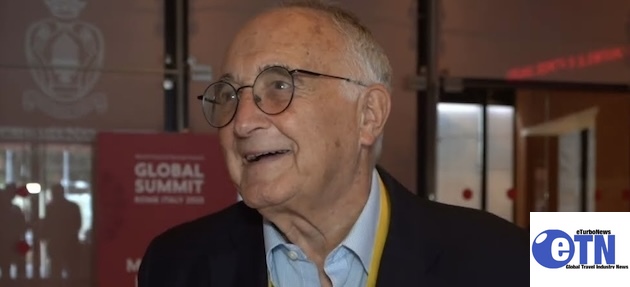
Professor Geoffrey Lipman is asking the European Commission to postpone implementation of its new anti-greenwashing directive for Small Island Developing States, Least Developed Countries, and Landlocked Developing Countries until 2030, arguing that thousands of tourism SMEs lack the financial and technical capacity to comply without jeopardizing their future.
BRUSSELS – One of the world’s most respected tourism statesmen is urging the European Union to postpone implementation of its new anti-greenwashing legislation for the world’s most vulnerable tourism economies.
Professor Geoffrey Lipman, President of SUNx Malta, has formally appealed to EU Commissioner for Sustainable Transport and Tourism Apostolos Tzitzikostas to delay until 2030 the application of the EU’s Directive (EU) 2024/825 – Empowering Consumers for the Green Transition for Small Island Developing States (SIDS), Least Developed Countries (LDCs), and Landlocked Developing Countries (LLDCs).
Unlike many industry requests seeking to weaken environmental regulations, Lipman’s proposal does not challenge the objectives of the directive. Instead, it argues that some of the world’s poorest tourism economies simply lack the financial, legal, and technical capacity to comply within the current timetable.
What Exactly Does Lipman Want Delayed?
Lipman’s letter specifically requests that the European Commission delay the application of Directive (EU) 2024/825 until 2030 for tourism SMEs operating in SIDS, LDCs, and LLDCs.
The Directive is scheduled to apply across the European Union beginning September 27, 2026following its adoption as one of Europe’s most significant measures to combat greenwashing and strengthen consumer protection.
The legislation introduces strict new rules governing environmental marketing, including:
- Banning vague environmental claims such as “green,” “eco-friendly,” or “environmentally friendly” unless they can be substantiated.
- Restricting “carbon neutral” claims based solely on carbon offsetting.
- Prohibiting sustainability labels that are not based on recognized certification schemes or established by public authorities.
- Requiring businesses to provide accurate, verifiable information whenever environmental claims are made about products or services.
Although the law is intended to protect consumers from misleading environmental advertising, Lipman argues that compliance creates a disproportionate burden for thousands of small tourism enterprises in developing countries that market themselves to European travelers.
Why Is SUNx Malta Asking for a Delay?

Prof. Geoffrey Lipman, Brussels, Belgium – Amazing Travel Awards
Professor Geoffrey Lipman is Creative Disruption Architect and Director of greenearth.travel, a global think tank network promoting green growth & travelism (travel & tourism) and specializing in strategy, innovation & funding. Prof Lipman is an Adjunct Professor of Victoria University Australia; Visiting Professor of Hasselt University BE; Visiting Professor of Oxford Brookes University UK; Senior Tourism Research […]
In his letter, Lipman outlines several reasons why a postponement is necessary.
First, he argues that many of these countries have contributed very little to the climate crisis but suffer disproportionately from its impacts.
Second, tourism represents the principal economic engine for many islands and developing nations, providing employment, foreign exchange earnings, and opportunities for sustainable development.
Third, the tourism industry in these destinations is overwhelmingly made up of small and medium-sized enterprises (SMEs) with limited financial and administrative resources.
According to Lipman, complying with the Directive will require legal guidance, revised marketing materials, documentation, certification, staff training, and continuous compliance procedures that many businesses simply cannot afford.

“The sheer cost and complexity of responding to your Directive 2024/825 will plunge these companies and their host countries into chaotic uncertainty and huge financial exposure,” Lipman writes.
SUNx Malta says it is already working with more than 1,000 members of its Climate Friendly Travel Collection to help businesses understand and adapt to the new EU rules.
The organization believes that tourism SMEs in vulnerable developing countries can realistically achieve compliance by 2030coinciding with the target year for the United Nations Sustainable Development Goals.
Rather than requesting a permanent exemption, Lipman is seeking a four-year transition period that would allow businesses to adapt without jeopardizing their livelihoods.
Why This Matters Beyond Europe
Although the Directive is European legislation, its impact extends well beyond the European Union.
Any tourism business promoting hotels, resorts, tours, cruises or destinations to European consumers may need to ensure that its environmental marketing complies with the new rules.
That includes thousands of tourism businesses throughout Africa, the Caribbean, the Pacific, Asia and Latin America that depend heavily on European visitors.
Lipman warns that without additional time, many operators may simply stop making sustainability claims altogether—or face legal uncertainty and significant compliance costs when marketing to EU travelers.
A Career Spanning Modern Tourism
Few people have the credentials to make such an appeal.
Professor Geoffrey Lipman has spent more than five decades helping shape global tourism policy.
He served on the board of the International Air Transport Association (IATA) during a transformative period for global aviation, contributing to airline liberalization and international aviation policy.
He later became the first President and CEO of the World Travel & Tourism Council (WTTC)leading the newly created organization during the 1990s and helping establish travel and tourism as one of the world’s most important economic sectors while strengthening collaboration between governments and the private sector.
Lipman subsequently served as Assistant Secretary-General of the United Nations World Tourism Organization (UNWTO)where he championed sustainable tourism, climate action, and the ST-EP (Sustainable Tourism – Eliminating Poverty) initiative. He also played a leading role in advancing tourism’s contribution to the global climate agenda.
Today, Lipman serves as President of SUNx Malta (Strong Universal Network)a Malta-based nonprofit organization dedicated to advancing Climate Friendly Travel and helping destinations and tourism SMEs prepare for a climate-resilient future.
Seeking International Support
Lipman has copied his appeal to the European Commissioners responsible for Climate, Net Zero and Clean Growth, as well as Environment, Water Resilience and Competitive Circular Economy. He is also seeking support from governments representing SIDS, LDCs and LLDCs, together with international travel and tourism organizations.
His proposal is likely to generate debate throughout the tourism sector.
Supporters may view it as a practical recognition that climate regulations should recognize differing levels of economic and institutional capacity. Critics, however, may argue that delaying implementation risks creating uneven consumer protections and slowing global efforts to combat greenwashing.
What is clear is that Lipman’s request does not seek to weaken Europe’s sustainability objectives. Rather, it asks Brussels to provide the world’s most vulnerable tourism economies with additional time to meet the same standards. The initiative has also received the support of the World Tourism Network (WTN)which previously honored Geoffrey Lipman with its prestigious Tourism Heroes Award in recognition of his decades of service to global tourism. WTN said its endorsement reflects the interests of its approximately 36,000 members in 133 countriesthe vast majority of whom are small and medium-sized enterprises that face many of the same financial and operational challenges in adapting to increasingly complex international sustainability regulations.