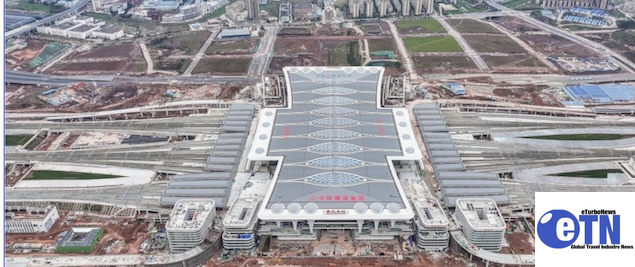
hina’s giant new Chongqing East Railway Station has reignited global debate over railway infrastructure, comparing China’s rapid high-speed rail expansion with Europe’s mature networks and America’s slower development. Railways are increasingly shaping tourism, economic growth, sustainability, and geopolitical competitiveness across the world’s leading economies.
A futuristic railway station in southwestern China has become the latest symbol of the country’s infrastructure ambition after billionaire Elon Musk highlighted a viral video showing the enormous scale of the new hub in Chongqing.
The station — Chongqing East Railway Station — reportedly spans 1.22 million square meters, equivalent to roughly 170 football fields, and was completed in just 38 months. The project has reignited global debate about how railways shape economic growth, tourism, industrial competitiveness, and national prestige.
China: Railways as National Strategy
Over the past two decades, China has built the world’s largest high-speed rail network, transforming domestic travel and regional development. Massive stations such as Chongqing East are designed not only as transport hubs but also as economic engines connected to airports, metro systems, hotels, retail districts, and logistics centers.
A recent viral video shared by Elon Musk emphasizes how China flattened mountainous terrain, mobilized tens of thousands of workers, and integrated eight floors of transport infrastructure into a single mega-station.
China’s railway strategy serves several purposes:
- Boosting domestic tourism
- Accelerating regional trade
- Reducing dependence on air travel for medium-distance routes
- Expanding urbanization into inland provinces
- Strengthening industrial supply chains
High-speed rail has dramatically reduced travel times between major Chinese cities, helping tourism flourish beyond traditional destinations like Beijing and Shanghai. Travelers can now reach remote scenic regions, mountain provinces, and secondary cities within hours instead of days.
The economic impact has been profound. Railway corridors often trigger hotel construction, shopping districts, technology parks, and real estate investment around stations. Analysts increasingly view rail connectivity as a strategic competitive advantage for China’s economy.
Europe: Mature Networks, Slower Expansion
Europe already possesses one of the world’s most sophisticated rail ecosystems, led by countries such as France, Germany, and Spain.
Europe’s railways excel in:
- Cross-border connectivity
- Sustainability
- Passenger comfort
- Urban integration
Systems like the TGV and ICE have made long rail travel a preferred alternative to short-haul flights.
China Mainland Trains – China Ticket Online
Tourism benefits enormously from Europe’s rail infrastructure. Visitors can travel seamlessly between cities such as Paris, Berlin, Rome, and Barcelona without airports or long security lines.
However, Europe faces mounting criticism about delays and cost overruns on major infrastructure projects. Germany’s long-running Stuttgart 21 rail redevelopment has become a symbol of bureaucratic complexity and rising costs. In online discussions following Musk’s post, many commenters contrasted China’s rapid execution with Europe’s slower approval processes.
United States: Rail Lagging Behind
In the United States, railways play a far smaller role in passenger transportation compared with China and Europe. The country remains heavily dependent on automobiles and domestic aviation.
While the Amtrak Northeast Corridor connecting Washington, DC, New York City, and Boston remains one of America’s busiest rail routes, true high-speed rail development has lagged for decades.
Projects such as California High-Speed Rail continue to face political disputes, environmental reviews, and escalating budgets.
Critics argue that the US lacks the centralized planning and long-term infrastructure policies that enabled China’s rapid expansion. Supporters of the American model counter that democratic oversight, land rights, and environmental protections inevitably slow large projects.
Still, transportation experts warned that weak rail investment could affect US competitiveness in tourism, sustainability, and regional economic integration.
Railways and Tourism: The Hidden Economic Multiplier
Modern railway systems do more than move passengers — they reshape entire tourism economies.
High-speed rail:
- Encourages weekend and short-stay travel
- Connects secondary cities to international tourism flows
- Reduces airport congestion
- Lower carbon emissions
- Creates transit-oriented commercial districts
In China, stations themselves are becoming attractions due to their futuristic architecture and massive scale. In Europe, historic stations such as Gare du Nord and Berlin Hauptbahnhof are already tourism landmarks.
Meanwhile, the United States is increasingly exploring rail revival as cities seek greener transportation and alternatives to congested highways and airports.
Infrastructure as Global Competition
Musk’s repost of Chongqing East Railway Station reflects a broader global conversation: infrastructure speed and efficiency are becoming measures of geopolitical and economic power.
Supporters of China’s model point to execution speed, industrial coordination, and large-scale planning. Critics raise concerns about debt, transparency, and centralized control.
What is increasingly clear is that railways are no longer just transportation projects. They are becoming symbols of how nations envision their future economies, sustainability goals, tourism strategies, and global influence.