The reopening of the Strait of Hormuz restores a critical global travel corridor, boosting aviation, tourism, and economic confidence. WTTC, led by Gloria Guevarawelcomed the move, highlighting its importance for global connectivity, stabilizing oil prices, and accelerating recovery across the travel and tourism sector.
Washington DC-Madrid: The global travel and tourism industry received a critical boost today as the Strait of Hormuz reopened to commercial traffic, restoring one of the world’s most vital maritime and aviation corridors. World Travel & Tourism Council (WTTC)quickly forward stepped to underline the significance of this development for global connectivity and economic recovery.
The Strait of Hormuz, a narrow but strategic waterway linking the Persian Gulf with international waters, plays a central role not only in global energy supply but also in the functioning of international travel networks. Its reopening is expected to stabilize oil prices—provided the current ceasefire holds—and restore operational confidence across aviation, cruise, and logistics sectors.
The Gulf region, home to some of the world’s most important aviation hubs and rapidly growing tourism destinations, stands to benefit immediately. Major transit centers connecting Europe, Asia, and Africa rely heavily on secure and efficient access through this corridor. Disruptions in the Strait have historically led to rerouted flights, increased costs, and uncertainty across the travel ecosystem.
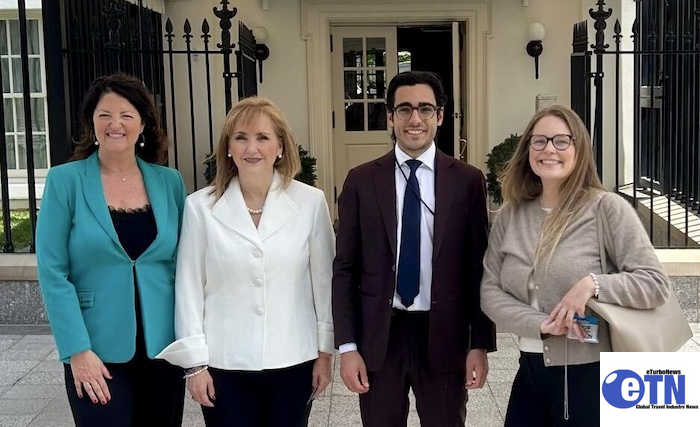
Gloria Guevara, President and CEO of WTTC, who is currently in Washington, DC, on an official mission to the United States—where this development has quickly become a top agenda item.

In a statement to eTurboNews, Guevara emphasized WTTC’s leadership role in guiding the industry through geopolitical uncertainty:
“WTTC welcomes the news regarding the reopening of the Strait of Hormuz to commercial traffic, a critical step in restoring confidence across global Travel & Tourism and the wider economy.
As one of the world’s most important maritime corridors, the Strait underpins not only energy supply chains but also aviation, cruise operations, and global connectivity.
The resumption of movement through this key route will help ease pressure on global travel operations and support the continued recovery and growth of the sector.
Maintaining reliable, efficient international connectivity remains essential to enabling Travel & Tourism to deliver jobs, investment, and economic growth worldwide. WTTC research has shown that destinations and the wider tourism sector can recover quickly from airspace closures and periods of uncertainty.”
WTTC, representing more than 200 of the world’s leading travel and tourism companies, has consistently positioned itself at the forefront of global industry advocacy. Its rapid response to the reopening highlights its role as a unifying voice for both public and private stakeholders navigating an increasingly complex geopolitical landscape.
The reopening of the Strait is expected to immediately improve airline route efficiency, reduce fuel costs, and restore traveler confidence—especially in the Gulf region, where tourism has become a cornerstone of economic diversification strategies.
As global tourism continues its recovery trajectory, today’s development reinforces a key message from WTTC: resilience, connectivity, and leadership remain essential pillars for the future of travel.
More updates to follow as global markets and travel operations respond to this evolving situation.