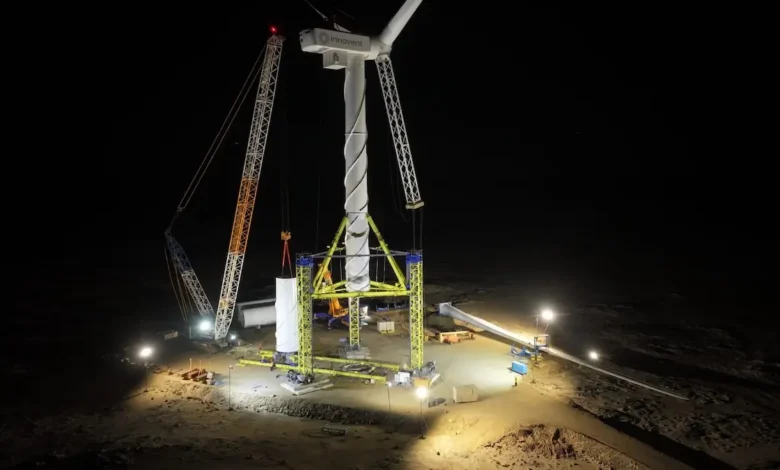
Setting up wind turbines when the wind is too strong for any crane? That’s exactly what the company Nabrawind has now achieved in Namibia. With the so-called Skylift technology, large turbines were built for the first time without heavy cranes and with gusts of up to 20 meters per second. The InnoVent Diaz wind farm is expected to cover six percent of Namibian electricity needs in the future.
Certain regions of Namibia experience some of the strongest winds in the world, making it difficult to set up conventional wind turbines. Large standard cranes can usually only work at low wind speeds of up to eight meters per second.
The new Skylift system from Nabrawind, on the other hand, is intended to work even in unstable winds with speeds of 15 meters per second and gusts of up to 20 meters per second. This would reduce weather-related delays in assembly in the future.
How wind turbines can be erected without a crane
The system combines two proprietary technologies called Total SES and BladeRunner to raise the tower elements without a crane. The rotor is installed at a low height of 30 to 40 meters before the entire tower is gradually raised.
According to Nabrawind, this method ensures that the structural integrity of the thin-walled tube towers is fully protected throughout the entire process. This simplifies on-site logistics, as expensive special cranes no longer have to travel.
In the InnoVent Diaz wind farm, a gearless system of the type Goldwind GW165/6000 was built as the first of its kind using this technology. The engineers had to develop a special process in which two rotor blades were mounted at a 30-degree angle to the ground.
A temporary counterweight stabilized the rotor until it reached the final hub height. Only at the end was the balance weight replaced with the third rotor blade using the BladeRunner system.
Namibia: New wind farm should cover 6 percent of energy needs
A total of seven of these wind turbines are to be built in Namibia. There are also four turbines of a different type that have already been installed. Due to the higher installation rate, the construction of the seventh system should be completed in a net cycle time of one week. Once fully operational, the wind farm is expected to generate 230 gigawatt hours of electricity annually.
The forecast energy production would cover around six percent of Namibia’s total electricity needs. At the same time, around 200,000 tonnes of climate-damaging carbon dioxide emissions could be avoided every year by operating clean wind turbines. The successful pilot project not only delivers green electricity, but also shows the validation of the installation system. Operators in wind-rich but logistically difficult regions could benefit from this further development worldwide.
Also interesting: