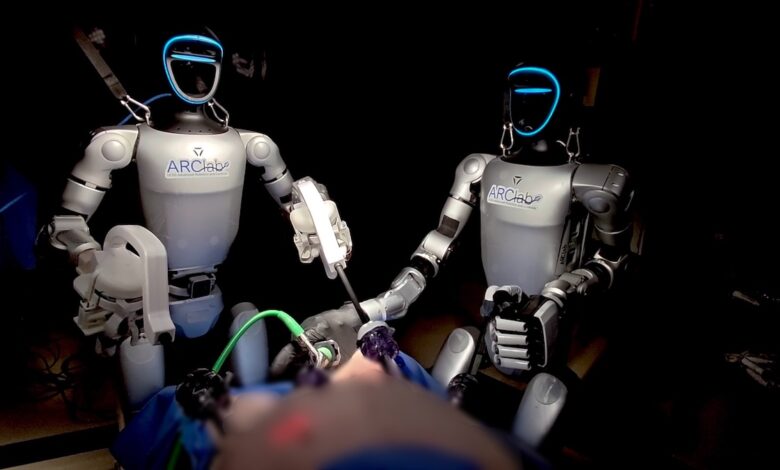
Two humanoid robots have carried out operations alone for the first time, remotely controlled by surgeons. For a preclinical study, they removed the gallbladder from mammals.
For a current study, remote-controlled humanoid robots were used in the operating room for the first time. A research team consisting of engineers and surgeons from the University of California San Diego completed two different procedures.
Humanoid surgical robot removes the gallbladder from a living animal
In the first operation, a human-robot team removed the gallbladder. The humanoid robot operated, a human surgeon assisted.
The second operation was accomplished by two humanoid robots working side by side as a robot-robot team. Both procedures took place on large, non-primate mammals.
The researchers see the experiment as proof of concept, a first step towards bringing humanoid robots into the operating room.
Answer to the surgeon shortage
The motivation of the study lies in a current structural problem. The growing need for treatment is offset by a shortage of surgeons. The result: longer waiting times, poorer access to care and greater health inequalities.
According to the research team, the robots could initially assist with procedures. Later, they will carry out entire operations under remote medical control.
“Remotely controlled and autonomous humanoid robots have real potential to expand access to critical surgeries that patients would otherwise not have access to,” said Michael Yip, one of the study authors and a faculty member at UC San Diego. The new findings should help address the health crisis not only in the USA, but worldwide.
For Yip, deployments outside of traditional clinics are also conceivable: “One can imagine these robots being used in remote communities where personnel are scarce, or in difficult environments such as search and rescue scenarios, where massive amounts of field medicine are needed in a short period of time.”
Advantages of surgical robots over special systems
Specialized surgical robot systems already exist. However, they are usually equipped with three or four robot arms, special tools and their own software. They also weigh around 800 kilograms, require a large team to assemble and take up so much space that operating rooms often have to be converted.
The robots used in the UC San Diego study, on the other hand, are around 1.52 meters tall and weigh around 27 kilograms. You can move freely through normal operating rooms and use conventional operating instruments.
The controls also feel more natural, especially for people without training in special systems. “We were surprised at how well “Surgie” – the name of the surgical robot – fitted into our workspace and workflow,” says tudien co-author Nikita Thareja.
The compact design does not change the precision, confirms Shanglei Liu, Professor of Surgery. She controlled the surgical robot herself during the study. An intervention using a teleoperated humanoid robot is just as precise as with a classic teleoperated surgical system. Liu said:
It costs a fraction and takes up a fraction of the space in the operating room. This means it can be used anywhere, from rural areas to the battlefield to space.
Surgical Robots: What’s Next?
Some problems with teleoperation are still unresolved. The surgical robots had to be recalibrated several times during the procedures. As a result, the operations took significantly longer than with established special systems. The team is also working on latency, i.e. the delay between the control command and the robot movement, especially for operations over long distances.
Because Surgie can walk and perform most physical tasks of a human, the research team has another vision for the future of autonomous surgical robots.
Collect tools and clean up the operating room after the procedure. “One of our goals is to develop an autonomous surgical assistant,” says Michael Yip. He added:
Many communities struggle with inadequate surgical team staffing, which means patients go untreated. Our goal is an operating room of the future where humanoid robots and humans work side by side as an integrated team to deliver procedures to those in need, in both traditional hospital environments and non-traditional field medicine scenarios.
Also interesting: