What is probably the world’s largest compressed air storage power plant has started operations in China. It will use salt caverns to store CO2-free energy for up to 600,000 households.
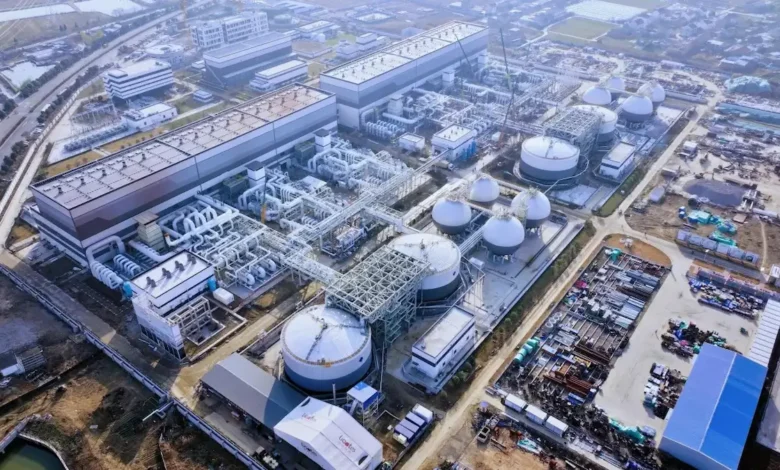
The world’s largest compressed air storage facility begins operations in the Chinese province of Jiangsu. In the salt caverns of Huai’an, the demonstration project uses underground cavities to efficiently store energy. The power plant is intended to stabilize the regional power grid and compensate for fluctuations between generation and consumption.
During times of low demand, the system presses air into the deep caverns and compresses it there. As demand increases, the escaping air drives turbines, generating electricity. This technology is intended to help control the load in the network and keep the frequency stable.
Compressed air storage power plant: electricity storage at a depth of 1,500 meters
According to the information, two units each produce 300 megawatts, which would be equivalent to a total installed capacity of 600 megawatts. With a storage capacity of 2,400 megawatt hours, the system achieves an efficiency of around 71 percent. This would make the station the world’s largest compressed air storage power plant.
The engineers rely on adiabatic high-temperature compression and do not use fossil fuels. A system of molten salt and pressurized thermal water traps the heat created by compression. This heat later flows back into the process and increases the efficiency of electricity generation.
Energy from hot salt and air
The power plant uses around 980,000 cubic meters of salt caverns far below the earth’s surface. The cavities lie at a depth of 1,150 to 1,500 meters in the Huai’an region. The partners invested a total of $520 million to build the infrastructure.
The first unit of the power plant began operation at full load in December 2025. This was recently followed by the second unit, which connected to the net on the first attempt. The entire system is now ready for permanent operation in the regional energy market.
Clean electricity for 600,000 households
The power plant generates around 792 million kilowatt hours of electricity per year. This amount of energy is mathematically enough to supply around 600,000 households. The system thus makes a measurable contribution to the regional energy supply.
Every year the company saves around 250,000 tons of standard coal. At the same time, annual carbon dioxide emissions in the region are falling by around 600,000 tons. The Shanghai Electric company supplied the core equipment such as turbines, generators and engines.
Model for international storage projects
The specialized tanks for storing the molten salt also come from the technology group. The project implementation demonstrates the integration of complex mechanical engineering and thermal energy storage. Such long-term storage systems are considered the key to stable networks with a high proportion of renewable energies.
The Jiangsu plant serves as a reference for the modernization of global energy systems. The project proves that huge storage facilities are technically possible for the energy transition. The knowledge gained supports the development of similar projects worldwide.
Also interesting: