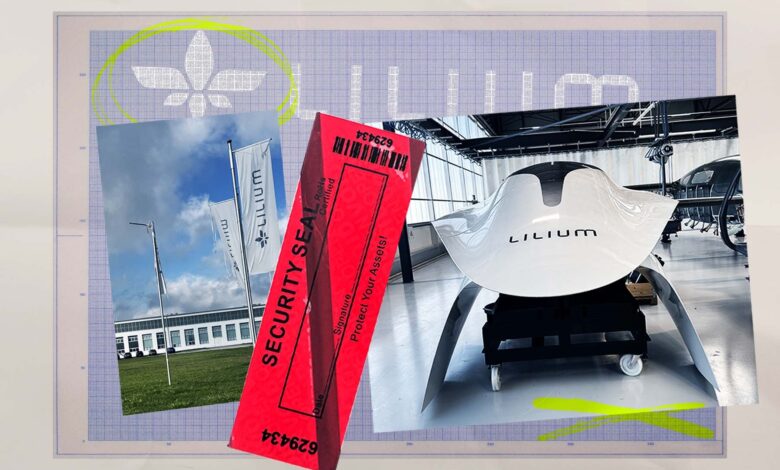

The flags are still hanging at the entrance: white fabric with the Lilium logo. Some are frayed. The company’s former reception can be seen through a glass front: a reception table, a Chesterfield sofa and a sideboard on which a total of 14 awards are lined up side by side. But the room is deserted.

Anyone who wants to get in here needs a key and someone who is still in charge of a place where hundreds of people once worked on a future that now seems more distant than ever before. Because there are now red stickers above the door gaps of all entrances: “Security Seal” is written on them – security seal.

It’s October 2025, almost a year after air taxi startup Lilium filed for bankruptcy. We drove to Gauting near Munich, to the Oberpfaffenhofen special airport. Lilium had its offices and production halls here. Electric vertical takeoff vehicles, so-called eVTOLs, were to be created here. Aircraft that can take off and land without a runway and that are supposed to be climate-friendly.
In the Lilium founders’ vision, they should connect regions with each other, shorten routes and save time – and at some point be as easy to book as an Uber ride.

The company worked on this promise for almost ten years. Around 1.5 billion euros went into development. Lilium gained prominent investors, convinced political supporters and became one of the best-known German deep tech startups. For many, the company was a beacon of hope: an example that Germany could once again become a globally relevant technology group.
For others, Lilium was an overpriced promise from the start, a flying taxi dream for investor presentations.
Either way: In the end there wasn’t enough money.
The jet that was never finished
The shell of a Lilium jet is in one of the halls. Light yellow, several meters long, the shape is reminiscent of an elongated football. The outer shell, windows, doors and sashes are still missing. Cables hang out of the fuselage, a metal staircase stands in front of the opening where there should once have been a door.
Everything looks as if someone could come in and continue working. Only no one will come anymore.

This is exactly where the power of this place lies. Because you understand: Lilium was not a company that was slowly phased out, but rather one that was stopped in the middle of the movement.
There are still half-full water bottles on the tables. High-visibility vests hang over the backs of chairs. In the offices, first names are stuck on lockers, and shoes, jackets and old house ID cards lie next to them. There are leaves from long-dried houseplants in the corners. There are instructions on how to use devices on a whiteboard. A self-printed meme hangs in one of the production halls. A photo by TV painter Bob Ross. Below is his motto: “No mistakes, just happy accidents.”

Making mistakes, learning from them, moving on – that’s part of the startup culture. At Lilium, the mantra eventually became a bitter punch line.
Because at the end of 2024 the company was actually close to providing decisive proof. The first test flight with a pilot on board should be just a few months away. Two jets were already being assembled.
With them, Lilium wanted to show that the technology not only works in presentations, simulations and unmanned tests, but also under real conditions.
But then the company ran out of money.

A race against time
Lilium had no significant sales of its own for years. This is not unusual for many startups. Investors fund growth, research and development in the hope that the company will be worth much more later. At Lilium, however, the capital requirement was particularly high. Developing, testing and certifying aircraft costs not millions, but billions.
In 2024 Lilium needed new capital. According to information from the company environment, investors were generally prepared to give money again. However, they set one condition: the German state should also commit to Lilium.
Specifically, it was about a loan of 100 million euros from the state development bank KfW. For this, Lilium needed a government guarantee. If the company was unable to repay the loan, taxpayers would ultimately have to pay.
This guarantee was discussed for months. First in Bavaria, where Lilium was based, then in the federal government. According to our research, Lilium management temporarily assumed that the loan would come. But no decision was made in the Bundestag’s budget committee.
For Lilium it was a race against time. At that time, according to sources close to the company, the company needed 20 to 30 million euros a month just to keep operations running. At the end of October 2024, Lilium filed for bankruptcy.

This meant that the KfW application was practically off the table. The state generally does not grant loans to companies that are already in insolvency proceedings.
Terminations shortly before Christmas
However, filing for bankruptcy did not mean the end of a company. Lilium was initially given time to find new investors or buyers. Discussions continued internally. There were glimmers of hope, promises, negotiations. But nothing became concrete in time.
In mid-December, Lilium initially announced around 200 layoffs. Shortly before Christmas, the next shock came: the investor talks had failed, it was said. A potential donor was unable to prove in a timely manner that he had the necessary liquid assets. This is reported by several insiders.
Lilium then ceased business operations and terminated the remaining employees – five days before Christmas Eve.
One of them was Keno Sanders, who had worked at Lilium for six years. He was involved in the jet’s propulsion system and was responsible for processes and personnel. Sanders is one of many employees we have spoken to since fall 2024. In a conversation he remembers the Allhands meeting shortly before Christmas, which Lilium called “Allwings”. The then CEO Klaus Roewe explained very matter-of-factly that salaries could no longer be paid and that bankruptcy had to be filed. Sanders describes the atmosphere as tense. Many employees wondered how long management had known how serious the situation was.
Many people were irritated by the fact that new employees had recently started working and a new canteen had been opened.
The salvation that wasn’t
Then, on the morning of December 24th, hope arose again. Lilium released a press release saying the company had found an investor after all. Operations can continue. The majority of employees should be allowed to return.
Many former Lilium employees also received this news. Sanders remembers “tremendous joy.” He loved the project, he says. He wanted to be part of something that made history.

But the joy didn’t last long. In the end, Lilium did not receive the promised money. The rescue failed. In February 2025 it was finally over. Around 1,000 people lost their jobs as a result of the bankruptcy.
What remains?
In the abandoned offices it becomes clear that Lilium was more than just a pitch deck and a vision. On a world map there are red pins in Europe, Asia, Africa and South America. Employees from numerous countries came to Bavaria to work on this project. The halls contain devices, test setups, 3D printers and milling machines. In one area, meter-long cables run neatly across the floor. Next to it there is a second aircraft skeleton in a “Structure Test Laboratory”, where it was apparently tested how resilient the construction is.

The place speaks of technical ambition. But also from a system that requires an extremely large amount of capital long before there is any income. And Lilium’s failure raises questions.
One thing is clear: the original vision of an air taxi network suitable for everyday use remained unfulfilled. At the same time, hundreds of people worked for years on a technology they thought was possible. Many stayed even after the situation had long since become threatening.
As we leave the halls, one image in particular sticks with us: a half-finished jet that looks as if it is just waiting for the next step in the work. A piece of the future that wasn’t finished.
You can now hear the whole story of the German air taxi developer: Our investigative storytelling podcast “Cashburners: the Lilium Story” tells the rise and fall of the company in six episodes. Anywhere there are podcasts.
Audio player not available
In order to display embedded audio content, your consent, which can be revoked at any time (via the switch or via “Revocation tracking and cookies” at the bottom of the page), is required for the processing of personal data. Data can be transferred to third countries such as the USA (Art. 49 Para. 1 lit. a GDPR). By switching to “on” you agree. You can find further information in our data protection declaration.