


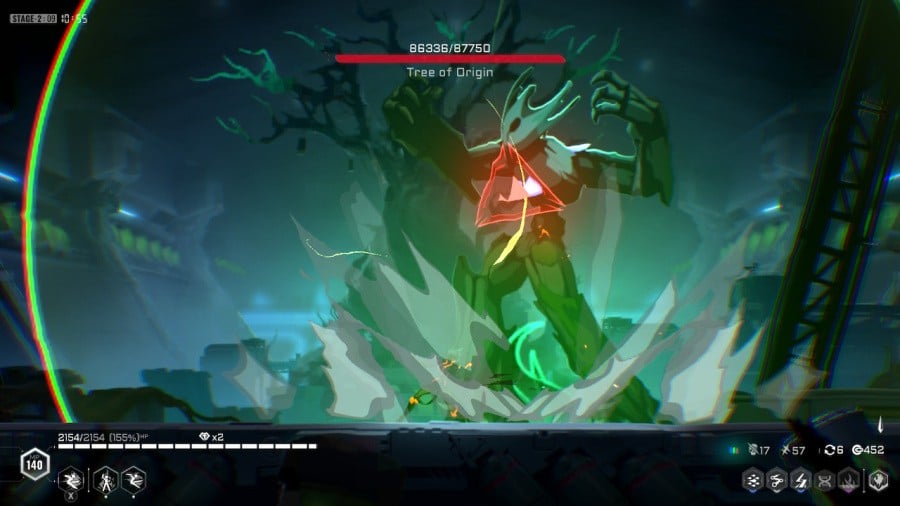
L’entropie, un concept scientifique défini par le hasard et le désordre, est un nom approprié pour un roguelike.
Depuis Bleu Blaz a commencé comme une série de jeux de combat, elle a connu une multitude de retombées, se retrouvant désormais dans le domaine de l’action sur plate-forme 2D et des principes du roguelike. C’est un énorme assemblage de dix-huit personnages jouables issus de diverses entrées de BlazBlue, dont Calamity Trigger, Continuum Shift, Chrono Phantasma et Central Fiction. Et, ce qui est impressionnant, chacun a un style de combat complètement indépendant et idiosyncrasique, même si les entrées réelles que vous utilisez sont assez identiques dans tous les domaines.
BlazBlue Entropy Effect est sorti en 2024 sur Steam. Entropy Effect X n’est pas exactement le même jeu, mais plutôt une refonte définitive. Cela réduit beaucoup de graisse par rapport à l’original, en remplaçant le monde du hub robot par un laboratoire de collègues anime. Il rationalise également les événements dans un tout nouveau scénario canon de la série qui promet d’être plus cohérent. Son succès sur ce front est cependant sujet à débat. Entropy Effect X propose également de nouveaux boss, de nouveaux défis Mind Crystal et de nouveaux modes de difficulté variable – mais perd malheureusement la fonctionnalité de jeu croisé dans le processus. Il supprime également le doublage anglais de l’original pour la langue japonaise sous-titrée uniquement.
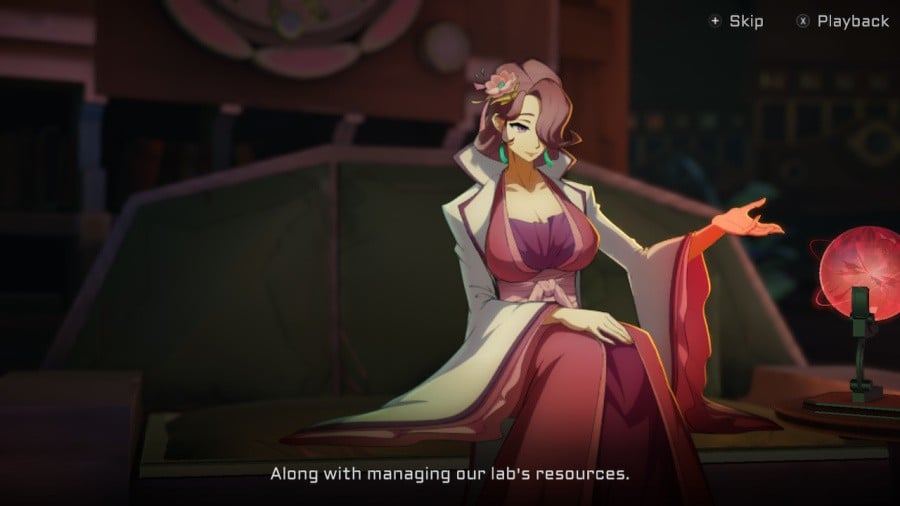
La prémisse d’Entropy Effect X rappelle en quelque sorte Tron. En commençant comme amnésique, une équipe de scientifiques vous envoie dans un sous-espace mainframe qui mélange réalité et irréalité ; une sorte de monde cauchemardesque dystopique et futuriste en décomposition. Votre objectif est de récupérer des « fragments de possibilités » à chaque partie, et que vous échouiez ou réussissiez, vous êtes renvoyé au QG pour un peu d’évolution de l’histoire, le déverrouillage du personnage et une opportunité de réoutillage général.
Honnêtement, l’intrigue est un non-sens total de technobabble, et le genre de chose qui surgit souvent dans les jeux japonais. Dans sa tentative d’être profondément profond, il finit par être verbeux, déroutant, fastidieux et sautable. Il existe cependant des flashbacks entièrement animés qui apparaissent chaque fois qu’un fragment de possibilité est obtenu, complétant ainsi l’histoire de l’effondrement de l’humanité. Ils sont courts, magnifiquement réalisés et valent la peine d’être conservés.
Les dix-huit membres de la liste de combat sont tous des membres de la distribution de BlazBlue, débloqués dans l’ordre de votre choix. Chacune peut être largement augmentée en puissance et même ses attributs fusionnés. Le processus de mise à niveau est géré en parcourant des étapes, en obtenant des niveaux MP, HP et DP, des compétences secondaires, en élargissant les ensembles de mouvements et en augmentant les statistiques critiques. Vous pouvez vous concentrer sur la création d’un ou plusieurs avatars, mais pour atteindre leur pleine capacité, il faudra des mois d’engagement.

Chaque personnage est étonnamment diversifié, empruntant des éléments uniques à leurs profils de jeu de combat. Bullet est puissant, capable d’attraper les ennemis et de les envoyer s’empiler sur les autres derrière, tandis que Noel est à distance, brandissant deux armes de poing qui peuvent tirer à distance. Hibiki possède des compétences d’ombre qui ont des propriétés d’attaque secondaires, et Takaoka peut créer des clones, et la liste est longue.
Une fois déployé dans le sous-espace à la recherche d’un fragment, Entropy Effect X est graphiquement fluide de bout en bout et, même si les personnages et les sprites ennemis sont plutôt petits (ce qui ne fonctionne pas très bien sur ordinateur de poche), il brille toujours en termes d’animation et de panache. Night City, votre première escale, est en grande partie un compagnon de lit Cyberpunk 2D, mais avec plus de détérioration. Mécaniquement, c’est vif, et si vous avez joué à Shinobi : Art of Vengeance ou Ninja Gaiden : Ragebound de l’année dernière, vous vous sentirez très à l’aise avec ses sprints, ses attaques aériennes et son assortiment de propriétés d’attaque secondaires évolutives.

Bien qu’il soit strictement en 2D, son système de mise à l’échelle ressemble à celui d’Hadès, et avec des éléments de compétences supplémentaires comme l’électricité, le feu et la glace – et la possibilité de se concentrer sur une combinaison pour augmenter la puissance – il a beaucoup en commun avec Absolum. Un oubli, cependant, est l’absence de compteur combo. Dans un jeu qui récompense les effacements d’écran parfaits, en particulier dans les difficultés plus élevées, un compteur de combo serait une bonne aide visuelle. Cela est d’autant plus vrai que les sprites sont plutôt petits et qu’il peut être difficile de se concentrer sur vos coups au milieu d’une rafale d’ennemis. Vous constaterez souvent que vous perdez de l’énergie sans savoir ce qui vous frappe.
L’action d’Entropy Effect X se déroule écran par écran. Vous entrez dans une zone générée aléatoirement dans ses plates-formes et ses pièges, et éliminez tous les ennemis avant de continuer. La sortie de chaque écran offre un choix de plusieurs options aléatoires : acquérir de nouvelles compétences secondaires ou échanger celles existantes ; entrez dans un magasin pour dépenser des points en MP, en HP ou en améliorations de compétences ; ou même tentez votre chance sur une roulette Gacha qui peut vous rapporter des améliorations chanceuses. À des moments critiques de votre course, vous pouvez débloquer des extensions de combat permanentes pour des choses comme les techniques de jonglage aérien ou les extensions de combo.
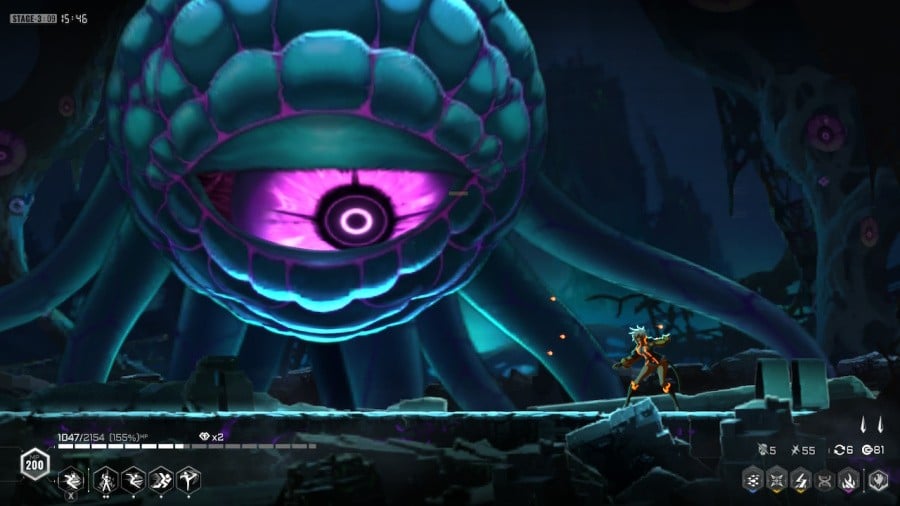
Au début, cependant, les choses semblent un peu ternes et creuses, avec un style visuel froid et impersonnel. Cependant, continuez à jouer, à apprendre et à vous développer, et les choses commencent à mijoter, vous obligeant à prêter attention à votre processus de mise à niveau avant de replonger. Ses boss gigantesques sont également impressionnants, avec des modèles qui exigent un réflexe si vous voulez gagner votre prochain fragment.
Comme tous les roguelikes, plus vous jouez longtemps, plus Entropy Effect X commence à prospérer. Vous pouvez vous plonger dans les innombrables améliorations du jeu, et l’utilisation du système « Entropie » pour augmenter la difficulté d’une course la rend plus redoutable, mais récompense avec des buffs plus puissants. Bien que les difficultés plus élevées soient dans l’ensemble plus complexes, elles nécessitent également d’être déverrouillées en terminant d’abord le mode Normal.
Au départ, le broyage est la seule solution. Les élixirs augmentant la santé sont rares et, en raison de la nature aléatoire des choses, vous ne savez jamais quand vous recevrez un « espace de repos » ou d’autres gratifications qui peuvent régénérer la santé. À cette fin, vous vous retrouverez à rejouer plusieurs fois les premières étapes. C’est bien sur le papier, mais il manque l’élan de récompense initial de quelque chose comme Absolum, et si vous êtes déterminé à construire un Avatar fort, vous devrez surmonter la répétition.
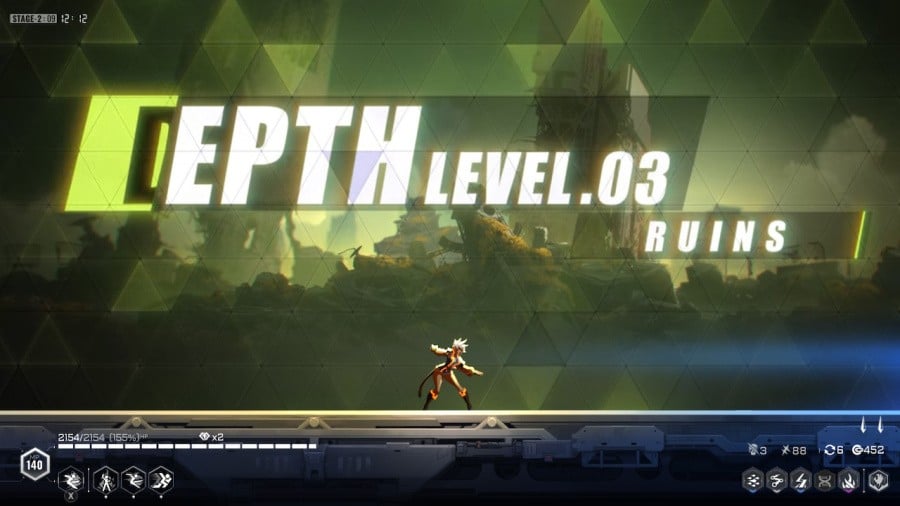
L’énigme du jeu réside cependant dans la manière dont on réagit à sa complexité vertigineuse. Bien qu’à première vue, Entropy Effect X soit un jeu de combat d’action époustouflant, sa structuration est intimidante. En général, on se sent dépassé dès le départ.
À l’image de son récit tentaculaire et déroutant, le jeu lui-même est incroyablement dense au début. Les options et les choix proposés lorsque vous quittez un écran sont étiquetés d’une manière qui n’a pas de sens, et vous devrez les répéter d’innombrables fois pour vous rappeler à quoi ils mènent tous. Le langage utilisé dans ses didacticiels est verbeux dans les manuels scientifiques, utilisant souvent une langue vernaculaire locale que vous n’avez aucun espoir de comprendre tant que vous ne lui avez pas accordé des heures d’attention.
Même si le système comporte sans doute trop d’options configurables, sa convolution peut néanmoins plaire à une certaine catégorie de joueurs. Le problème réside davantage dans la façon dont les choses sont expliquées – ou non, selon les cas. Vous pouvez parcourir les écrans d’aide pour essayer de comprendre comment tout fonctionne, ou parcourir aveuglément avec le sentiment tenace que vous négligez les fonctionnalités clés.

De plus, la façon dont l’action est découpée est quelque peu intrusive. Avoir des options d’outils lorsque vous quittez un écran est une bonne chose, mais lorsque vous les effacez en trente secondes, il devient un peu fastidieux de continuer à entrer dans les espaces entre les écrans pour les mises à niveau ou les gacha rolls. De nombreuses options de sortie, comme l’augmentation de la santé ou le changement de compétences, pourraient facilement se produire sur place plutôt que de vous déplacer vers des zones provisoires.
BlazBlue Entropy Effect X est remarquable par son ampleur, vertigineux dans ses profondeurs et impressionnant par son ambition. Son casting de personnages est énorme, ses combats tendus et ses rencontres avec des boss impressionnantes. Comme tout roguelike, tout est question de travail répétitif, mais ce n’est pas un jeu initialement convivial pour les joueurs. Il existe tellement d’options, dont beaucoup sont ambiguës, qu’il faut du temps pour comprendre toutes les possibilités et élaborer une stratégie. À cette fin, il peut en désactiver certains avant d’avoir la possibilité de les réactiver.