
Lanark County, Ontario, offers a quieter kind of travel—where maple syrup traditions, historic towns, and winding trails invite visitors to slow down. Just outside Ottawa, this rural destination blends nature, culture, and community, showing how tourism can sustain local life while delivering deeply authentic experiences.
LANARK COUNTY, Ont — The road bends gently past a stand of maple trees just beginning to turn, their leaves flickering between green and ember. A hand-painted sign appears—Fresh Syrup Ahead—and then disappears again as quickly as it came. There are no billboards, no queues of tour buses, no urgent sense that you are meant to be anywhere in particular.
This is Lanark County, a place that does not announce itself as much as reveal itself, slowly, to those willing to notice.
An hour west of Ottawa, in a region shaped by rivers and restraint, tourism has taken on a different meaning. Here, it is less about spectacle and more about continuity—an economic lifeline built not on crowds, but on connection.
A Tourism Economy Without the Noise
In many rural regions, tourism arrives loudly, reshaping economies and landscapes in its wake. Lanark County has taken another path.
Instead of resorts and large-scale attractions, the backbone of its visitor economy is made up of small businesses: family-run cafes, maple syrup producers, antique shops, and independent galleries. The effect is subtle but significant. Every visitor becomes part of a local exchange—buying bread baked that morning, or syrup drawn from trees just beyond the parking lot.
“It’s not about bringing in millions of people,” a shop owner in Perth might tell you. “It’s about the right people coming, and staying while.”
Tourism here does more than generate revenue. It helps sustain a way of life that might otherwise disappear: heritage buildings maintained because they are visited, farms diversified because they are discovered, traditions continued because they are shared.
The Geography of Escape
Lanark County sits at a geological crossroads, where the ancient rock of the Canadian Shield meets softer limestone plains. The result is a landscape of contrasts—rugged highlands giving way to gentle farmland, dense forest opening onto wide, reflective lakes.
For visitors, this translates into something increasingly rare: room.
Cyclists follow converted rail trails through corridors of trees. Canoes slip quietly across lakes that hold the sky like glass. Hikers move through the Lanark Highlands, where the terrain rises and falls with a kind of quiet insistence.
There is no single landmark that defines the place. Instead, the landscape itself becomes the attraction—one that resists being consumed quickly.
Small Towns, Long Histories
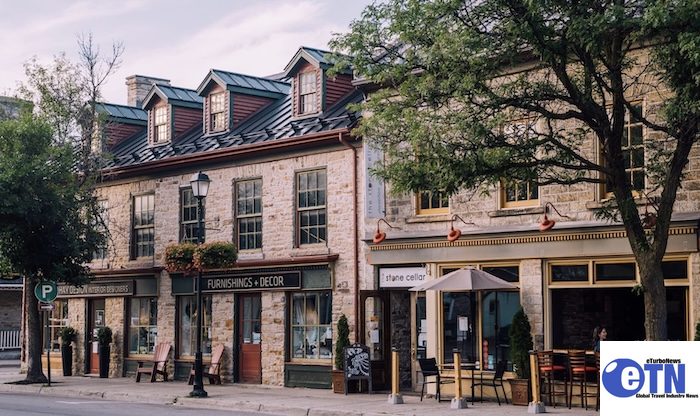
In towns like Perth and Almonte, history is not cordoned off behind glass. It is embedded in everyday life: in the limestone facades, in the creak of wooden floors, in the steady rhythm of storefronts that have changed hands but not purpose.
Perth’s streets unfold in a grid first laid out in the early 19th century. Almonte, once a textile hub, now hums with galleries and cafés, its waterfalls still coursing through the center of town. In Smiths Falls, the Rideau Canal—once an industrial artery—has become a passage for leisure.
Visitors arrive looking for something difficult to name. They might call it charm, or authenticity. What they find is a sense of continuity—a feeling that the past has not been erased, only adapted.
The Taste of a Place

Home – Lanark
The government of Lanark County is dedicated to supporting residents through a range of essential services, from housing and childcare to long-term care and newcomer resources.
If there is a unifying thread in Lanark County’s tourism story, it may be maple syrup.
In early spring, when winter loosens its grip, sugar bushes across the region come alive. Steam rises from evaporators. Sap becomes syrup. Visitors gather for pancake breakfasts, but they stay for something less tangible: a glimpse into a seasonal ritual that has changed little over generations.
Beyond maple, the county’s culinary scene has grown quietly ambitious. Craft breweries, farm-to-table restaurants, and artisanal producers have turned the region into an understated destination for food travelers.
But even here, scale remains modest. Meals feel personal. Ingredients feel close.
Who Comes—and What They’re Seeking
Lanark County does not attract crowds in the conventional sense. Instead, it draws a particular kind of traveler.
There are urban escapees from Ottawa, arriving on Friday afternoons with bicycles strapped to their cars. There are couples tracing culinary routes, moving from bakery to brewery. There are hikers and paddlers, chasing solitude rather than summits.
Increasingly, there are experiential travelers—people less interested in checking off sights than in participating, however briefly, in a place’s rhythms.
What they share is a desire for something quieter. Something real.
A delicate balance
With its growing reputation, Lanark County faces a familiar question: how to welcome more visitors without losing what makes it distinct.
The answer, for now, lies in restraint.
Tourism initiatives emphasize itineraries over attractions, encouraging visitors to spread out, to stay longer, to engage more deeply. The focus remains on sustainability—not only environmental, but cultural and economic.
It is an approach that resists easy scaling. But it may also be its greatest strength.
The Luxury of Slowness
In an era of acceleration—of destinations optimized for visibility, efficiency, and volume—Lanark County offers a counterpoint.
Here, the experience is not designed to overwhelm. It unfolds gradually: in the taste of maple syrup still warm from the boil, in the quiet of a lakeshore at dusk, in the unhurried conversation between a visitor and a shopkeeper.
It is, in its own way, a kind of luxury.
Not the luxury of excess, but of time.
And in Lanark County, time is something you are gently encouraged to take.