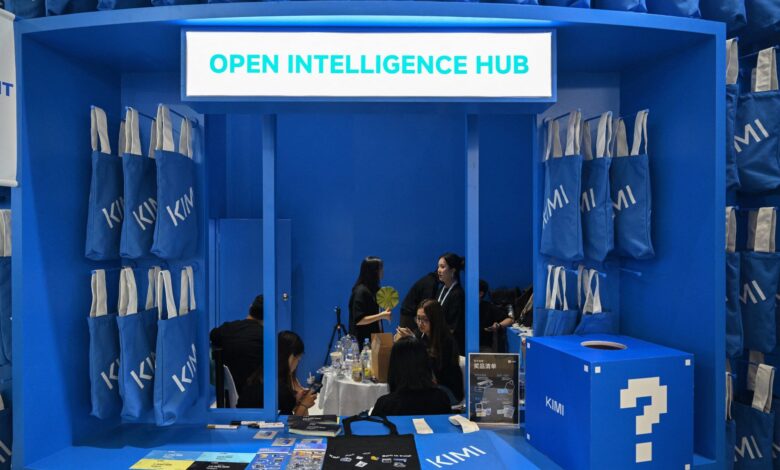
The Chinese AI model “Kimi K3” is unsettling Silicon Valley tech companies. In the USA, AI experts argue about opportunities and hurdles in the AI race.

Chinese AI models are throwing US companies into turmoil. Just last week, the Chinese company Moonshot AI released its “Kimi K3” model. The general consensus is that “Kimi K3” can compete with some leading US models – and at a fraction of the cost.
The US industry fears that China could pull away in the race for dominance in the AI market. There are also voices criticizing that the Chinese are training their models at the expense of the work already done by Anthropic, OpenAI and Google.
The tension reveals a clear strategic gap between the two countries: the Chinese are relying on open source or open weight models. With open source, everyone can fully view, change and further develop an AI. With Open Weight, everyone can use and adapt the finished AI, but they do not receive the complete “blueprint”. Meanwhile, US companies are largely sticking with closed models.
Read too

Debate about open or closed models
A debate broke out on X over the weekend after OpenAI manager Dean Ball published a detailed statement about Kimi K3.
“I am personally surprised that the Chinese state continues to allow models of this quality to be released as open source given the potential risks,” wrote Ball. He was previously a senior AI advisor to President Donald Trump. He has recently headed the strategy department at OpenAI.
He further wrote that the open weight strategy would lead to complete “AI communism.” Open models could be a “brake” because they “deter investments in AI”.
But what really got the discussion going was this quote:
“I suspect that at some point the Trump administration will come to the conclusion that it would make the most sense for it to make the use of freely available AI models from China significantly less attractive through stricter rules and requirements,” he wrote.
Ball suggested that stricter rules and uncertainty about possible legal consequences could discourage many U.S. companies from using open AI models.
He later clarified that this was his prediction and not a recommendation. He supports open source as long as AI doesn’t become too dangerous – which in his opinion would be a “sad day”.
Anthropic and OpenAI: More control through closed systems
The deliberate creation of regulatory uncertainty for the benefit of American AI companies is reminiscent of “regulatory capture.” The term describes the case in which supervisory authorities increasingly design rules in the interests of the industry they are supposed to control – often under the influence of the companies themselves.
Representatives from Anthropic and OpenAI have always stressed that their models are too powerful to be made openly available. The release would allow anyone to use their tools for any purpose – without significant control.
A closed system gives the manufacturer more control overall. There’s security, access and pricing. The labs have warned that the open-weight models coming from China pose a threat to national security and their businesses.
David Sacks, venture capitalist and initially Trump’s first AI and crypto “czar”, has chaired the President’s Advisory Council on Science and Technology since March. He called the “instrumentalization of regulatory uncertainty” “completely unacceptable.”
“We are at a critical juncture in AI policy,” Sacks wrote on X in response to Ball’s post. “The leading providers of closed AI models already form a duopoly and now want the government to slow down their open source competition.” By duopoly, Sacks means OpenAI and Anthropic. “They have made their intentions known. Now it is the turn of the rest of Silicon Valley – the vast majority who continue to believe in open competition.”
Read too

“DeepSeek has more efficient infrastructure”
Chamath Palihapitiya, co-host of Sacks’ podcast “All-In” and also a venture capitalist, made similar comments. “The future belongs to open source,” he wrote on X. “We have to embrace it and keep doing it.”
Software entrepreneur Suhail Doshi accuses American AI laboratories of training their models with “humanity’s data” without paying for it.
Calls to restrict open-weight models under the guise of “distillation” are “complete nonsense,” Doshi wrote on X. “This is an attack on future American innovation.”
An analyst from Citrini Research, who appears on X under the name Jukan, also contradicted Ball. The warning about Chinese dominance falls short, he wrote. Open source models alone do not give companies a dominant market position. DeepSeek works efficiently primarily because of its internal infrastructure and can therefore keep the costs per token low – not just because of its open model.
“Chinese companies may lack sufficient computing capacity to meet all inference computing needs themselves, but they are not selling at a loss and may well recoup their training costs,” Jukan wrote.
Read the original article on Business Insider.