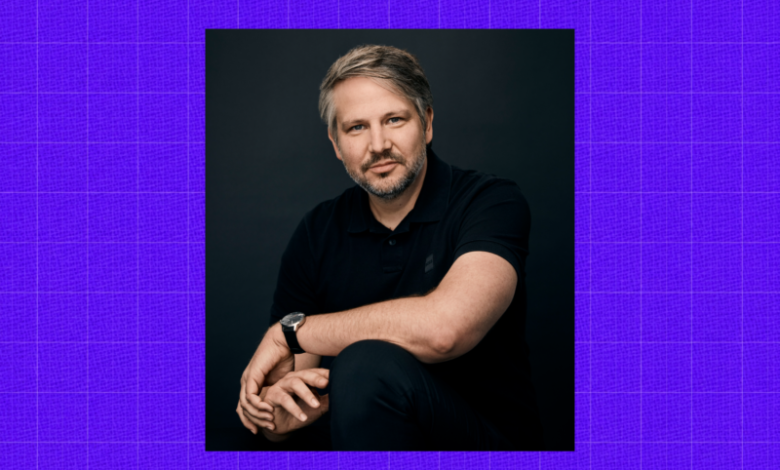
Why do most startups fail? Vercel CTO Malte Ubl explains why founders often hold on to the wrong things – and what counts instead.

What does it take to make a startup big? And why do so many founders fail despite good ideas? Malte Ubl, CTO of the billion-dollar startup Vercel, examined these questions at the start-up scene startup camp “Start-up scene is looking for the super founders”. The former Google manager spoke to the participants about the eternal startup search for product-market fit, the right founder DNA and why it is sometimes better to get started quickly instead of spending three years working on the perfect version. Vercel is also a partner in our Gründerszene Fellowship.
From the Google Group back to the startup
Before Ubl landed at Vercel, he spent almost ten years at Google. Exactly where others realize their career dreams. Among other things, he was responsible for the desktop version of Google search. Sounds like a dream job? For Ubl, at some point it was more like a digital hamster wheel: “It was far too boring for me,” he says. So we went back to startup life, with less corporate comfort and probably a lot more chaos.
Read too

The move from Google to Vercel was also a change in the rules of the game for Ubl. At Google, tiny improvements could make all the difference. Sometimes it was about 0.01 percent, which ultimately has a huge effect. Ubl’s job was to find exactly these mini screws and make them measurable. With a startup, on the other hand, the clock runs faster: “If the product doesn’t grow four percent week after week, it’s not worth investing in it.” In short: Google was about fine-tuning and Vercel was about putting the pedal to the metal.
When asked why so many startups fail, Ubl says the biggest problem isn’t a lack of technology or capital, but the inability of many founders to move on from a bad idea. “Honesty with yourself is by far the most important thing,” says Ubl. At Vercel, radically honest feedback is part of the corporate culture. This is exactly the attitude that founders need to adopt.

“If it doesn’t work, then do something else. Instead of getting lost in an idea for months and getting no response.” It’s better to discover quickly that something isn’t working than to spend months or years going in the wrong direction.
Product-market fit can be recognized immediately
Founders hope for the moment when they finally know that their idea works. Ubl says, “If you have product-market fit, it’s not a question at all.” There’s no need to sugarcoat or interpret a product with a real market: “It’s not just like, ‘Yeah, it looks pretty good.’ But most of the time it really hits home.”
For him, the story of Vercel shows that even successful companies sometimes spend forever searching for their big aha moment. Today the company is one of the most important infrastructure startups in the world, but it took a full six years for that to happen. Even with the big ones, it’s sometimes a case of searching, tinkering and doing a few extra laps.
Don’t plan – build
Ubl advised the participants to get started more quickly. “Having the opportunity for absolutely anyone to be able to build at least one really good, testable prototype themselves is incredible.”
His advice: Don’t write more concepts, but work directly with potential customers. “Do things that don’t scale.” You need real customers to get constant feedback. This is the only way to find out whether the actual problem really exists and whether the solution is suitable.
Trends do not create a successful startup
At the end of the discussion, the question was once again how founders come up with a good idea. Ubl warns against simply chasing the next AI or startup hype. “I think, firstly, everything is interesting and you just have to go deep to understand the problems that need to be solved.”
Read too

The best founders don’t just jump on the next hype bandwagon, but start where they really know their stuff. Where they don’t just know a problem from a blog article, but have experienced it themselves. Because in the end you always come back to the same point: “Honesty with yourself is the most important thing.”