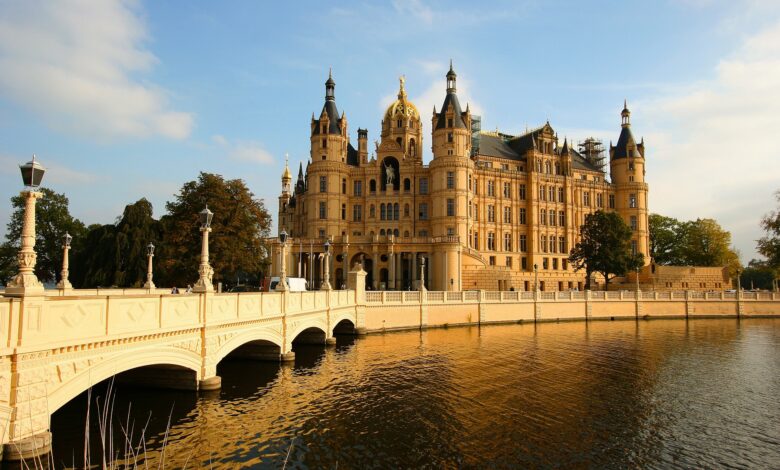

Schwerin castle, the Neuschwanstein of the north

The town center has been well preserved

Niklot, ancestor of the Dukes, in Schwerin castle,

The castle and its elegant orangery, from the water

Downtown Schwerin is a laid back place
Following the collapse of East Germany’s German Democratic Republic 30 years ago, a number of towns and cities emerged as hitherto undiscovered. Because of their remoter location they were largely undamaged by wartime bombing and their architectural splendor survived the worst of the GDR town planning.
Among such towns are Görlitz, profiled elsewhere on this site, and Schwerin, 20 miles south of Wismar and inland from the Baltic coast.
Once the historic seat of the Dukes of Mecklenburg, Schwerin, with a population just under 100,000, had always played second fiddle to its larger industrial neighbor Rostock, particularly during the days of the GDR. Rostock, as a state-supported shipbuilding city, was much more in keeping with the image the country wanted to present.
However once the reunification of Germany was completed and the Land of Mecklenburg-Western Pomerania was re-established, the decision was made to restore Schwerin to its rightful place as the state capital. As an endorsement of that decision, the island-based castle and its associated buildings were made a UNESCO World Heritage site in 2024.
Neuschwanstein of the north
The jewel in the architecture of the city, Schwerin castle became the seat of the parliament of Mecklenburg-Western Pomerania. In the 19thth Century the water-surrounded building had been the ducal residence but in 1918, the duchy ceased to exist and the castle became the property of the state.
A castle has stood on the Schwerin island since the latter years of the first millennium. The town was an important location in the medieval quest to extend eastwards along the Baltic coast. Accordingly, those earlier buildings on the island were more militaristic, but in more peaceful and prosperous recent history the emphasis changed.
Accordingly, when the current castle was built in the mid 19th Century by a group of architects including Gottfried Semper (who was responsible for building the Semper Opera in Dresden) they created one of the finest Renaissance buildings in northern Germany. It has been dubbed the Neuschwanstein of the north. In scale and in beauty it is the equal of any Loire Valley chateau, having also been partly modeled on Chambord.
The museum section of the castle can be visited daily all year round (closed Mondays) and there are also guided tours of the parliament section, on request. Alternatively you can wander through the castle gardens, one of the finest gardens to mix baroque with classical English design.
Undoubtedly the best way to appreciate views of the castle is on a trip boat on the Schweriner See, the third largest lake in Germany. These trips run from March until October and start from the pier by the castle, and besides castle views, they reveal a boathouse-dwelling culture that is unique to Mecklenburg.
Schwerin itself is a town of two halves. Close to the castle island, it is a historic and administrative center, with state government ministries in a variety of imposing baroque and neoclassical buildings. It has a more modern, shopping and eating quarter nearby, and a lot of its population (still not quite as numerous as in GDR days) are retirees from elsewhere in Germany, attracted by lakeside living in new luxury waterside apartments, and Schwerin’s peace and quiet.
Looking for more? See other destinations in Eastern Germany