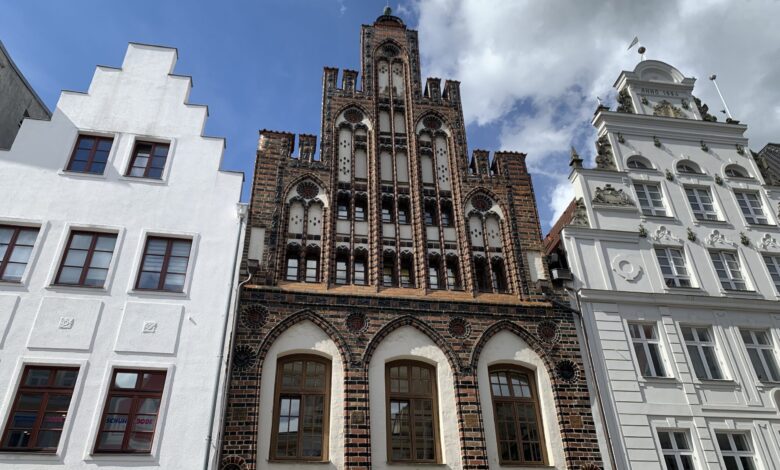

Brick gothic facade on Kropeliner Strasse

The astronomical clock in St Mary’s

Town hall on Neuer Markt

The unpopular seagull fountain on Neuer Markt

The ‘porn fountain’ with the university behind
The backstory doesn’t look encouraging. A river port city, former stronghold of the Hanseatic League, whose shipbuilding and aircraft industry in World War II made it a priority target for Allied bombs. A city that hosted a Stasi (secret police) headquarters in GDR days and which suffers from depopulation today, following the exodus of 60,000 people after the Wall came down. But despite all that, Rostock is a cheerful surprise.
It’s a cobbled, eminently walkable place that still has a large part of its ancient city wall. It is connected to a seaside resort – Warnemunde – with a frequent, easy-use train connection. And its massive brick cathedral St Mary’s, which was started back in the 13th century, has two astonishing surprises.
After the devastation of World War II, the GDR rebuilt much of the city center, some of it in uncompromisingly socialist style, particularly along the showpiece boulevard Lange Strasse. But along the parallel main pedestrianized shopping street, Kröpeliner Strasse, restoration was done sensitively, respecting bits of medieval brick gothic, baroque and more recent neo-Renaissance facades, particularly of the university building on Universitätsplatz.
The GDR also added a lot of statues and fountains, including what locals call the ‘porno fountain’ (official name the ‘fountain of joy’) also on Universitätsplatz, which along with Neuer Markt is the focus of city life. The fountain is an exuberant collection of figures, both human and animal, in various vigorous poses, including a wild boar doing situps. Its humans are naked, which inspired the nickname, but then so are huge numbers of naked statues all around the world, so to pick on this one seems a bit unnecessary. Particularly as it is a very popular cooling off spot for children during the summer months.
Street cafes here often play host to different nationalities. Rostock has ferry services to Denmark and Sweden, and Warnemunde also has a sea cruise port, so you’re likely to hear lots of different languages in town.
At the eastern end of Kröpeliner Strasse is Neuer Markt, still open on one side after the damage of World War II. The square is the location for the Rathaus, a strange combination of original brick gothic architecture peeping out above and behind, and pompous pink baroque in front. Much of the surrounding square has been sensitively restored, traffic free apart from the trams, but the middle hosts another fountain, of morose sea gods dominated by a seagull on a high pole. This Möwenbrunnen (‘seagull fountain’) is not popular with locals, and was put here during post-reunification days, at a time when the city most needed something optimistic to look at.
The Cathedral
Back in medieval times this part of Germany was heavily forested, and its mostly sandy soil has little to offer in the way of stone. So six million bricks had to be fired to build St Mary’s, some of them decoratively glazed to create a checkered, even houndstooth, exterior.
At first sight its interior seems fairly sparse. But turn back to look above the entry, and you’ll see the massive decorative wooden organ loft, from 1750. The instrument here, still in use comprises an astonishing 5,700 organ pipes, and hanging below it is the Duke of Mecklenburg’s glazed-in royal box, a bit like a very fancy basket hanging under a hot air balloon. This is where the Duke would sit to gaze out upon his subjects, and at times, with all that organ power going on, it must have felt like it was taking off.
The other big feature of the cathedral is tucked away behind the nave. This 15th century astronomical clock is just as special as its much more famous cousin in Prague, and what it lacks in moving showtime figurines, it makes up for in complexity, ingenuity and authenticity, because whilst Prague is now electrically powered, the clockwork here is the original, and still needs to be wound up every day.
It is also far more intimate, being mostly right at eye level. Besides telling the time, the date, and having moving apostles every hour, its intricacies detail things like the phase of the moon, the state of the harvest, and the actual timings of sunrise and sunset in Rostock, every day of the year. How it survived the war is something of a miracle.
Looking for more? See other destinations in Culture