When you think of problems with electric cars, you probably still have burning batteries and exploding batteries in your head. Because when it comes to the safety of electric cars, persistent fears persist. In fact, the vehicles are relatively safe, even if there are their own accident patterns that distinguish them from combustion engines.
The spread of electric cars is progressing in Germany, but it could go much faster. In addition to aspects such as the relatively high prices and problems with range and charging, the safety factor is still an issue.
Horror stories about burning batteries are still doing the rounds, and electric cars are said to have strange driving characteristics. A current study shows how the vehicles really perform in traffic.
This is how electric cars differ in accidents
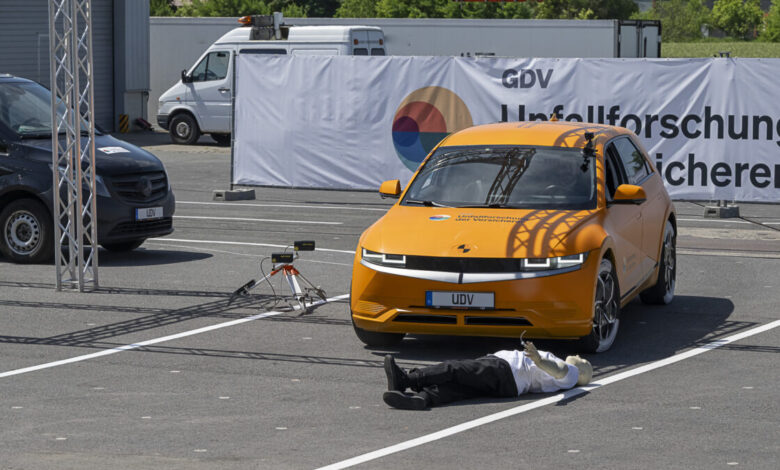
The insurers’ accident research department (UDV) examined various traffic scenarios in an extensive test. As part of this, experts evaluated almost 500 serious accidents from the insurers’ database and compared electric cars with identical models with combustion engines – everything from the smallest car to the luxury class was included.
The basic conclusion is positive, even if the almost 500 cases examined cannot of course represent the entire accident. Anyone who drives an electric car hardly causes any damage anymore. The difference in frequency compared to other types of drive is negligible.
However, the details are interesting. E-cars have their own accident pattern. Even if the frequency is similar, the accidents often happen in different areas. Specifically, collisions with pedestrians occur significantly more often, whether when starting off, backing up or turning. It is particularly dangerous at dusk or in the dark.
This result suggests that pedestrians are less likely to perceive an approaching electric car in these moments than a combustion engine. Since 2021, vehicles with electric motors have had to produce an artificial noise below 20 km/h, but this is apparently either too quiet or does not sound clearly enough like a car.
When the accelerator pedal becomes a brake
A second noticeable thing concerns the operation. Accidents due to incorrect operation occur more frequently than with combustion engines, especially when starting off. This primarily concerns vehicles with so-called one-pedal drive, in which acceleration and braking can be controlled via a single pedal. Stepping on the pedal accelerates, and if you take your foot away, the car brakes itself.
If you get used to this driving style, you might press the wrong pedal in a moment of shock. The age of the driver plays a big role here. In the cases evaluated, almost half of those who caused the accident were older than 75 years. The UDV wants to clarify in further studies how much the One-Pedal-Drive function actually affects safety.
This is how electric cars perform in crash tests
When it comes to impact protection, however, electric cars perform above average. In the reviews, they come off at least as well as comparable combustion engines, and often even better. Numerous models recently received the highest rating of five stars in the European New Car Assessment Program (Euro NCAP), from the Tesla Model 3 to the MINI Cooper E (via Allianz). And the strict US counterpart IIHS also awarded several electric vehicles the top grade in 2025.
One reason is the greater weight caused by the batteries, as the occupants of a heavier vehicle tend to be better protected in the event of a collision. This is particularly beneficial for small electric cars, as small cars otherwise have a high risk of injury to their occupants in the event of an accident. But the extra weight also means more responsibility. Fortunately, drivers of electric cars drive more carefully on average. Losses of control are less common, and accidents under the influence of alcohol or drugs are also less common.
The thing with the fire
A burning battery continues to be the biggest concern with an electric vehicle for many drivers. However, according to current knowledge, an electric car does not catch fire more easily than a gasoline or diesel engine, and there are usually no explosions anyway. The fact that electric car fires receive so much attention is due to the still new technology and the human tendency to be more interested in the unfamiliar.
However, if a fire does occur, there is a special feature. If the battery is severely deformed in an accident, one cell after the other can ignite, creating a chain reaction that can only be stopped with enormous amounts of water. Another tricky thing is that a battery that has already been extinguished can catch fire again a day later. That’s why burned-out vehicles are often temporarily stored in water basins.
There is always room for improvement
Electric cars have their problems, but safety is only a limited part of them. The new findings are not an argument against e-mobility, but simply a pointer to where manufacturers still need to make improvements. This applies, among other things, to clearly audible warning noises and assistance systems that intervene when driving off.
Also interesting: