A decades-long debate about the real economic value of cruise tourism has been resurfaced following the release of the Cruising for Impact report by the World Travel & Tourism Council (WTTC).
Positioned as a data-driven assessment of the cruise sector’s global contribution, the report highlights a key finding: more than 60% of cruise passengers return to destinations they first discovered by sea, according to data from the Cruise Lines International Association (CLIA). WTTC frames this as evidence of cruising’s role not just in introducing travelers to new places, but in sustaining long-term tourism demand and future visitor pipelines.
Yet, the report has gained mostly positive traction worldwide. Some voices from the Caribbean—one of the world’s most cruise-dependent regions—are urging a deeper, more grounded discussion.
A Valuable Report—But Not the Full Picture
The WTTC report arrives at a time when destinations worldwide are reassessing tourism through the lenses of sustainability, economic resilience, and community benefit. By leveraging CLIA’s extensive global dataset, WTTC provides one of the most comprehensive recent snapshots of cruise tourism’s contribution.
However, stakeholders such as MacLellan & Associates believe additional regional context is essential.
Robert MacLellanManaging Director of his consulting and real estate firm, welcomes the report’s intent but questions its balance.
Who is Robert MacLellan?

Robert MacLellan is based in Bermuda and has over 40 years’ experience in the hospitality industry, employed initially in operations management positions by major international companies, including Forte Hotels, Holiday Inns, Loews Hotels, and P & O Princess Cruises. His property development experience was gained with Stanhope Properties PLC in London, where he was Managing Director of their leisure, retail and property management division and with Road Chef Motorways PLC, a catering/retail/hotel/fuel distribution company where he was also Managing Director. He directed worldwide cruise ship operations as Vice President of Hotel Services at Ocean Cruise Lines.
Robert has managed hotels and marinas in Bermuda, St. Thomas, Jamaica, the UK, and Spain, and traveled extensively in Europe, the Caribbean, North and South America, South East Asia, and the Middle East. His previous consultancy involvement includes working on US and Caribbean assignments during the 1980’s for Eric Bernard Associates, based in Palm Beach, Florida, followed by a period as Operations Consultant with the Aspect Group in London, working on timeshare, golf, and mixed-use resort assignments in the UK and Spain.
Robert has a Master’s Degree in International Hotel Management from the University of Surrey, England, where he majored in hotel design and development and wrote his dissertation on international hotel management contracts. Robert is a regular speaker at regional conferences and is regularly quoted in hospitality industry media.
“I found this month’s report rather biased,” MacLellan told eTurboNews. “This is particularly so, given its significant reliance on data from the Cruise Lines International Association.”
He adds: “WTTC represents a broad spectrum of travel and tourism stakeholders, including cruise lines, hotels, and others. That’s precisely why its reports are so important—and why they need to reflect the full complexity of impacts on destinations like those in the Caribbean.”
A Changing Cruise Model
MacLellan’s concerns stem largely from the cruise industry’s evolution over recent decades.
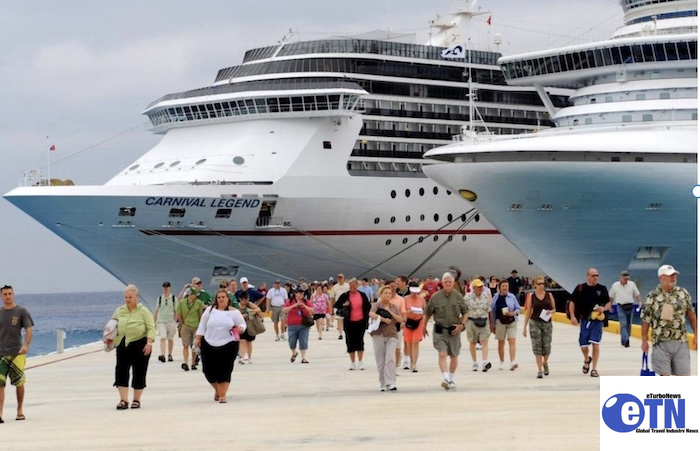
Today’s ships are no longer simply transport vessels—they are floating mega-resorts designed to capture as much passenger spending as possible within their own ecosystems.
“Ships now have multiple restaurants, bars, shops, casinos, spas, and water parks,” MacLellan explained. “All of this creates a direct disincentive for passengers to spend time—and money—ashore.”
He also points to operational practices that reinforce this shift.
“Ships ban bringing duty-free liquor onboard in calling ports, often on ‘security’ grounds. At the same time, they operate their own retail outlets selling exactly those kinds of products. That’s not a level playing field for local businesses.”
The Reality of Onshore Spending
Jewelry shop onboard a cruise ship
The question of how many cruise passengers actually spend in destinations remains one of the most contentious issues in the debate.
While industry data often presents relatively strong spending figures, MacLellan challenges their accuracy in real-world settings.
“The average spend per cruise ship passenger quoted in some reports seems very dubious,” he said. “From what we hear on the ground, the reality is far more modest.”
Drawing on feedback from local operators, he adds: “Most taxi drivers in the Caribbean will tell you that the average purchase per person ashore is more like ‘two beers and a T-shirt.’”
This stands in stark contrast to stay-over visitors.
“How does that compare,” he asks, “with a guest staying in a hotel or villa—paying for accommodation, dining, car rental, excursions, and entertainment over several days? The difference is enormous.”
A 2025 report from the World Bank reinforces this disparity, estimating that cruise visitors generate between $37 and $139 per visit in the Caribbean, compared to more than $1,600 for stay-over tourists.
Excursions and Economic Leakage
Another area of concern is the structure of shore excursions.
“Commissions for shore excursions have risen from around 10% in earlier years to as much as 50% today,” MacLellan noted. “That inevitably pushes prices up and makes it harder for local operators to remain viable.”
The consequences, he says, are visible.
“A smaller percentage of passengers now go on excursions, and an increasing number don’t go ashore at all in certain ports. That’s a fundamental shift in how cruise tourism interacts with local economies.”
The Return Visitor Question
WTTC and CLIA emphasize that cruising plays a crucial role in destination discovery, with more than 60% of passengers returning to places they first visited by ship.
MacLellan agrees this is an important metric—but believes it needs deeper analysis. “The key question is not just whether they return,” he said. “It’s how they return.”
“It would be interesting for WTTC to analyze what percentage of those visitors actually come back for a stay-over vacation—spending the kind of money that tourism leaders in the Caribbean rely on.”
He continues: “Discovery is valuable, no doubt. But from an economic standpoint, a day visitor and a week-long visitor are completely different propositions.”
Such an analysis, he suggests, would strengthen—not weaken—the WTTC’s work by providing a clearer picture of long-term value creation.
Taxation, Costs, and Local Impact
MacLellan also highlights what he sees as a structural imbalance between cruise lines and land-based tourism businesses.
“Cruise ships benefit from offshore tax structures and very low wage costs for much of their crew,” he said. “Meanwhile, hotels and tourism businesses in the Caribbean pay local taxes, employ local staff, and contribute directly to national economies.”
He adds that the disparity extends to taxation policies.
“Cruise ships currently pay very low port taxes per passenger in the Caribbean, especially compared to regions like Alaska or the Mediterranean,” he explained. “At the same time, stay-over visitors are heavily taxed through airport fees, hotel taxes, and VAT.”
Those local contributions, he emphasizes, have a multiplier effect.
“When you employ local staff and pay local taxes, that money circulates within the economy. That’s a critical difference.”