

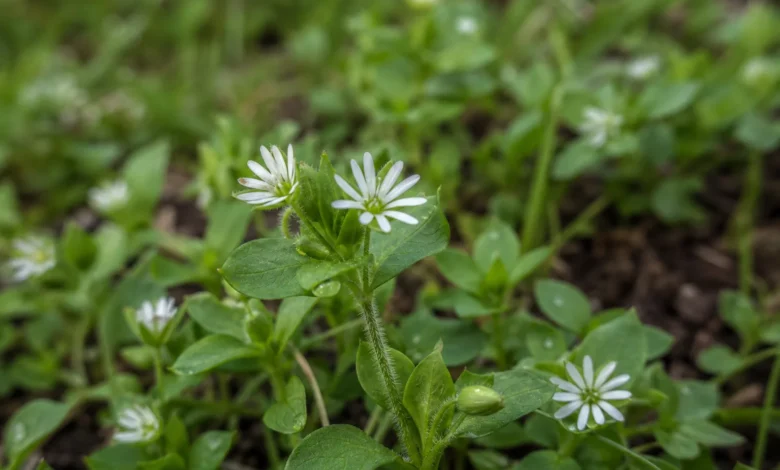
Between the blades of grass there is a dense, flat carpet of delicate shoots decorated with tiny white flowers. Maybe you’ve noticed it while mowing the lawn and are wondering whether it’s harmless or better if it disappears. Most of the time it is chickweed, an edible wild herb that many consider to be just a nuisance weed. You can recognize chickweed by a few specific details – and they are more important than they initially seem. Because sometimes a plant grows right next to it that can hardly be distinguished from it and causes nausea if eaten. Whether the herb ends up in the compost or on bread and butter depends precisely on these characteristics.
Recognize chickweed: growth, leaves, flowers
Chickweed does not grow in height, but rather in width. Their thin shoots lie flat on the ground and form a dense, soft carpet that rarely grows higher than 40 centimeters – it usually remains much flatter. Wherever a shoot touches the ground, it puts down new roots. The plant takes over entire bed areas in just a few weeks.
The leaves are small and ovate, their color a fresh grass green; they sit in pairs on the stem. The flowers are only noticeable at second glance: snow-white, barely larger than five millimeters, with five deeply cut petals that look like ten at first glance.
The most important identifying mark is on the stem. A fine line of tiny hairs runs along one side – just along one side, not all around. If you run your finger over the shoot or hold it up to the light, you will clearly feel or see this one-sided hairline. It is the most reliable evidence because it is there all year round, regardless of the flowers.
Where and when chickweed grows
Chickweed is widespread throughout Germany and grows wherever the soil is nutrient-rich and loose: in the lawn, between the rows of vegetables, at the edge of the bed and on freshly dug soil. A dense stand of chickweed is therefore even a useful indicator – it shows that the soil contains plenty of nitrogen. The plant tolerates full sun as well as partial shade.
Their long flowering period is unusual. According to the profile of the Federal Agency for Nature Conservation, chickweed blooms from February to November and thrives in nitrogen-rich locations. In mild winters it even produces flowers all the time. Because it pollinates itself, a single plant produces thousands of seeds that are passed on by ants. This explains why it often appears seemingly overnight. If you want to know which other species are still growing in the greenery, you can identify other types of weeds in the lawn at the same time.

Danger of confusion: The poisonous field gauchheil
As harmless as chickweed is, its counterpart can be just as unpleasant. The Acker-Gauchheil originally comes from southeastern Europe, has long since become naturalized here and grows in the same places: sunny beds, roadsides, open ground. At first glance it looks like chickweed – low, creeping, with small oval leaves.
But the difference really counts here. The field gauchheil contains saponins, especially in the roots. Anyone who accidentally eats it risks nausea, vomiting and diarrhea; in larger quantities it can cause cramps or circulatory problems. The risk is higher for small children and pets because even smaller amounts are sufficient. The Roth district office makes it clear that caution is advised with this plant because it is poisonous. If someone has accidentally eaten it and feels unwell, the case should be referred to a doctor or a poison control center.

Fortunately, the two can be clearly distinguished by three features:
| feature | Chickweed (edible) | Field Gauchheil (poisonous) |
|---|---|---|
| Stem | fine hairline on one side | smooth and bare |
| Flower color | snow white | bright orange to brick red |
| flowering time | as early as February, almost all year round | only from June to October |
The simplest touchstone remains the hairline: the chickweed has it, the smooth field gauchheil does not. Anyone who frequently experiences such traps in the garden will find guidance in other poisonous look-alike plants in the garden.
Two more harmless doppelgangers
Not every white-flowered plant in the lawn is the same as chickweed. Two close relatives are regularly confused with it – both are harmless, but taste less delicious.
The greater stitchwort grows more upright and taller than the chickweed, its white flowers are significantly larger and the leaves are narrow and pointed. It is non-toxic, but is considered less aromatic by wild herb collectors.

The water gut prefers moister, shady places and is most similar to chickweed in growth. It is also edible, but tastes paler. In short, if you catch either of these two, you don’t have to worry; only the aroma is a little weaker.
Control chickweed when it is unwanted
When chickweed takes over and crowds out vegetables, many want to get rid of it. But simply tearing it down doesn’t help much. The shoots break easily, the fine roots remain in the ground and sprout again. Instead, pull out entire pads including the roots.
The best time is after a rainstorm or in early spring before the first seed pods form. The roots slide out of moist, loose soil almost by themselves. If you get there early, you can prevent thousands of seeds from spreading across the bed.

However, you don’t have to remove every plant. A carpet of chickweed protects open soil from erosion, keeps it moist and provides an early food source for insects. Feel free to leave some residue in non-critical areas and cover cleared areas with mulch so that new seedlings do not appear immediately. For really stubborn growth, the same patience as with other growths helps – similar to how you can naturally remove stubborn weeds like ivy.
Using chickweed: kitchen and green manure
Before the chickweed ends up on your plate, there is a single, non-negotiable rule: only harvest what you have clearly determined. If in doubt, the hairline on the stem helps again. If the identification is certain, you will get an amazingly nutrient-rich wild vegetable.
Chickweed is full of vitamin C and vitamin A and also provides iron, magnesium, potassium and silica. The taste is mild and slightly nutty – many find it reminiscent of young, tender corn. This makes them a classic among wild herb collectors.
In the kitchen it is uncomplicated. It tastes best raw: as a base or addition to a salad, chopped into herb quark, on buttered bread or pureed in a green smoothie. You should only heat it briefly, otherwise it will lose its aroma and vitamins. The delicate shoot tips with the flowers are the finest part.

What’s Hot

Garden and plants
7 plants are similar to dandelions – only one is poisonous
Leftover chickweed doesn’t have to go in the trash. Sown as green manure, grown in autumn and worked flat into the soil before winter, it returns nitrogen to the soil – practical for everyone who builds their own composter for green manure anyway. They also like to eat chickens, rabbits and pet birds. This means that the supposed weeds can be turned into salad, fertilizer or animal feed depending on your needs – and you have to think twice about picking up a hoe.
Frequently asked questions
Can chickweed be reliably identified even without flowers?
Yes. Rely on the fine hairline that runs down one side of the stem – it’s visible all year round, even outside of the flowering season from February to November. If you hold a shoot up to the light or run your finger along it, you will see the one-sided hairiness even on flowerless plants.
Is chickweed safe for dogs and cats?
Real chickweed is harmless to dogs, cats and other animals – it is even used specifically as food for pet birds and rabbits. It only becomes dangerous if the poisonous field gauchheil mixes in. Therefore, before feeding, do the same stem test as you would for your own lettuce.
How long does freshly harvested chickweed last?
Not for long – chickweed wilts quickly. It is best to process them on the day of harvest. Loosely wrapped in a slightly damp kitchen towel, it will keep in the vegetable drawer of the refrigerator for about one to two days. You should only wash it shortly before using it, otherwise it will become muddy.