
One Climbing aid for cucumbers in the bucket often decides whether you harvest crunchy fruit in summer or whether the tendrils lie sullenly on the ground. The space that outdoor cucumbers usually have is missing on the balcony and terrace – and that’s exactly why the climbing aid needs to be planned a little more cleverly here. The good news: You don’t need expensive materials or skilled craftsmanship. In this article I will show you three variants that you can build yourself in half an hour and reveal which one suits your location.
In short
- Bamboo teepee – quickest and cheapest solution for a single bucket, from three sticks and some string.
- wire mesh – worth it as soon as there are several pots in a row; a grid supplies them all.
- Wooden lattice – the most decorative variant, easy to expand, but sensitive to tipping at great heights.
- Wind stability – the most important point in the bucket: the framework must withstand ripe fruit and gusts without falling over.
Why a trellis is essential for cucumbers in the pot
Cucumbers are naturally climbing plants. They form fine tendrils with which they cling to anything within reach. If they don’t get a hold, the shoots crawl over the edge of the pot and lie on the earth or ground – there the fruits rot more quickly, snails have an easy time and the harvest turns out poor.
There is a second reason in the bucket: space. While an outdoor cucumber can spread horizontally, the container plant must grow upwards, otherwise it will take up half the balcony. One Climbing aid for cucumbers in the bucket directs growth vertically and at the same time makes the plant more airy – this prevents mildew.
A detail that many people overlook: Attach the framework early, ideally right when planting. Later, the roots will run through the entire ball of the pot, and every stick that you stick into them will injure them. And think about the weight. A fully grown cucumber plant with several ripe fruits becomes surprisingly heavy – the structure has to support it without bending.
Variant 1: Bamboo sticks with string
This is the classic for a single bucket – cheap, fast, surprisingly stable. All you need is bamboo sticks at least 100 centimeters long and some twine or thin rope. Your hands are enough for the rest.
Method A: the four-framework
Insert four bamboo sticks evenly spaced and properly deep into the soil of the pot – the deeper, the more stable. First connect the rods with a first row of rope just above the edge of the pot. From there, work your way up and add another horizontal row every 10 to 20 centimeters. This creates a kind of ladder on which the tendrils climb rung by rung.
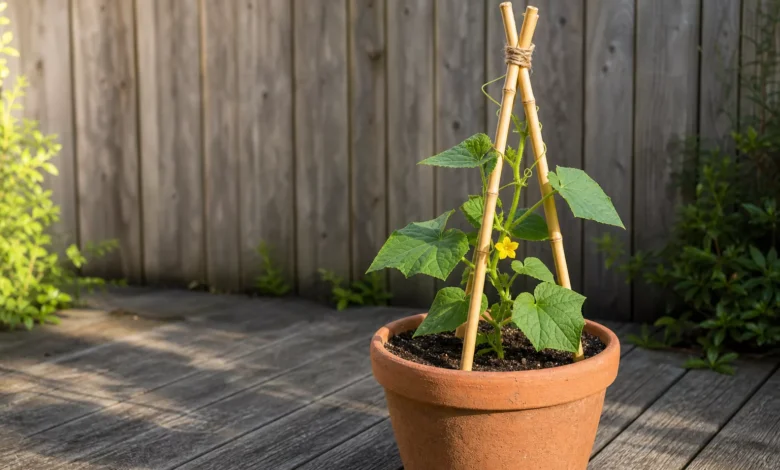
Method B: the pyramid teepee
The tent version is even quicker: Insert three sticks in a triangle, tie them together at the top and wrap the yarn in a spiral from bottom to top around the frame. This results in a pyramid that hardly tips over, even in windy conditions, because the three legs are wide. A tepee in a bucket looks great visually.
An honest tip from practice: If you plant a lot of pots, the individual framework for each pot quickly becomes tedious. Then you are better off with the next variant.

Variant 2: Wire mesh with wooden strip frame
As soon as there are several pots in a row, the wire mesh shows its strength: a single long grid supplies several plants at the same time. This solution is a little more complex, but extremely durable and hard to knock over.
You will need a piece of chicken wire or hoarding, a few wooden strips (a little longer than the height of the fence), nails and a hammer. Nail two strips together in a V or X shape – these crosses will become your support feet. Set up the wire mesh; Either bury it a little or temporarily support it so that it stands vertically.
Now comes the trick: insert the legs of the wooden crosses through the mesh of the wire from behind. The height of the mesh determines the hold – the higher you thread the supports, the more secure the entire grid will be. Simply place the pots directly in front of them so that each plant has its own section to climb. As with building your own trellis, the following applies here: First check the stability, then plant.

Variant 3: Wooden grille made of strips
If you like it more decorative, build a small wooden grid – the most beautiful of the three variants and goes well with terracotta pots. Material: thin strips of wood, hammer, nails and a piece of rope for later.
First, cut two vertical strips to around one meter long each. Determine how far apart the two should be at the bottom of the pot – parallel seems quieter, converging slightly towards the top saves space. Then nail several horizontal strips across the two verticals to create a grid. Put the finished framework in the bucket.
If the plant grows beyond the trellis, extend it upwards with a stretched rope and attach it to a wall or a low eaves. By the way, a simple ladder can also be used as a climbing aid for bedding cucumbers – but the grid remains the more elegant choice in the pot.
A word of caution: A very high, free-standing wooden trellis is prone to tipping over in the wind, especially with the additional weight of ripe fruit. Therefore, either stay at a moderate height or anchor the scaffolding additionally.

Which variant suits you?
All three designs work – the right one depends on your location, budget and number of pots. This little decision-making aid will take away your thinking:
- Bamboo teepee: minimal effort, very cheap, ideal for a single bucket on the balcony. It lasts for one to two seasons, then the rods become brittle.
- Wire mesh frame: More construction work, medium costs, but can be used for many years and is perfect for a whole row of pots on the house wall.
- Wooden grille: medium effort, nice look, easy to expand – but needs wind protection and a little more space at the top.
As a rule of thumb: one pot, little time – bamboo. Several pots on a wall – wire mesh. An eye-catcher on the terrace – wooden lattice. If you are currently putting together your plants for the terrace and pots, the trellis can be included in the planning straight away.
Pro tips
- Wind stability first: Shake the finished framework before planting. If it wobbles, stick the rods deeper or weigh down the bucket with a few stones on the ground.
- Apply early: Place the trellis directly when planting – after a few weeks the roots will pull through the ball and each stick will cause damage.
- Choose rough materials: The tendrils hold much better on wood, bamboo and natural cord than on smooth plastic. If necessary, wrap smooth struts with string.
- Maintain minimum height: Plan on climbing height of around one meter so that the shoots do not rest on the ground again.
- Help allowed: At the beginning, tie young shoots loosely or thread them in the right direction – then the tendrils will continue to climb on their own.
Conclusion
A stable climbing aid is not a nice-to-have for potted cucumbers, but rather the basis for a good harvest. Whether it’s a quick bamboo teepee, durable wire mesh or a decorative wooden grille – each variant can be built in a short time and with little money. Above all, pay attention to stability and the right time, then your cucumbers will climb reliably throughout the summer. If you enjoy building things yourself, you can next try creating a raised bed.
Frequently asked questions
What is the minimum height that a climbing aid for cucumbers in a pot should be?
The scaffolding should reach around one meter, preferably a little more. This gives the tendrils enough space to climb and the shoots do not fall back onto the ground. There are hardly any upper limits to the height – as long as the construction remains stable.
When is the best time to attach the trellis?
Ideally directly when planting. At this point the root ball is still small and you can safely insert stakes or trellises into the soil. If you wait several weeks, the roots will pull through the pot and will be injured when inserted.
How many cucumber plants does a climbing aid support in a pot?
One strong cucumber plant is usually enough per standard pot – it alone fills the framework. Two plants only work if the pot and trellis are appropriately large, otherwise they will compete for light and nutrients and both plants will remain weaker.
What to do if the trellis becomes too small?
Extend it upward: Stretch a rope from the top of the scaffold to a wall, railing or low eaves. The tendrils continue to climb easily and you gain additional climbing height without repotting.