

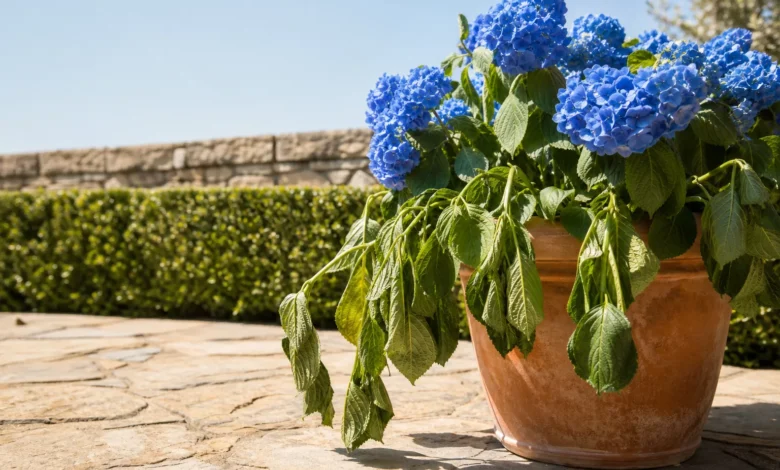

It’s just after twelve o’clock, the thermometer shows 31 degrees, and your hydrangea is hanging limply over the edge of the bed as if it had given up. The first reflex: quickly get the watering can and pour liters of water. This is usually the wrong step. If your Hydrangeas fail in the heatin the vast majority of cases this is not an emergency call, but rather a clever protective mechanism. In this fact check, we separate five stubborn watering myths from what really works—and give you an instant routine you can use tonight.
In short
- Midday Hanging – is a protective reflex, not an emergency; most plants will be upright again in the morning.
- Water in the evening – a deep application to the root disc works better than hectic spraying in the midday sun.
- Pause fertilizer – After heat stress, no nutrient salts for around two weeks, as they exacerbate cell stress.
- Location decides – Farm hydrangeas need partial shade, panicle and oak leaf hydrangeas can tolerate more sun.
Why hydrangeas weaken in the heat
The botanical name says it all: Hydrangea Translated means something like “water vessel”. Hydrangeas are designed for a generous water balance. Its large, soft leaves evaporate enormous amounts on a hot summer day – according to expert advice, a fully grown farmer’s hydrangea can release up to 50 liters per day. At the same time, the roots sit shallowly beneath the surface and simply cannot grow quickly enough in the blazing sun.
When evaporation exceeds supply, the plant lowers its leaves and shoots. This is intentional: less leaf area means less sun and less water loss. The hydrangea drives itself into economy mode. As soon as the temperatures drop in the evening and evaporation slows down, the cells fill up again, and the next morning the plant usually stands upright again on its own.

The immediate test: Is it still hanging in the morning?
Before you do anything, ask yourself a single question: Is the hydrangea still hanging limply early in the morning? This diagnostic switch saves you a lot of incorrect treatment.
If the plant is upright again in the morning, the midday hanging was just the normal heat reflex – you don’t need to do anything other than water properly in the evening. If, on the other hand, it still hangs limp in the cool of the morning, there is something wrong with the water supply. Then reach deep into the soil with your finger or a wooden stick: If the soil is bone dry or compacted at a depth of fifteen centimeters, the irrigation water will run off the surface and not reach the roots at all. If, on the other hand, it is wet at the bottom and smells musty, this indicates waterlogging and a root problem – then you should check whether your hydrangea has received too much water.
5 myths fact checked
There is a surprising amount of well-intentioned advice circulating around the limp hydrangea that does more harm than good. Here are the five most common ones – and what’s really behind them.
- Myth 1: Pour liters immediately. Fact: A single, profound gift in the evening brings more than constant toppings. Allow about 5 liters per 20 centimeters of plant height, directly to the root disc. Frequent superficial watering attracts the shallow roots even further up and makes the plant more sensitive.
- Myth 2: Spraying the leaves cools. Fact: In the midday sun, the water droplets act like small burning glasses and leave brown burn marks. Damp foliage also promotes mildew and leaf spots. The cooling effect only lasts a few minutes – it’s not worth the risk.
- Myth 3: The time doesn’t matter. Fact: If you water at midday, a lot of the water is lost to evaporation before the roots absorb it. A two-stage strategy is more effective: water thoroughly in the evening and supplement in the morning if necessary.
- Myth 4: Extra fertilizer strengthens the stressed plant. Fact: Exactly the opposite. Nutrient salts in hot, dry soil exacerbate cell stress and can literally burn the root tips. After heat or sunburn damage, stop using the fertilizer completely for around two weeks.
- Myth 5: All hydrangeas tolerate full sun. Fact: The popular farmer’s hydrangea (Hydrangea macrophylla) comes from the light penumbra on the edges of forests and suffers from a hot south-facing wall that stores and radiates heat. Panicle and oak leaf hydrangeas, on the other hand, tolerate significantly more sun.
The 4-step instant routine for limp hydrangeas
If your plant is still hanging in the morning, work through these four steps one after the other – and resist the urge to reach for the pot straight away.
1. Shade instead of watering. Take the edge off the midday sun. A loosely stretched shade net, a parasol or, if necessary, an old bed sheet over two rods are sufficient. Never place the material directly on the leaves, otherwise the shoots will bend.
2. Water deeply in the evening. As soon as the sun is gone, water the root disc thoroughly, preferably with low-lime rainwater. Chalky tap water causes yellow leaves on hydrangeas over time.
3. Pause fertilizer. No fertilizer for around two weeks until the plant has visibly recovered.
4. Move the bucket. Move potted hydrangeas away from the south wall and hot pavement to a partially shaded spot with filtered afternoon light.

Long-term prevention: mulch and location
The real work doesn’t happen in the hot moment, but before it. A 5 to 7 centimeter thick layer of mulch made of pine bark, bark mulch or dry shredding keeps moisture in the soil and protects the shallow roots from overheating. Apply fresh grass clippings only thinly – as they rot, they develop heat and bind nitrogen.
The second lever is location. A spot with morning sun and filtered afternoon light is ideal, such as under a light tree or on a west instead of south wall. If your farmer’s hydrangea is constantly too hot, plan a move in the fall – then the stress on the plant is lowest. If you still want to plant in sunny corners, it is better to choose robust shrubs for full sun and heat.

Pro tips
- Collect rainwater: Place a barrel under the downspout – low-lime rainwater is much better for hydrangeas than tap water.
- Decouple the bucket: Two simple wooden strips under the pot keep it away from the heated pavement and noticeably reduce the soil temperature.
- No nitrogen from August: Apply nitrogen-based fertilizer now so that the shoots mature and become hardy.
Conclusion: Patience beats panic pouring
A limp hydrangea on a 30-degree day looks dramatic, but rarely is. The morning test tells you whether there really is a need for action, and the four steps help in an emergency more reliably than any spray bottle. If you get the location and mulch right, you’ll save yourself from trembling next summer – and you’ll be rewarded with strong blue umbels that stand upright again in the first morning light.

What’s Hot
Garden and plants
More comfort in the garden: Why a patio cover is becoming increasingly popular
Frequently asked questions
Why does my hydrangea only hang at midday and then stand upright again in the evening?
This is the normal heat reflex. The plant lowers its leaves to reduce evaporation when the sun is at its strongest. As soon as it cools down, the cells fill up again. As long as she is upright in the morning, everything is fine.
How often and how much do I need to water hydrangeas in high heat?
It’s better to be rare and penetrating. In the evening, add about 5 liters per 20 centimeters of plant height directly to the root disc. On extreme days, supplement in the morning. Frequent superficial watering does more harm than good.
Can I spray hydrangeas with the shower when it’s hot?
Better not. In the midday sun, the drops act like burning glasses and cause burn marks; damp leaves also promote mildew. The cooling effect is minimal. Instead, water the soil in the evening.
How long after heat stress can I fertilize again?
Wait around two weeks until the plant has visibly recovered. As long as the soil is hot and dry, nutrient salts increase stress and can damage the root tips. Only when fresh growth begins do you fertilize again in moderation.