
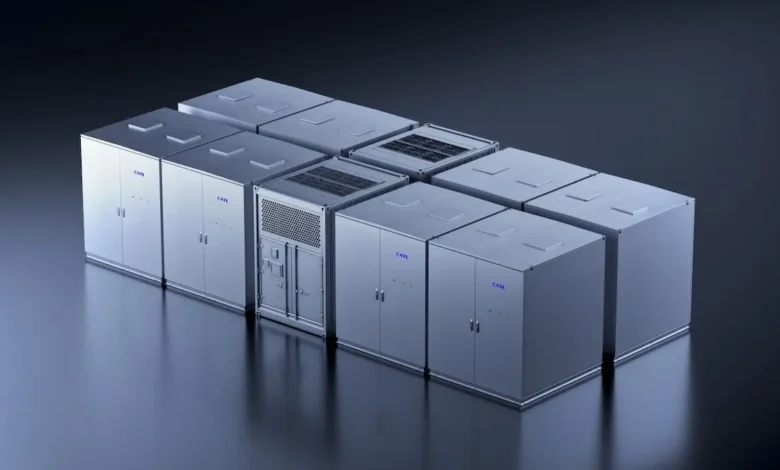
Large-scale stationary storage systems are becoming a critical infrastructure due to the energy transition and the electricity requirements of AI. But lithium supply chains and raw material prices remain a risk. With the TENER system, CATL is now bringing sodium-ion batteries into a commercially scaled storage platform for the first time. The energy storage device promises high efficiency, quiet operation and does not require rare raw materials.
The energy transition and the enormous power requirements of artificial intelligence are increasingly making large-scale stationary storage systems a critical infrastructure. Lithium-ion technology has dominated the market so far, but concentrated supply chains and volatile raw material prices pose growing risks for companies. A strategic alternative is therefore needed more urgently than ever in order to guarantee long-term security of supply and planning certainty.
The Chinese battery giant CATL has recognized this potential and has invested around 1.2 billion euros in research into alternatives since 2016. The result of this work, in which over 300 research and development specialists were involved, is based on sodium. The element is more than 1,000 times more abundant on Earth than lithium, is geographically extremely widely distributed and offers immense cost advantages.
This is CATL’s new large-scale sodium-ion battery
The newly introduced TENER system promises a rated capacity of more than 30 megawatt hours on a fully modular architecture with flexible storage durations of one, two, four, six or eight hours. An integrated, bidirectional voltage regulation system automatically balances the wide voltage range of the sodium batteries, which is said to increase overall efficiency by almost two percent.
In addition, according to the company, the newly developed BMS system uses the continuously decreasing voltage curve of sodium chemistry to enable more precise SOC estimation. Thanks to a unique upward discharge airflow design, system heat generation is said to decrease by almost 30 percent. Combined with a highly efficient liquid cooling system, this ensures that auxiliary power consumption drops from two percent to one percent, according to CATL.
In addition to a 20 percent higher overcharge SOC tolerance compared to lithium, the system should only be loud at 65 decibels during operation. Since this is around ten decibels quieter than conventional systems, the systems can be built directly where the need arises without high transmission losses. This would save transmission and distribution costs. 300,000 cells have already been provided separately to validate the memory.
Commercial reality and seamless platform compatibility
The massive investments and purchase contracts prove that the technology has long since left the pure laboratory phase behind it. According to CATL, 640 million euros have already flowed into the new Fuding base for an additional 40 gigawatt hours of annual capacity, while a three-year major commercial order for 60 gigawatt hours was signed with HyperStrong in April 2026.
The company is aiming for a cumulative delivery mark of one gigawatt hour by the end of 2026. A 1 GWh site should then only need 34 modules, each weighing around 42 tons. The first deliveries are scheduled to start in China in September 2026, followed by the international market launch in June 2027.
The system is fully compatible with existing lithium iron phosphate (LFP) systems as both technologies share the same physical footprint and can be swapped without chassis modifications. Sodium technology thus forms the second stable foundation of the future global energy infrastructure.
Also interesting: