
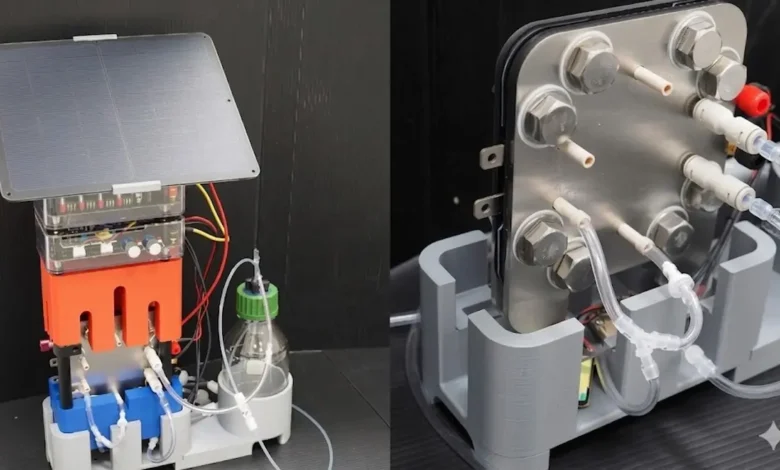
Researchers at Osaka Municipal University have developed an artificial photosynthesis system that can generate energy from sunlight, water and CO2. Neither a battery nor an external control is required. The highlight is a self-regulating electrolyzer that produces formic acid as an energy source.
Artificial photosynthesis imitates the natural model of plants to produce usable fuels from existing environmental resources. Previous systems require continuous adjustment of voltage and current, which is known in the professional world as maximum power point tracking.
However, this traditional method requires additional electronic components as well as heavy batteries to stabilize the energy flow. This increases both the technical hurdles and the overall economic costs for the installations.
Artificial photosynthesis: New system regulates itself completely
However, a new system in Japan is based on a specially developed electrolyzer with a solid electrolyte. This is supplied with electricity from a solar cell. The device completely regulates its electrical properties by changing temperature and impedance. This makes external control hardware unnecessary during operation.
As the sun’s rays increase, the system heats up, which reduces the electrical resistance and allows the current to flow unhindered. Yutaka Amao, a professor at Osaka Municipal University, explained the automatic adjustment of the changed system:
As the sun’s rays increase, the electrolyzer heats up naturally. The system is designed so that this heating leads to a decrease in electrical resistance, allowing current to flow better.
This self-sufficient functionality stabilizes the production of fuel throughout the day. In practical tests under real outdoor light, a prototype has already successfully produced formic acid from water and carbon dioxide.
Chemical production continued stably even when the intensity of sunlight fluctuated. The development was presented, among other things, at the world exhibition in Osaka in 2025. There, the system has already successfully supplied a miniature diorama with clean energy.
What does this mean for private households?
According to the scientists involved, the technology has great potential for direct use in everyday life. In the future, such systems could supply private households with environmentally friendly electricity or storage media.
The complete automation and reduced complexity are intended to make electronic control easier in everyday life. This is intended to significantly increase the acceptance and spread of decentralized green technologies among consumers. Detailed results of the scientific study were published on March 20, 2026 in the specialist journal EES Solar.
The research groups involved are optimistic about the further development of this low-maintenance process. The combination of solar cells and intelligent material chemistry could be an important step towards the energy transition. This would provide consumers with a potentially cheaper path to energy storage.
Also interesting: