The transition from sandbox experimentation to durable production is the defining challenge of the agentic era. While building a functional agent is now a low-barrier task, the primary engineering burden lies in safe system governance: Retrofitting legacy infrastructure for autonomous consumers, solving identity propagation across multi-hop chains, and managing the non-deterministic, emergent behaviors that distinguish agents from traditional software.
MuleSoft addresses this complexity through an enhanced experience: A unified interface designed to streamline the discovery and management of agentic assets (agents, LLMs, MCPs, and APIs) regardless of their host environment. By reorganizing the control plane around the service rather than the underlying management product, this interface ensures that consistency, not just coverage, operationalizes the transition from development to production-ready scale from a high-productivity surface.
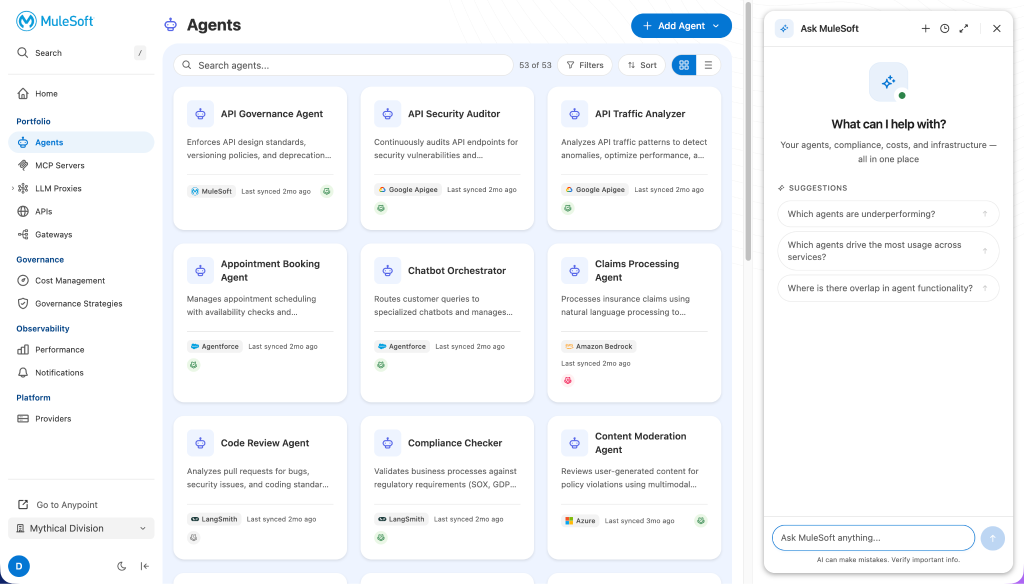
Central to this experience is the MuleSoft Omni Gateway, a unified control plane that synchronizes governance across API, AI, and agent traffic. Unlike traditional environments where LLMs, MCP servers, and APIs are managed via disconnected tools, Omni Gateway provides a common enforcement layer for protocol-agnostic routing, observation, and policy execution. This enables teams to manage complex agentic interactions in a single place, ensuring that governance remains durable across any workload or model vendor.
We’ll discuss the operational pillars of this new enhanced experience: Scan, Register, Manage, Monitor, and Headless MuleSoft. Each category demonstrates how MuleSoft Omni Gateway establishes a robust governance framework designed specifically for the agentic era.
Quick walkthrough of the enhanced experience
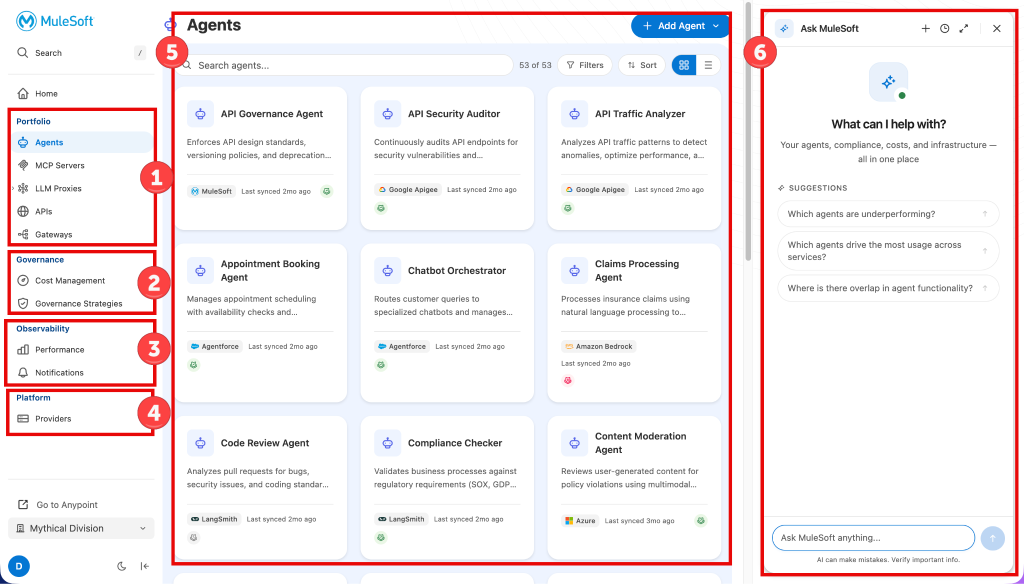
The enhanced experience moves beyond simple asset tracking to a service-based mental model, visible through a streamlined interface. The core components provide a unified view to manage the full dependency chain of an agentic workflow, set broad organizational governance controls, monitor real-time metrics, and facilitate natural language interaction with your infrastructure. They include:
- Portfolio
- Governance
- Observability
- Platform
- Main display
- Embedded Chat
Scan: Providing visibility across different ecosystems and platforms
The enhanced experience enables visibility by automating the discovery of agents, MCP servers, and APIs scattered across disparate platforms. Through Scanners, the MuleSoft Omni Gateway authenticates against and crawls ecosystems including Amazon Bedrock AgentCore, Google Vertex AI, and Azure Foundry AI. These scanners reach into third-party environments on a scheduled basis (typically 1-day increments) to detect new or updated assets and their associated metadata and register them.
This process includes an optional manual review stage, allowing platform teams to audit agents before they are officially imported. This unified registry serves as the single source of truth for all assets, providing an up-to-date catalog that covers your entire enterprise landscape.
Building on these discovery capabilities, MuleSoft Omni Gateway introduces true gateway federation. Beyond simply scanning for inventory, the gateway establishes a live link with existing API management layers from Kong and Apigee. This federation allows MuleSoft Omni Gateway to act as a universal conductor, synchronizing policy management across heterogeneous gateways without requiring traffic to be rerouted or infrastructure to be migrated. Learn more about federated gateway support.
Take a look at the interactive product tour on how you can easily set up a provider in the enhanced experience.
Register: Capturing the fringe
Registration in the MuleSoft Omni Gateway ensures visibility extends beyond what scanners can automatically detect by capturing “fringe” assets like custom agents and local MCP servers. The registry provides streamlined paths for direct registration, allowing architects and developers to secure assets such as APIs (via spec upload or instance-only entry), agents (with metadata cards or governance shells), and MCPs (via URL/schema) without generating new assets, reducing management complexity and enabling immediate governance of existing workloads.
In addition, with the new support for gRPC, graphQL, WebSocket, Agents, and MCP servers in Anypoint API Experience Hub (AEH), select catalog of services can be shared externally through the developer portal. AEH simplifies building of thriving API ecosystems and grows developer engagement. You can create personalized API portals in minutes using out-of-the-box templates that work with APIs from any platform or system. Read about all of the latest product and feature updates.
Manage: Production readiness and policy control
Prepare your services for production with centralized rules to limit access, control costs, and secure your digital estate. MuleSoft Omni Gateway provides secure design-time and runtime rules to govern assets throughout their lifecycle, with key steps that cover services according to specific business outcomes.
Leveraging the trusted security and orchestration already available through MuleSoft’s API and AI Gateway capabilities, this framework ensures that governance is consistent with established enterprise standards while addressing the unique demands of agentic workflows.
MCP Bridge: Exposing systems as agent tools
MCP Bridge enables enterprises to securely expose existing enterprise systems as agent tools without rewriting code, offering a secure bridge for API-to-MCP conversion. It supports natural language skill generation and allows aggregation of multiple APIs and out-of-the-box SaaS actions into a single, governed instance.
The LLM Proxy: Intelligent model governance
The LLM Proxy serves as the primary enforcement point for intelligent model governance, ensuring every model interaction adheres to inherited enterprise guardrails. This includes semantic routing for cost-effective model use and unified policy execution for PII detection and prompt security filters.
Monitor: Observability and cost optimization
Governance isn’t static; it requires continuous oversight of traffic, health, and usage across the full portfolio. The enhanced experience shifts monitoring from reactive auditing to proactive optimization through specialized management surfaces.
Operational health
Omni Gateway provides deep visibility into operational health through real-time telemetry, ensuring agents and APIs meet enterprise standards for availability and latency. This includes real-time visualization of request volumes and error rates, and a centralized notification hub for multichannel alerts (Email, Slack) to facilitate instant response and policy intervention.
Cost optimization and compliance
Omni allows teams to treat LLM tokens and tool calls as metered resources for cost optimization, proactively flagging and providing recommendations for cost-inflating issues like large tool descriptions. To ensure enterprise-wide consistency, it manages standardized design-time rules (eg OWASP API Security validation) and runtime policies (eg Rate Limiting) from a centralized surface.
Take a look at the interactive product tour on how you can monitor your agentic assets in the enhanced experience.
A unified governance layer for all your AI and API assets
MuleSoft Omni Gateway redefines governance as enterprises continue on in the agentic era. By having a service-centric view across the Scan, Register, Manage, and Monitor pillars, it allows platform teams to focus on the high-value work of safe system integration.
At its core, this transition is supported by four key architectural principles:
- Service-centric management: Transitioning from siloed asset tracking to managing cohesive service chains
- Decoupled control: Separating the governance experience from the fragmented underlying infrastructure
- Protocol-agnostic enforcement: Applying consistent security across REST, gRPC, GraphQL, WebSockets, and MCP
- Consistency over coverage: Extending proven governance disciplines across the full AI stack to reduce production risk
By adhering to these principles, MuleSoft ensures that agents aren’t just “built,” but are genuinely ready for production: governed, observed, and acted on from a single, trusted surface while allowing you to continue to have a firm API-led foundation.
To learn more about MuleSoft Omni Gateway, review the following resources: