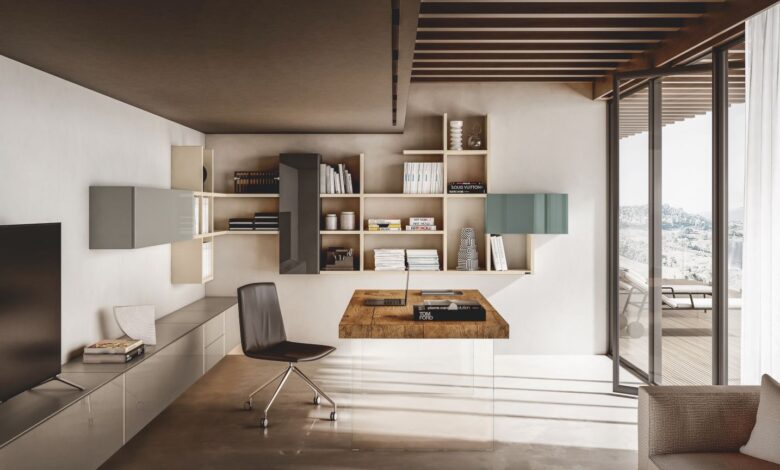
A few years ago, “working from home” sounded like a perk. Now it’s just…Tuesday at your home office. Thanks to the pandemic and a wider shift in how companies operate, smart working has gone from occasional to normal, and for many people it’s become a long-term set-up rather than a temporary fix.
Yes, technically, you can work from your kitchen table with a laptop and decent Wi-Fi. But if you’re doing it for more than a couple of days, the furniture starts to matter. Comfort and ergonomics are the baseline because no one should be leaving a video call with a stiff neck and numb wrists as a personality trait. And style is not a “nice to have”. Whether you’ve got a dedicated room or you’re carving out a corner of the living area or bedroom, you still have to live with it. The home office has to pull double duty: hardworking, but not office-y.
That’s where materials and design come in. Warm woods, crisp steel, airy glass, buttery leather. Each one sets a tone, and the right combination gives you a space that feels calm, focused, and genuinely pleasant to spend time in, even when your inbox is being dramatic.
Elegant and Adaptable: The Desk that Behaves Like Furniture
A proper workstation that doesn’t look like you’ve moved into a co-working space is a rare find. Iren, designed by Kensaku Oshiro for Poltrona Frau, gets it right. It’s sleek, but it’s also clever.
The design uses two overlapping surfaces that slide with a simple movement, expanding the desk from around 119 cm to 149 cm when you need more breathing room. The top is leather-clad, the base is solid ash in mocha or wengé finish, and there’s a subtle forward tilt that supports your forearms in a more natural, less “computer gremlin” position.

There’s also a wall-mounted version for tighter spaces, which is basically the difference between “I have a home office” and “I have one wall that works very hard.”
The Executive Desk that Doesn’t Bully the Room
If you like your home office to feel like a grown-up space, not a temporary compromise, Alma by Palma Amine for Giorgetti brings a sort of quiet authority.
Made in canaletto walnut with leather details in various colors, it comes with three worktop options: a clean plan version, one with a leather upstand and a touch-activated LED lamp, and a third with a double upstand plus integrated lighting for better visual comfort. You can add a matching drawer unit in the same walnut and leather, with push-to-open fronts.

And if you want it truly “no excuses”, there’s an integrated multi-socket option with Schuko, RJ45 and high-speed USB. It’s the kind of desk that makes you sit up straighter without being rude about it.
The 1950s, Still Showing Off
Some designs age. Others just become more charming. The Eames Desk Unit (EDU), created in 1950 by Charles and Ray Eames, still looks fresh because it was never trying to be trendy in the first place.
Part of the Eames Storage Units series, it captures that post-war American modernist spirit: light, functional, slightly industrial, softened with warm materials and color. There’s a steel frame with visible cross-bracing, asymmetrical colored plywood panels, and a worktop in wood or laminate.

It fits into homes and studios without fuss, which is precisely why it’s endured. Still produced by Herman Miller and Vitra, it’s a proper 20th-century icon, with the museum credentials to prove it.
The 1940s Classic with Compass Legs
Another timeless one: Compas by Jean Prouvé, now produced by Vitra. Designed in the 1940s, it’s named after those metal “compass” legs, which give stability while keeping the profile visually light. The top comes in solid or veneered wood, paired with bent, painted steel. Warm meets cool, without any awkwardness.

The proportions are calm, the lines are clean, and it slips into domestic and professional spaces without ever feeling like it’s trying too hard.
The Floating Desk Trick
If you want something discreet but with a strong perspective, Air by Daniele Lago for Lago is a neat solution. Glass side panels hold a wooden oak top that hides an integrated drawer. The contrast is the whole magic: solid wood plus transparency creates a floating effect, so the desk feels light in the room.

The top can also be customized with XGlass, a finish built for durability and easy cleaning, with a shine that doesn’t fade into looking tired after a few months.
Steel, but Make It Domestic
Yes, USM Haller is an office design classic. And yes, it works brilliantly at home, especially if you like clean lines and modular logic. The LB54 desk, designed in 1965 by Fritz Haller and Paul Schärer, mixes chrome-plated steel tubes with powder-coated steel panels.

The look is industrial, but the color options soften it, making it surprisingly easy to blend into residential interiors. Add the fact that it’s GREENGUARD and Cradle to Cradle certified, and it’s a very solid choice for anyone who wants their home office to look sharp without feeling sterile.
Glass, the Elegant Evergreen
For a home office that feels airy and refined, Marcell by Massimo Castagna for Tonelli Design leans into the beauty of transparency. The top and legs are in tempered glass, clear or smoked, paired with a lateral wooden storage element in finishes like eucalyptus, Siberian ash, or natural oak.

It works across styles because it has visual lightness, and it becomes more practical with optional drawers, doors, and accessories such as a tabletop mirror. It’s one of those pieces that makes a room feel bigger simply by not shouting.
Glass, but with a compact punch
Also from Tonelli, Work Box by Marco Gaudenzi is compact, minimal, and quietly confident. Entirely in 15 mm tempered glass, it somehow feels present without being heavy, almost as if it’s hovering.

A pull-out shelf in white lacquered wood or natural wood adds warmth and practicality. With its small footprint (roughly 85 × 50 × 85 cm), it’s ideal when space is tight, but you still want something that looks intentional, not improvised.
The Writing Desk with a Memory
If you like your home office to feel a little more like a study, Missive by Sam Baron for Exto brings that nostalgic desk energy without going full antique.

The top is leather and canaletto walnut, natural or stained, with a brass structure in polished, nickel, or bronze finish. There’s a compartmented organizer hidden beneath a sliding leather-clad lid, and the legs have a double profile: squared at the top, cylindrical at the feet. It’s simple, elegant, and works whether your home leans classic or modern.
For lovers of Scandinavian design that nods to mid-century without being stuck in it, Pavilion AV16, designed by Torbjørn Anderssen & Espen Voll for &Tradition, is a tidy option.

The top is Forbo linoleum, which is easy to clean and pleasingly tactile, with veneered edges and a tubular steel frame. It’s compact enough to slot into almost any room, and the range of finishes gives interior designers plenty to play with.
The Chair that Made Ergonomics Look Good
A home office without a good chair is just a slow-motion betrayal of your spine. Penelope, designed by Charles Pollock for Anonima Castelli in 1982, is a landmark piece because it balances comfort, ergonomics, and real design presence.

A steel base supports a metal mesh shell coated in synthetic resin, resistant yet flexible, and nicely breathable. A polyurethane tube wraps part of the structure, acting like a shock absorber. The overall vibe sits between industrial rigor and formal elegance, and it’s one of those designs that helped make Italian furniture a global obsession.
The Breathable Icon
From the US comes another heavyweight in the ergonomic chair category: the Aeron by Bill Stumpf and Don Chadwick for Herman Miller (1994). It famously replaced padded upholstery with the Pellicle elastomeric mesh, which adapts to the body, distributes weight evenly, and keeps airflow constant.
The chair supports posture and circulation, and crucially, it helps regulate temperature so you don’t end a long work session feeling like you’ve been laminated. In 2016, Herman Miller released Aeron Remastered, updating materials, mechanics, and environmental impact.

Some versions now incorporate recycled ocean-bound plastic, reducing the footprint without touching performance. It comes in multiple finishes so it can look perfectly at home in a living space, not just a corporate office.
Read more:
Last Updated on April 17, 2026 by Editorial Team