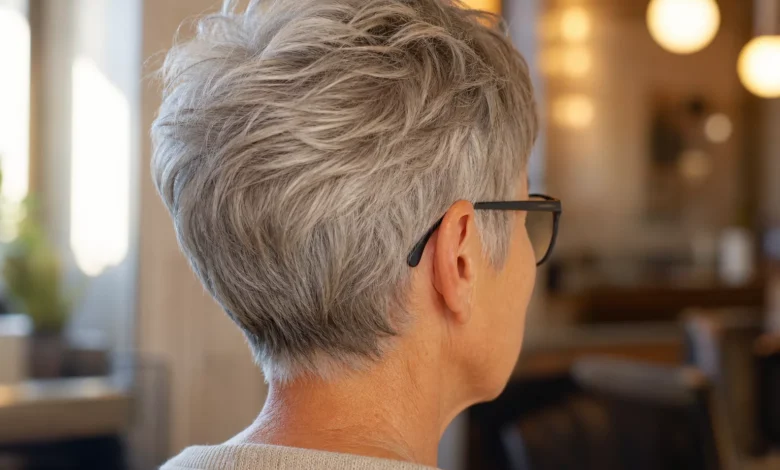
“It’s better to wear longer hair with glasses” – this advice persists, especially from the age of 60. There is little to say for it and a lot to say against it. A short cut gives the face air and makes the glasses a conscious accent instead of a compromise. A Pixie cut from 60 with glasses often even looks particularly elegant – when the cut and frame match. A round frame requires a different cut than a striking cat-eye frame, a rimless model requires a different one. Anyone who knows this logic goes to the hairdresser’s appointment with a clear picture in their head.
Why the pixie cut works so well after 60 with glasses
A short cut exposes the cheekbones, jawline and eye area – and thus also the glasses. The frame and hairstyle complement each other: the glasses are given a stage, the face appears more open and alert. With longer hair the frame often disappears halfway behind strands, with pixie it stands out clearly in the picture.
There is also an advantage that grows over the years. Gray and silver hair has a natural shine and fine light reflections that make a short haircut look lively – without any coloring. The pixie brings structure and volume on its own and can be shaped in just a few minutes in the morning. This is a solid argument for active women who don’t want to spend half an hour in front of the mirror. If you would like to read about the basic advantages of this cut again, you can find them in the overview of the pixie cut for women over 60.
Which pixie type goes with which shape of glasses
The most important principle is contrast: round shapes look more exciting next to clear edges, strict lines look milder next to soft ones. Applied to glasses and the cut, this means that the hairstyle should not reflect the frame, but rather balance it. Five common glasses shapes, five suitable pixie types – the following overview will put things in order.
| Glasses shape | Matching pixie type | Why |
|---|---|---|
| Round glasses | edgy, slightly asymmetrical pixie | Clear contours provide a counterpoint to the round frame. |
| Square, strong glasses | soft, side-parted pixie | The soft line takes away the severity of the striking frame. |
| Cat-eye glasses | Pixie with movement and layers on the top of the head | The curve at the top takes up the outward edge of the frame. |
| Rimless or narrow glasses | textured pixie with clear contour | The defined silhouette gives the understated glasses support. |
| Large or oversized glasses | longer, side bangs | The bangs create balance with the large surface of the frame. |
The table is a starting point, not a rigid rule. When the shape of the face and hair structure come into play, the image sometimes shifts a step – which is why it’s worth taking a closer look before cutting. If you would like to see even more combinations, you will find more hairstyles with glasses over 60 in our collection of ideas.

Bangs and glasses: This is how fringes harmonize with the frame
The bangs are the place where the hairstyle and the glasses touch each other most directly – and therefore the point where the most success or failure can occur. Straight, thick bangs that reach just above the eyebrows quickly appear overloaded with wide upper rims. A fringe that falls to the side, on the other hand, lies diagonally over the forehead, leaves room for the frame and appears airier.
For most glasses wearers over 60, the side, slightly slanted bangs are the safe choice. It conceals forehead wrinkles without covering the eye area and immediately makes the face look a few years younger. The length is important: If the bangs fall too far, they press on the upper edge of the glasses and constantly slip. One to two centimeters above the edge of the frame is a good guideline. If you prefer your bangs to be a little longer, a long pixie cut is also worth considering as a longer alternative.

Fine or thick hair: choose the right option
Not every pixie suits every hair – the structure is a deciding factor. Fine, thinning hair benefits from a layered cut. The steps create levels that can be easily raised to create more fullness and movement. A very smooth, compact cut, on the other hand, lays flat and emphasizes the shape of the head more than desired.
Thick, strong hair can tolerate more structure. A slightly choppy cut with clear edges and longer bangs takes out volume and gives the cut contour without it appearing bulky. Face shape, skin tone and the natural direction of hair fall also play a role – a good hairdresser takes all four factors into account. If even the long pixie is still too short for you, you will find a gentler option with a bob from 60 with glasses as an alternative to the pixie.

Styling tips for everyday life and special occasions
Daily styling with the pixie rarely takes more than five minutes. A small amount of styling wax or a few sprays of texture spray into dry hair, roughened the ends with your fingers – the structure is ready, making the cut full and lively. Less is more: too much product weighs down fine hair and makes it appear stringy.
For a special occasion it can be a little more defined. However, caution is advised when using the curling iron. Fine, white or silver hair is sensitive to heat, can break and lose vibrancy over time. If at all, then with low temperature and heat protection. A round brush when blow-drying is often enough to give the ends a festive lift.

Most people forget this one thing when they go to the hairdresser
As good as a pixie looks in the salon mirror, the real test comes with the glasses on your nose. So the most important advice in advance: take your glasses with you to the appointment and put them on before the first incision is made. This is the only way the hairdresser can see where the brackets are, how high the frame sits and how the bangs fall towards the top edge.
The effect is bigger than you think. A pony that sits perfectly without glasses can suddenly rest on the edge with frames on or interfere with your vision. If you have the glasses with you, you will save yourself this surprise – and the correction appointment two days later.

What’s Hot

Hairstyles
5 bangs variants make medium-length hairstyles look younger over 50
Professional tips for your hairdresser appointment
- Glasses on: Always check the cut in the mirror with the frame on, not just without it.
- Show temples: Show the hairdresser where the hangers go over the ears – the hair shouldn’t stick out there.
- Photo included: A picture of the desired pixie clarifies the length and style of the bangs faster than any description.
- Consider second glasses: Anyone who switches between reading glasses and sunglasses says this – the temple width can vary slightly.
Frequently asked questions
How often does a pixie cut need to be recut after 60?
To ensure that the contour remains clear, a pixie usually needs a trim every four to six weeks – more often than with longer hairstyles because the growth on the short contours is immediately visible. If you like the shape a little looser, you can stretch it for up to eight weeks.
Should I reconsider my glasses after switching to a pixie cut?
Changing is worth a quick check at the optician. Because the pixie shows more of the face, very small frames quickly appear lost and very large frames quickly appear dominant. A medium-sized frame that fits the new proportions can enhance the effect of the cut – a single consultation is usually enough for this.