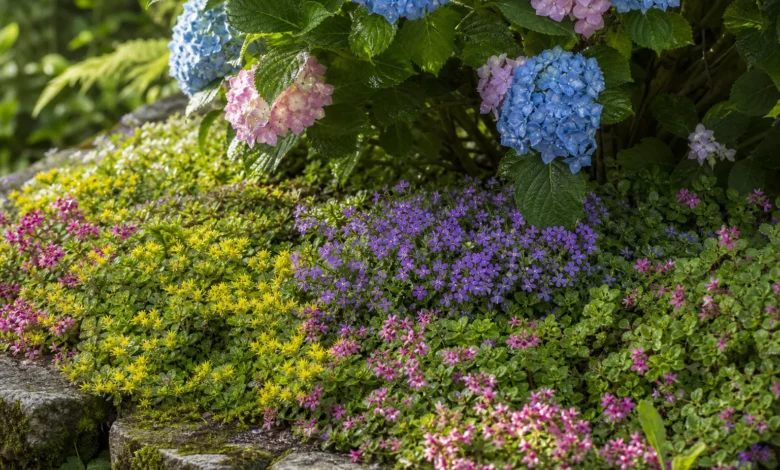
The ground directly beneath a hydrangea bush is often left bare. The dense canopy blocks the light, the hydrangea’s flat roots occupy the top layer of soil, and most perennials simply don’t like this shady, root-filled corner. Ground cover under hydrangeas solves exactly this problem: They get by with little light, have shallow roots and tolerate the low-lime, slightly acidic soil that the hydrangea prefers anyway. Instead of bare earth, a closed carpet grows there, which often blooms in March or April – weeks before the hydrangea opens its first flower balls.
In short
- Choose by color – yellow golden strawberry, violet blue cushion, blue memorial and white lily of the valley cover the entire flower spectrum.
- Check location – Almost all varieties want shade to partial shade and a low-lime, slightly acidic soil.
- Pay attention to height – from 8 cm for the blue cushion to 40 cm for the bergenia; Low cushion plants put the least pressure on the hydrangea.
- Panicle hydrangea – tolerates more sun and lime, which means the selection of ground cover plants is significantly larger.
Why plant ground cover under hydrangeas?
A vegetated root zone is more than just decoration. A dense carpet shades the soil, keeps the moisture in the soil and saves you the occasional watering in dry weeks – an advantage especially when the hydrangea is sagging in the heat and needs every drop.
At the same time, planting keeps weeds small, which would otherwise quickly gain a foothold in open ground. The shallow roots of the ground cover protect the even shallower hydrangea roots from drying out and strong temperature fluctuations. And visually the gap between shrub and lawn closes: the transition looks grown instead of thrown together.
Which soil is suitable: shade and little lime
Before you jump to the plant list, clarify two things about your bed: how much light gets under the shrub, and how calcareous is the soil? These two questions decide which ground cover plants are actually worth considering.
Hydrangeas prefer to be in partial shade, but can also tolerate deeper shade – so their companions should be shade-resistant. Even more important is the pH value. Hydrangeas don’t like lime and want slightly acidic soil. There is a visible reason for this: lime raises the pH value, and aluminum is no longer available to the plant in calcareous soil – blue hydrangea flowers then turn pink or white. Therefore, choose neighbors who value the same low-lime, humus-rich soil. If the foliage of your hydrangea turns yellow, it’s worth taking a look first; To find out why, read how to correctly interpret yellow leaves on the hydrangea.
The most beautiful ground cover among hydrangeas according to flower color
The following types are sorted by flower color – so you can match the carpet to your hydrangea flowers or deliberately create a contrast. All tolerate shade to partial shade and slightly acidic soil.
Yellow
Golden strawberry (Waldsteinia geoides) is the classic for this corner: 15 to 30 centimeters high, robust and undemanding, with strawberry-like, shiny foliage. It grows in partial shade with some sun, likes acidic soil and opens its small yellow flowers in April and May – a welcome pasture for bees early in the year.

Elf flower or sock flower (Epimedium) reaches a similar height and is even more shade-tolerant – it thrives even where there is little light. Depending on the variety, it blooms yellow, white, orange, red, pink or purple, and its foliage changes color throughout the year. In this way, it brings structure to the bed beyond the flowering period.

Carpet St. John’s wort, primrose and dead nettle also bloom yellow; The red dwarf barberry also copes well with little light.
Purple, pink and violet
Bergenia (Bergenia) is the tallest species in this selection at 25 to 40 centimeters. Its pink to purple flower clusters grow on strong stems above large, leathery foliage that turns reddish in autumn. It is bee-friendly and can be easily propagated by division – one plant quickly becomes several.

Blue cushion (Aubrieta) It’s called that, but it blooms purple instead of really blue, and also red, pink or white. At 8 to 15 centimeters, it remains low, grows quickly and forms dense cushions that reliably close the soil. It likes sandy to loamy soil and flowers in April and May.

Periwinkle (Vinca), hosta (Hosta), carpet knotweed, creeping gunsel, cranesbill and deadnettle also thrive in this color family.
Blue
Memorial tree (Omphalodes verna) bears sky blue flowers with a white eye, rarely pure white. It is hardy without protection and blooms early in spring – especially when the hydrangea itself is still bare. The above-ground parts move in in autumn and sprout again the next year.

What’s Hot

Garden design
Combining hydrangeas and ornamental grasses: 5 ideas for the bed
Larkspur (Corydalis) is available as a low ground cover or as a tendril up to one meter. The low varieties have a catch: after flowering in May or June, they die down and the area remains bare until the next season. Therefore, combine it with an evergreen partner who will fill the gap. But its flowers smell pleasant.

White
Lily of the valley (Convallaria majalis), periwinkle, carpet knotweed, cranesbill, creeping fennel, soapwort, lungwort, primrose and the white-flowering deadnettle are suitable for a calm, white carpet. The memorial is also available in a pure white version.
Professional tips for an easy-care hydrangea bed
- Plan for winter green: Pachysandra and small periwinkle (Vinca minor) stay green even in winter and prevent the bed from looking bare from November onwards.
- Mix leaf structure: Round bergenia foliage next to the silvery-green, narrow foliage of the Japanese sedge (Carex) keeps the area lively even without flowers; We’ll show you separately how to combine hydrangeas with ornamental grasses.
- No usurers: Avoid overgrown species that rob the shrub of water and nutrients; Cushion-forming varieties such as blue cushion or golden strawberry remain friendlier.
- Same thirst: Plants with similar water and soil requirements as the hydrangea – humus, slightly acidic, evenly moist – noticeably reduce the amount of care required.
- Keep your distance: Plant the ground cover a hand’s width away from the base of the trunk so that the hydrangea roots retain air.
Hydrangea or panicle hydrangea? This changes the choice of ground cover
Not every hydrangea has the same requirements, and that expands your selection. The classic farmer’s hydrangea wants partial shade and soil with a low lime content – its companions have to adapt accordingly. The panicle hydrangea (Hydrangea paniculata) is more robust: it can tolerate significantly more sun and also slightly more calcareous soil.

What’s Hot

Garden and plants
Hydrangea weakens in the heat: 5 myths fact-checked
For you this means: There is more room for maneuver under a panicle hydrangea. In addition to the shade-resistant species from above, more sun-tolerant ground covers can also be considered. If you want to go beyond the low carpet-formers, you can find other companion plants for hydrangeas with a little more height.
Frequently asked questions
Do the roots of ground cover and hydrangea compete for nutrients?
Both have shallow roots and share the same layer of soil. In practice, this is rarely a problem if you add a layer of compost or bark mulch in the spring and fertilize if necessary. Plant the ground cover with a hand’s width distance from the base of the trunk so that the roots hardly get in each other’s way.
When is the best time to plant ground cover under hydrangeas?
Early autumn is ideal, around September to October: the ground is still warm and the plants will take root well until winter. Alternatively, spring works from April, as soon as there is no longer any threat of severe frost. The hot mid-summer weeks are the least favorable for planting.
How often do I need to water newly planted ground cover plants?
In dry weather, you should water every two to three days for the first two to three weeks so that the roots can take root. After that, the rain is usually enough, supplemented by additional doses in longer dry phases. The soil should be evenly moist, but never waterlogged.