In a world where geopolitical tremors can derail even the most carefully planned global gathering, the travel industry’s most influential organization has chosen an unlikely stage to send a message of confidence, resilience, and leadership: the waters of Egypt’s historic Suez Canal.
Far from the conference halls and hotel ballrooms that have traditionally hosted the world’s tourism elite, the World Travel & Tourism Council (WTTC) has embarked on a bold experiment — and perhaps a defining statement about the future of international meetings and incentives. Its inaugural Leadership Cruise aboard the luxurious Crystal Serenity is more than a floating summit. It is a demonstration of how global leadership can adapt, innovate, and command attention in uncertain times.
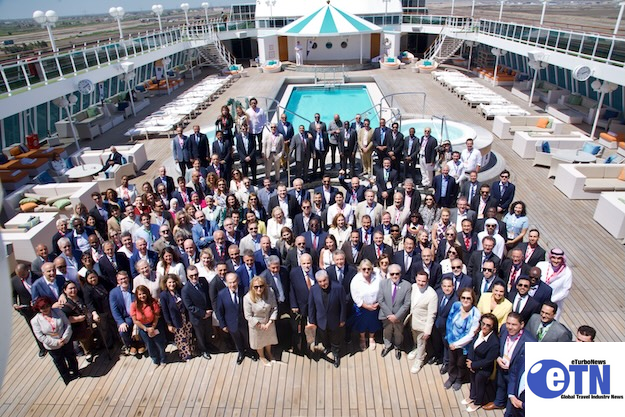
With more than 300 senior executives, government ministers, investors, and tourism innovators gathered onboard, the message is unmistakable: when the world becomes noisy, fragmented, and distracted, the most productive place to convene may be at sea.
The concept is deceptively simple. Put decision-makers together in an environment free from interruption, airport chaos, political distractions, and the endless fragmentation of modern conferences. A cruise guarantees what every global organizer craves but rarely achieves — total commitment.
“On land, people disappear between meetings,” one executive attending the cruise remarked privately. “Onboard, conversations continue at breakfast, on deck, during excursions, and late into the evening. The connectivity between leaders becomes exponentially stronger.”
World Travel & Tourism Council
The World Travel & Tourism Council (WTTC) represents the Travel & Tourism sector globally.
For WTTC, the strategy is both symbolic and practical. The organization is not merely discussing resilience; it is staging it in real time.
At a moment when international instability has caused many corporations and governments to retreat into caution, WTTC has instead moved decisively toward confidence. Choosing Egypt — a country that has largely remained isolated from the direct shocks of today’s geopolitical crises — reflects a carefully calibrated understanding of global sentiment and risk management.
And few places could have better embody resilience than modern Egypt itself.
Under the leadership of President Abdel Fattah El-Sisi, Egypt has transformed itself into one of the most dynamic tourism success stories of the decade. The country’s Travel & Tourism sector contributed an impressive US$34.4 billion to the economy in 2025, while welcoming nearly 19 million international visitors.
Tourism revenues have surged dramatically, climbing from just US$4.9 billion in 2020/21 to more than US$18 billion in 2025 — a recovery trajectory that many destinations around the world are still struggling to replicate.
WTTC President & CEO Gloria Guevara described Egypt as “a great example of resilience in the Travel & Tourism sector,” praising both the nation’s leadership and its ambitious long-term vision.
Indeed, Egypt’s investments are staggering in scale.
The country is doubling hotel capacity from 240,000 rooms, expanding aviation infrastructure across 27 airports, and investing heavily in high-speed rail connectivity designed to reshape how travelers move throughout the country. Alongside these infrastructure developments, Egypt continues to capitalize on one of the world’s richest cultural inheritances.
The recently opened Grand Egyptian Museum near Cairo has already become one of the most anticipated cultural attractions on Earth. Housing more than 100,000 artifacts — including 20,000 displayed publicly for the first time — the museum represents not only a celebration of ancient civilization but also a statement about Egypt’s modern ambitions.
Few countries can offer such an extraordinary blend of historical prestige, coastal tourism, luxury travel, archaeological discovery, and large-scale infrastructure expansion simultaneously.
WTTC’s decision to bring global leaders directly into this environment is a calculated move designed to inspire confidence across the industry.
And confidence is precisely what the global travel economy needs.
According to WTTC’s latest research, Travel & Tourism contributed US$11.6 trillion to global GDP in 2025, accounting for nearly 10% of the world economy and supporting 366 million jobs — roughly one in every nine jobs worldwide.
Yet despite this enormous economic footprint, the industry continues to face mounting challenges: geopolitical volatility, inflationary pressure, air capacity shortages, climate concerns, changing traveler behavior, and intensifying competition between destinations.
Rather than avoiding these realities, WTTC has positioned itself as the organization most willing to confront them directly.
The Leadership Cruise is designed not as a ceremonial showcase, but as a working summit focused on practical collaboration between governments and the private sector. Ministers and CEOs onboard are expected to discuss tourism expansion strategies, destination resilience, infrastructure modernization, sustainability goals, and long-term recovery planning.
This is where WTTC increasingly distinguishes itself from many traditional international organizations. While others remain focused on speeches and declarations, WTTC has become more operational, more agile, and more business-oriented in its approach to global tourism leadership.
Under Chairman Manfredi Lefebvre, the organization has also embraced a more experiential style of engagement — one that reflects the changing nature of global business itself.
“It is an honor to host the first ever WTTC Leadership Cruise onboard the beautiful Crystal Serenity,” Lefebvre said. “Over 300 leaders from our sector have gathered to experience the best of Egypt alongside positive and constructive discussion about the resilience and recovery taking place in the Travel & Tourism sector.”
That combination — strategic dialogue paired with immersive destination experience — may prove to be one of the most influential innovations in the meetings and incentives industry in years.
For decades, corporate summits have relied on predictable formulas: convention centers, panel discussions, hotel receptions. But today’s global executives increasingly seek environments that foster deeper engagement, stronger relationships, and uninterrupted collaboration.
The cruise format delivers all three.
It also solves one of the modern business world’s biggest challenges: attention scarcity.
In an age of constant digital interruption, executives rarely remain fully present. A leadership cruise changes that equation entirely. Delegates cannot rush off to competing appointments across town. They cannot disappear into sprawling cities between sessions. Instead, conversations evolve organically over several days, often producing stronger partnerships and more candid exchanges than traditional conferences ever allow.
Industry analysts say the WTTC model could reshape the future of high-level international gatherings, particularly for sectors requiring intense public-private cooperation.
And perhaps that is the most powerful message emerging from the Suez Canal this week.
At a time when many global industries remain reactive, cautious, and fragmented, WTTC is projecting something increasingly rare: decisive optimism.
Not naive optimism. Strategic optimism.
By bringing the world’s tourism leaders together in one of the most historically significant waterways on Earth — aboard a vessel symbolizing movement, connection, and global commerce — WTTC is making a broader statement about the future of international travel itself.
The industry will not simply recover. It intends to lead.