PORT SAID, Egypt – WTTC’s Egyptian Leadership Cruise may have become the unlikely diplomatic bridge positioning the United States back at the center of international tourism influence amid rising geopolitical tensions.
As the sun rose over the Nile and luxury river vessels carried government officials, tourism executives, former heads of state, and investors through one of the world’s oldest civilizations, a different kind of summit was quietly unfolding.
There were no formal treaty signings. No military alliances. No trade-war declarations.
Yet beneath the ceremonial receptions, strategic conversations, and carefully choreographed diplomacy, the World Travel & Tourism Council’s Leadership Cruise in Egypt may have achieved something far larger than a tourism gathering.
It positioned tourism itself as a geopolitical at a time when the world is increasingly fractured by conflict, economic nationalism, border stabilizes, and diplomatic uncertainty.
And at the center of that recalibration stood the United States.
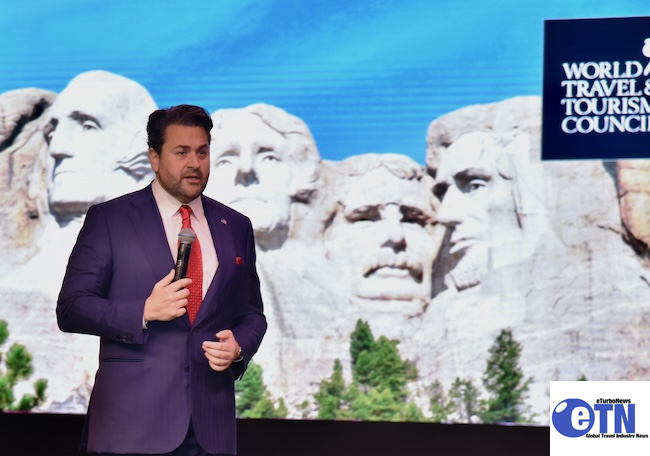
More specifically, the first US Special Presidential Envoy for Tourism, His Excellency Ambassador Nick Adams, who chose the WTTC platform for his first major international public address since assuming office.
That decision sent a message across the global tourism industry.
If Washington wanted to reassert leadership in international tourism diplomacy, WTTC was becoming the bridge.
A New American Tourism Doctrine
For decades, the United States dominated the tourism economy while largely avoiding formal leadership structures in global tourism governance.
World Travel & Tourism Council
The World Travel & Tourism Council (WTTC) represents the Travel & Tourism sector globally.
America remained the world’s largest Travel & Tourism market, generating $2.63 trillion in Travel & Tourism GDP, but tourism itself was rarely elevated to the level of strategic diplomacy.
The creation of the US Special Presidential Envoy for Tourism role changes that equation.
The position reflects a growing recognition in Washington that tourism is no longer simply a leisure sector. It now intersects directly with economic resilience, labor markets, infrastructure investment, aviation policy, border management, soft power, sustainability, and international competitiveness.
By appearing at WTTC’s Egyptian leadership gathering, Adams signaled that the United States intends to play a more visible and coordinated role in shaping the future of global tourism.
His keynote, titled “Shaping the Next Phase of Travel,” focused on international cooperation, investment, destination competitiveness, and stronger public-private alignment.
But the broader implications extend well beyond industry messaging.
At a time when geopolitical tensions continue to strain traditional diplomacy, tourism may be emerging as one of the few sectors still capable of bringing governments, multinational corporations, and regional blocs into constructive conversation. WTTC appears determined to occupy that space.
Why Egypt Became the Perfect Stage
Egypt’s role in the story was far from symbolic.
Situated at the crossroads of Africa, the Middle East, Europe, and Asia, Egypt has increasingly positioned itself as both a tourism powerhouse and a geopolitical connector.
Hosting the WTTC Leadership Cruise on the Nile transformed the gathering into more than a conference. It became a moving diplomatic platform.
Participants discussed recovery, resilience, investment, infrastructure, workforce development, sustainability, and regional growth while traveling through one of the world’s most historically powerful trade and cultural corridors.
The setting reinforces WTTC’s central argument: tourism has the ability to transcend political divides because it depends fundamentally on mobility, openness, and international cooperation.
Trump Tourism: Join the Fight | Trump Tourism
Travel from and to the United States and the industry behind has changed under US President Donald Trump. There are new challenges, expectations, and regulations.
In an era defined by global fragmentation, that argument carries increasing strategic weight.
WTTC’s Expanding Global Influence
Historically viewed as the private sector voice of global tourism, WTTC now appears to be evolving into something far more influential.
The organization increasingly functions as a convening platform where governments and industry leaders can align around long-term economic priorities even as political relations between nations become more volatile.
That role has become especially important as tourism moves beyond pandemic recovery into what industry leaders describe as a transformational phase.
The sector today contributes $11.6 trillion to global GDP and supports 366 million jobs worldwide.
Those numbers have elevated tourism from an auxiliary industry into a strategic pillar of economic policy.
Gloria Guevara, President & CEO of WTTC, framed the significance of America’s deeper engagement in unequivocal terms.
“We were delighted to welcome His Excellency Nick Adams for his first major international address in his new role.
The United States’ creation of this position sends a powerful message: Travel & Tourism matters. As a sector contributing $11.6 trillion to global GDP, supporting 366 million jobs, and accounting for nearly one in ten dollars worldwide, its importance has never been clearer. This bold step by the US demonstrates real leadership – elevating Travel & Tourism as a strategic priority for growth, investment, and international cooperation.”
Her remarks reflected a growing industry belief that tourism must now be treated as an integrated component of national economic strategy rather than a secondary commercial activity.
The Strategic Importance of Nick Adams’ Appearance
Adams’ participation also carried unusual diplomatic significance because it linked three major developments simultaneously:
• America’s hosting of the G20
• The FIFA World Cup and America 250 celebrations
• The emergence of tourism as a formal policy instrument within the US government
The convergence of those events suggests that the United States sees the coming years as a defining opportunity to reshape its international tourism image while accelerating investment and job creation.
Adams made those ambitions explicit during the gathering.
“I’m pleased to see a new relationship develop between the United States and the World Travel & Tourism Council.
America is the number one tourism market in the world, and my aim is to drive more growth, jobs and national pride across the sector. Personally, I think that by working together, public and private sector focused on the same goals, we can reach 100 million visitors to America per year by 2030, starting with welcoming millions of people to the FIFA World Cup and America 250 celebrations this summer.
“With the United States also hosting the G20 this year, we have every opportunity to create more investment and hundreds of thousands of new jobs, as well as build an even stronger reputation for warmly welcoming visitors to our great country.”
Industry observers noted that the language represented more than standard tourism promotion.
The emphasis on national pride, investment, competitiveness, and global coordination suggested tourism is being reframed inside Washington as part of America’s broader international positioning.
Beyond Recovery: Tourism as Geopolitical Infrastructure
WTTC leaders repeatedly emphasized that the global sector is now moving “beyond recovery.” That phrase carries deeper implications than it initially appears. Recovery implies rebuilding what was lost during the pandemic.
Transformation implies creating an entirely new operating framework. The Nile Cruise demonstrated how that framework may increasingly function.
Governments provide policy direction. Private sector leaders provide investment and operational scale.
International organizations like WTTC provide neutral convening power.= Together, they create a form of economic diplomacy capable of operating even when traditional political relationships become strained.
WTTC Chairman Manfredi Lefebvre underscored that dynamic during the event.
“At a time when public-private collaboration has never been more critical, His Excellency Adams brought energy, conviction, and a clear strategic vision for the future of Travel & Tourism. His presence reinforced the importance of strong global coordination and decisive leadership as the sector moves beyond recovery and into a new era defined by resilience, competitiveness, and sustained, long-term growth.
This level of commitment from the United States sends a powerful signal to the world – demonstrating a renewed commitment to partnership, progress, and the continued strength of our global sector.”
His remarks highlighted the broader strategic reality emerging across the industry.
As geopolitical tensions intensify globally, tourism organizations are increasingly being asked to perform roles once reserved for formal diplomatic institutions.
The Success of the WTTC Nile Cruise
Measured conventionally, the WTTC Leadership Cruise succeeded because it generated visibility, convened influential stakeholders, and reinforced confidence in tourism recovery across the Middle East and beyond.
But its deeper success may lie elsewhere. The gathering successfully accomplished three strategic objectives.
- First, it repositioned WTTC as the premier international bridge between governments and the private sector.
- Second, it brought the United States directly back into global tourism leadership conversations at a moment of increasing international competition.
- Third, it demonstrated that tourism remains one of the few global industries capable of fostering constructive collaboration across political, regional, and ideological divisions.
That may ultimately prove the most important outcome.
In an increasingly polarized world, tourism depends on movement, openness, connectivity, and mutual economic benefit.
Those principles make the sector uniquely positioned to sustain forms of international cooperation that are becoming harder to achieve elsewhere.
The Nile Cruise was therefore more than an executive retreat. It was a demonstration of tourism diplomacy in action.
And for the United States, it marked the beginning of what could become a far more ambitious effort to reclaim leadership at the global tourism table. WTTC simply provided the bridge. But in Egypt this week, that bridge appeared stronger than ever.