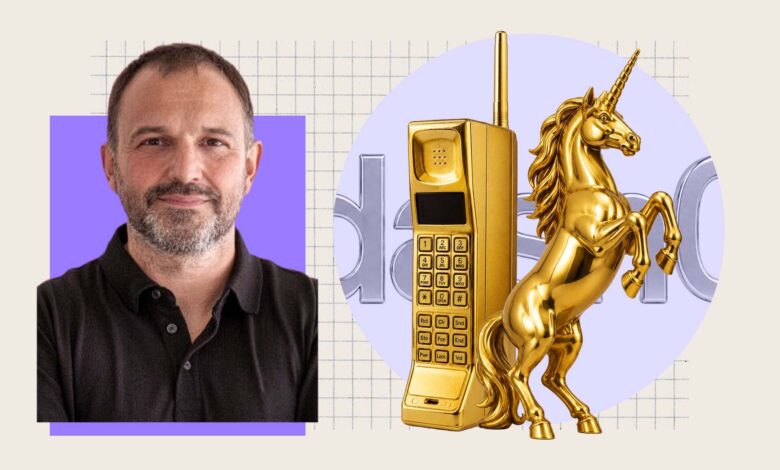
Three startups, three successes: Dash0 CEO and unicorn founder Mirko Novakovic reveals why hard work is more important than a brilliant idea – and why founders should pick up the phone instead of email.

Three start-ups, three successful companies: Mirko Novakovic is one of the most successful serial founders in Germany. After founding the IT service provider Codecentric in 2005, he started his second company in 2015: Instana. The startup developed software for monitoring modern cloud applications and was sold to IBM in 2020 for around $500 million – one of the largest German startup exits in recent years.
Actually, says Mirko Novakovic in an interview with Gründerszene, it should be over after that. “After that, I decided I’d never do anything again. But that’s pretty boring too.” So nothing came of the break.
Together with Ben Blackmore, Miel Donkers, Marcel Birkner and Michele Mancioppi, Novakovic founded Dash0 in 2023. The startup is developing an AI-powered observability platform that helps developers and IT teams detect and fix errors in applications faster. The technical basis is the open source standard OpenTelemetry, which brings together data from different systems. At the center of the platform is an AI agent that analyzes abnormalities and supports users in troubleshooting in real time.

In March 2026, Dash0 raised $110 million and became a unicorn. At the founder scene startup camp “Founder scene is looking for the super founders”, Mirko Novakovic talked about what is behind his success, what lessons he has learned from 20 years as a serial founder – and why the telephone, of all things, is one of the most important sales tools for him. Dash0 is also a partner of our Gründerszene Fellowship.
“Startup scene is looking for super founders” is a ten-week startup fellowship from Gründerszene. Eight selected fellows develop consumer startups in Berlin using artificial intelligence – from the idea to the first product. During the program, the fellows work together in the Axel Springer high-rise and are accompanied by experienced entrepreneurs, investors and experts. Partners like OpenAI, Vercel, Dash0 and DHL support them with technology, know-how and mentoring. Gründerszene documents the entire journey with articles, videos and social media content – and shows up close how the next generation of startups is being created today. All resulting products belong to Axel Springer.
What lies behind his success
What particularly interested the fellows was the question: What is his recipe for success? “So I always say, you have to work hard.” Actually clear…right? “It’s not that clear to most people. I’ve heard it so many times, but very few people actually do it. You have to do the basics and repeat them over and over again.”
But what does Mirko Novakovic mean by the “basics”? For him, this primarily includes visibility, discipline and the willingness to actively seek opportunities. He gives an example: “This year alone I flew 88 times. If you take 88 flights and go through life a little openly, then you will meet people, CEOs or other founders, and you can expand your network. Of course, there is always some luck involved, but you can only be lucky if you take 88 flights. If you only take one flight, then you probably won’t meet anyone by chance at the baggage carousel.”
That’s why Novakovic is constantly on the go, attending meetups, conferences and customers on site. He is convinced that this is exactly where new partnerships, new customers are acquired and business ideas emerge. A strong network is not an end in itself, but the result of continuous work. The serial founder sees personal exchange as an integral part of building a company.
Read too

Novakovic plans his working day accordingly. The Dash0 CEO uses every free minute for appointments: “I’m actually completely booked – and now I’m just making breakfast appointments.” For him this is not stress, but part of the way he works. On the contrary: “I also get angry if I am not fully booked for a day.”
Being on the move is essential if you want to sell your product. “But I also know a lot of founders who think they can sell from the office. That doesn’t work. The basics are person to person in the B2B environment. Companies are built brick by brick.”
You can no longer win customers via email
For Mirko Novakovic, the telephone is still a central tool in sales. His team has found that traditional emails are less and less likely to attract the attention of potential customers.
For him, cold calls are not only a means of acquiring customers, but also an important tool for further developing the product. The aim of the discussions is to find out as much as possible about the needs of potential users: What problems do they want to solve? What features are they missing? And what solution would you like? Instead of approaching decision-makers directly, Novakovic recommends a bottom-up approach. First, founders should talk to the operational employees – i.e. the people who will later work with the product on a daily basis. This is where the most valuable insights into processes and problems can be gained.
Stick with it instead of giving up
For many founders, sales fails due to perseverance. Novakovic points to a number of touchpoints: “You have to try 16 times and most people stop after 5 times. And that’s the problem.”
If you want to win customers, you have to follow up consistently. Especially in B2B sales, personal approach, regular follow-ups and the willingness to continually adapt your approach to the target group are crucial.
Novakovic also tries to allay the fear of shy founders who are afraid of cold calls. “Everyone is a little bit afraid.” His message: In the worst case scenario, the other person hangs up – nothing more will happen.
You should therefore not take failed calls personally. It’s better to tick it off, laugh about it and start the next attempt. It is also helpful to make cold calls together as a team. This way everyone gets a basket, and at the same time we can learn from each other and improve each other.
Read too

This is how the cold call works
For Novakovic, a cold call is not a sales pitch, but rather the door opener for the actual exchange. His most important rules:
- Go into the interview well prepared. He recommends finding out about the company, current projects or initiatives in advance. If you already understand what the potential customer is dealing with, you can ask more targeted questions and argue more relevantly.
- Be friendly but firm. A confident, respectful demeanor increases the chance that the conversation will continue.
- Keep it short. A cold call should ideally last no longer than one to one and a half minutes. It’s not about fully explaining the product.
- Pursue a clear goal. The actual goal of the call is not the conclusion, but rather a personal appointment or a more detailed follow-up conversation.
“Start-up scene is looking for super founders” is supported by Dash0, DHL, OpenAI & Vercel.
Read too