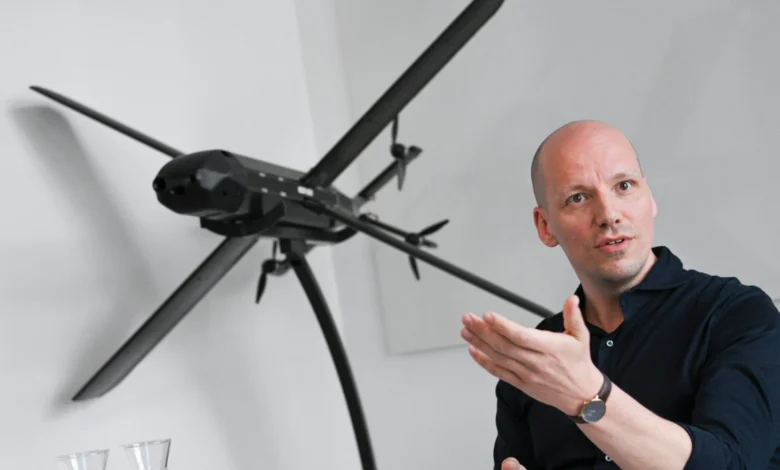
A US drone fails during a US military test against Russian jammers. The drone from the Munich startup Helsing, on the other hand, almost always hits.

One drone after another buzzes over the Pabradė military training area in Lithuania, just a few kilometers from the border with Belarus – many crash over the area, only a few directly hit the training targets. In mid-May, American electronic combat units rehearsed the defense against autonomous robot aircraft during the “Flytrap 5” exercise and flooded the frequency spectrum with jamming signals. They simulate the high-tech battlefield of Ukraine, where many Western precision weapons fail due to Russian jamming.
US troops are testing around 200 drones together with drone experts from Great Britain. Of all things, a product from a German manufacturer proved to be particularly resistant to the disruptive attacks, according to statements made by US officers involved.
Helsing convinces in the drone text
During the tests, the HX-2 attack drone from the Munich-based AI arms startup Helsing proved to be accurate despite electronic interference. When asked, the company confirmed: In 15 of 17 flights, the autonomous “kamikaze drone” hit the target in “Flytrap 5”. What’s more: Since a reconnaissance drone from a US manufacturer failed in the test due to electronic interference, the US soldiers improvised and also used the HX-2 to search for targets.

“Originally, the HX-2 was used as a one-way attack system,” Alex Miller, US Army CTO and adviser to the US Joint Chiefs of Staff, told US news site Axios. “However, our users reported that they also used the HX-2 as a reconnaissance platform because of its ability to acquire and track targets using AI, even under jamming conditions.”
Read too

What European drone manufacturers have ahead of the USA
The fact that US armed forces are now relying on European technology for autonomous systems breaks with the traditional market structure. So far, the procurement of flying military equipment between Europe and the USA has been more of a one-way street; European states import almost exclusively from the USA. But in the area of unmanned systems, the market could develop in favor of the Europeans. Various European arms startups cooperate closely with the Ukrainian armed forces. European planes are already constantly using them under real conditions against Russian electronic jamming devices, forcing manufacturers to implement extremely short innovation cycles.
At the ILA aviation trade fair in Berlin, several representatives of manufacturers, who wished to remain anonymous, reported how the Ukrainians promote innovation and that they purchase weapons in a completely different way than the cumbersome NATO procurement offices. The condition is always: exchange of data from the battlefield, of digital combat experience, for technology transfers.
Western European startups must get involved in Ukraine and work with Ukrainian companies. In return, they can try out their innovations directly on the front lines. The rhythm of software updates has now shrunk to two weeks, a startup developer told Gründerszene.
Fully autonomous systems without radio connection
The results of this forced technical evolution are directly visible at the trade fair: Helsing is showing the HX-2, which was successful in Lithuania and whose series model is now in regular use in Ukraine. Last year, the drone from Munich and its predecessor, the HF-1, came under criticism. Ukrainian soldiers complained that the first prototypes of the planes did not live up to the manufacturer’s promises. In the meantime, says Helsing, the software has been significantly further developed under the pressure of front-line operations, and the series version of the aircraft is one of the most successful disposable drones at the front.
Read too

Helsing and the electronics specialist Hensoldt showed the autonomous jet drone “CA-1 Electronic Attack”. The plane is much larger than a disposable drone and is intended to fly ahead of manned fighter jets in the future and block anti-aircraft defenses with jammers. Western radio technology has been adapted thanks to data from the Ukrainian war, and defense companies now know the methods and frequencies of Russian electronic warfare.
Since Russia has now flexibly expanded the jammed spectrum from the usual radio bands up to 18 gigahertz, manufacturers are switching to fully autonomous AI-controlled systems that continue to pursue their mission if the radio connection to the base is disrupted.
This interceptor drone from Quantum Systems is designed to stop Shaheds
The German defense startup Quantum Systems also showed drones at the ILA that emerged directly from experiences in Ukraine: In response to the Russian Shahed long-range drones, the Munich-based drone manufacturer has added the very compact and fast interceptor drone “Strila” to its portfolio. The plane is significantly cheaper than a conventional anti-aircraft guided missile and was developed by the Ukrainian start-up WIY-Drones.

The vertical interceptor drone reaches a top speed of over 400 kilometers per hour and flies up to 6,000 meters high. The hunting drone, which weighs just over five kilograms, has a maximum range of 34 kilometers. Quantum Systems now wants to take over industrial production and build 15,000 units for Ukraine. The interceptor drone was also a star of the trade fair in view of Iran’s attacks on the Gulf states with Shahed aircraft.
In order to bring the “Strila” as close as possible to the opposing Shaheds in the future, Quantum Systems has also developed the Pulse P19. The propeller plane is somewhat reminiscent of a fighter plane from the Second World War; it flies much faster and more dynamically than the well-known armed US drones of the “Reaper” type. In the future, it will hunt for Shahed drones autonomously and for hours on end, with a range of up to 2,200 kilometers. At the ILA exhibition stand, a model of the aircraft carried 18 Strila interceptor drones under the wings at two of six weapon stations; according to the manufacturer, significantly more would be conceivable.
Read too

Airbus relies on unmanned attack helicopters
The third star of the trade fair was the “U760 Ravenstorm” from Airbus Defense and Space. The unmanned combat aircraft is designed as a heavy support jet (“loyal wingman”) for manned jets such as the Eurofighter. It will operate autonomously in the future and is designed flexibly for attacks in the air, on the ground and for electronic warfare.

Airbus is thus reorganizing its entire military portfolio and introducing its own “U” designation for unmanned aircraft. Together with Quantum Systems, Airbus also showed a large transport drone based on the H145 light helicopter.

It is already in use by the Bundeswehr as a combat helicopter. Airbus has now removed the entire cockpit of the U145, but the helicopter can now be opened from the front and loaded with a pallet system. The U145 at the trade fair again carried the Strila interceptor drones from the Quantum Systems portfolio on stubby wings.
Read too

The aim is “so that crews can effectively control the airspace against unmanned threats,” says Stefan Thomé, Executive Vice President Programs at Airbus Helicopters. Because currently manned helicopters over Ukraine are more likely to be flying targets for drones. The light interceptor drones on board as a means of defense could become standard equipment for all aircraft over the battlefields of the future.