
If you want money from VCs, you have to deliver. Long days, short nights, quick decisions, constant pressure: In the startup world, this is almost de rigueur. But what does it actually look like on the other side of the table?
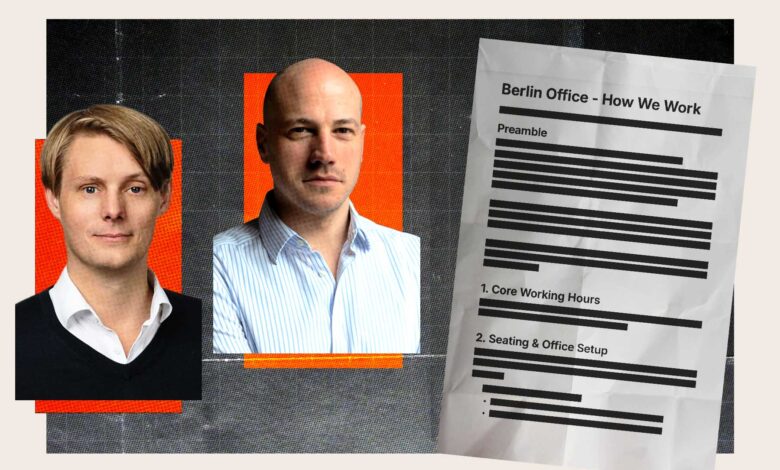
An internal document from the Berlin office of early-stage investor Antler provides a rare insight into this. The paper is titled “Berlin Office – How We Work” and describes on several pages how the team wants to work together. It’s about working hours, home office, illness and working with founders. It is written there that this document is intended to serve as a guideline for all new employees.
What does Antler partner Klink say about this?
Particularly noticeable: core working hours from 9:00 a.m. to 7:30 p.m., home office only in exceptional cases and an internal traffic light system for sick reports. Several employees confirmed to Gründerszene that the document was authentic and up-to-date.
However, Antler rejects the claim that these are official or binding requirements. The paper was created from notes from a meeting between three team members, was freely editable and simply recorded how the team wanted to work together. It was a “living document” that no longer exists in this form.
Nevertheless, the paper shows in detail what expectations at least parts of the team had formulated for their everyday work.
Core working hours: 9:00 a.m. to 7:30 p.m
The first point in the document concerns working hours. “Core hours in the office: 9:00 a.m. – 7:30 p.m.” It says: “During this time we try to overlap in time. The work often extends beyond these times.”
For Pascal Croset, such a formulation is problematic. The specialist lawyer for labor law has been advising employers, employees and managers for more than 20 years. “This working time massively exceeds the Working Hours Act. Even if employees agreed, it would be illegal,” says Croset to Gründerszene. Working hours from 9:00 a.m. to 7:30 p.m. are legally problematic even with the express consent of the employees.

Antler sees it differently. “The time windows mentioned describe when the team wants to be in the office together if possible. This is gross, i.e. minus breaks, personal appointments described, etc.,” says Antler partner Christoph Klink when asked by Gründerszene.
Sometimes work – mostly remotely – also takes place at other times of the day. As far as he knows, the working hours are “always within the legal requirements”. We therefore do not share the employment lawyer’s assessment.
As close as possible to the founders
Why does Antler care so much about presence anyway? The investor’s residency program provides an answer. Founders can start at Antler without an existing team or even without a specific business idea. Within a few weeks they should find co-founders, validate their idea and develop an initial prototype.
In the end, an investment committee decides whether Antler invests. During this phase, Antler employees should share as much time as possible with the founders, according to the document. “Team members should spend up to 50 percent of their time with the founders,” it says. The goal: create proximity, help faster and send a visible signal to the founders.

It also becomes clear how strongly the document is geared towards personal collaboration. If a residency program is not currently running, the work should, if possible, take place in a shared team room. If possible, meetings should be held in other rooms to enable concentrated work. The door to the team room should always remain open.
These are details that seem banal at first glance. Together, however, they paint a pretty clear picture: Antler sees presence not as a necessary evil, but as part of the culture. As in many other companies.
Home office only in exceptional cases
This attitude is particularly clear when it comes to home offices. “We are generally in the office in order to spend as much time as a team with each other and with the founders,” the document says.
Home office is generally not planned during the residency phase. Exceptions only apply for unavoidable reasons such as illness or “a burst water pipe at home,” as the document states.
Outside of this phase, a maximum of two home office days per month are possible. And even these, according to the document, can only be taken on Fridays. Another passage is particularly interesting: “Private weekend trips take place before or after working hours or require free time.”
If you work remotely on Fridays, you should not use the day to travel to the weekend. The only exception applies during the so-called “quiet season” between mid-July and mid-August. According to the document, extended remote working is also possible during this time, sometimes even from a different location.
In addition: Camera always on during calls, except for 1:1 conversations, travel or illness. Home office days would also have to be entered in the calendar in advance and communicated to the team.
Antler defends the strong culture of presence. “We enjoy and consciously work personally with founders on site. We invite them to our office to work closely and intensively together,” says Klink. This is exactly what the founders value and regularly emphasize in a positive way. “We are a small team of a handful of people. Spending time together on site makes an enormous difference and motivates us as investors and founders.”
Personal commitments? Yes, but only certain ones
However, the document also provides for exceptions. “There is scope to accommodate personal limitations that are important and difficult to circumvent,” it says.
As an example, the paper cites a fixed sports course that only takes place at a certain time and can therefore lead to a later arrival at the office. The situation is different with activities that can be planned flexibly. A general visit to the gym should take place outside of core working hours. The basic idea of the document is also evident here: personal appointments are possible as long as they do not permanently conflict with shared office hours.
The traffic light system for illness
Another chapter of the document is particularly unusual: under the heading Illness, Antler describes a traffic light system.
Anyone who only has mild symptoms such as a runny nose or a dry throat should continue to come to the office and pay attention to hygiene and distance. Anyone who coughs more heavily or feels exhausted should work from home and reassess their own situation every day. Only if you have a fever or flu-like symptoms is the recommendation clear: stay at home.
This is also problematic for labor lawyer Croset. “The whole system with sick, half sick and not really sick is of course illegal and already clearly regulated by the law. If employees are sick, then they are sick,” he says. Ultimately, whether someone is fit to work or not cannot be decided by an internal traffic light system.
Antler rejects the criticism. “The guideline arose from the question of the pandemic – which mild symptoms require isolation,” says Klink. “It is absolutely clear that you don’t work while sick, that you take it easy when in doubt, that you stay at home and that you take others into consideration.”
“Totally unusual”
What particularly surprises Croset is that such rules are even written down. This is “totally unusual,” says the specialist lawyer.
In his opinion, such a document could even have consequences under labor law. If there were disputes about overtime, employees could use the paper as evidence that overtime was structurally expected in the company.
Antler also rejects this assessment and emphasizes that he is of course working within the legal requirements.
One thing is certain: the document provides a rare insight into the working culture of one of Europe’s largest early-stage investors. And it shows how closely some VCs understand working with founders – even if this could occasionally lead to conflicts with employment law issues. But some deaths you have to die for success.