If you’re planning a trip through Germany and haven’t heard much about Koblenz, let this be your sign to add it to the itinerary. Tucked into the heart of the Rhineland-Palatinate region at the dramatic confluence of the Rhine and Moselle Rivers, Koblenz is one of those places that quietly punches well above its weight.
Koblenz may not have the name recognition of Germany’s biggest cities, but that’s part of its appeal. Whether you’re looking for a quick day trip or an overnight stop on a longer Germany adventure, Koblenz delivers history, scenery, and charm in a compact, walkable package.
Koblenz ranks among Germany’s oldest cities and bursts with sights from the past 2,000 years. It’s the kind of place that rewards the traveler who veers off the beaten path. You’ll experience centuries of history, staggering natural scenery, and a laid-back charm that’s all its own. Whether you have one day or three, Koblenz earns its place on any Germany itinerary.


How to Get to Koblenz
Getting to Koblenz is straightforward. The city is well connected by rail and sits roughly midway between Frankfurt and Cologne, making it an obvious pitstop for anyone traveling between the two mega cities. Regional trains run frequently, tickets are affordable, and booking through Deutsche Bahn is pretty simple.
Insider tip: aim to disembark at Koblenz Stadtmitte rather than the main main station. The Stadtmitte station drops you just a little closer to the Old Town action, which is a nice head start if you’re working with a single day.
If you’re traveling by car, parking garages are available, but honestly, the car won’t do you much good once you’re in Koblenz. The historic center is a pedestrian zone, so your feet will be your best mode of transport. And if you happen to be taking a Rhine River cruise, there’s a good chance Koblenz is already on your route. It’s one of the most popular stops along the river, and for good reason.

Getting Around Koblenz
The beauty of Koblenz is that almost everything you’ll want to see is within easy walking distance. The Old Town, the riverfront, the cable car station, and the major landmarks are all clustered in a small radius. Plus, the whole old town is a pedestrian zone, so you can feel safe walking around. Comfortable shoes are your most important piece of gear.
When to Visit Koblenz
Koblenz is a year-round destination, but late spring through early autumn (May–September) is the sweet spot. The weather is warm enough to enjoy the outdoor squares, the Rhine Promenade, and the terrace gardens in full glory. If you’re lucky enough to visit in early September, the Rhein in Flamme festival is an unforgettable spectacle. A convoy of illuminated boats sails the Rhine as fireworks light up the sky above the river.
How Long to Stay in Koblenz
One full day is genuinely enough to hit all the highlights of Koblenz. That said, if you want to linger or use it as a base for day trips in the area, a few nights is fine. In that case, an overnight stay opens up a lot more possibilities.

Walking Tour of Old Town
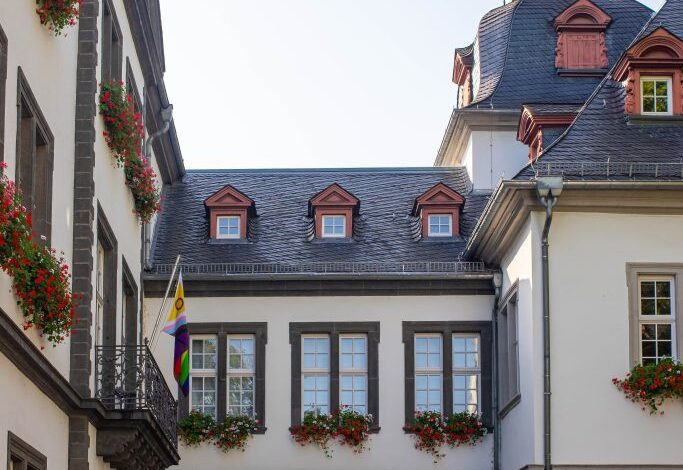
Koblenz’s Old Town was heavily damaged during World War II and was subsequently rebuilt in a distinctive style — neither fully medieval nor fully modern, but a warm and welcoming blend of both. The result is a city center that feels historic without being stuffy. Being a tour guide myself, I believe that the best way to discover the Old Town of Koblenz is a guided walking tour. You’ll be entertained with great stories and learn a few things along the way.
If walking tours aren’t your thing, here are some of the highlights to see in Koblenz:
- Romanesque Church of Our Lady
- Old Town’s six squares. Highlights are Am Plan and Jesuitenplatz
- History column is a sculptural marvel that documents the 2,000 year history of Koblenz
- Eye roller clock. Every half hour the eye-rolling clock face sticks out its tongue to mock the good citizens of Koblenz.


Koblenz Cable Car
This is the top thing to do in Koblenz, so don’t leave without riding the cable car. It’s one of the most memorable experiences the city has to offer. The gondolas glide up and over the Rhine River, offering panoramic 360° views of the Deutsches Eck, the fortress, and the sprawling river landscape below. The ride takes about 10 minutes each way and is genuinely breathtaking, particularly on a clear day.
Insider tip: To save time and money, grab a combination ticket that bundles the round-trip cable car ride with entry to Ehrenbreitstein Fortress. It costs around €19 and saves you nearly €4 compared to buying both separately. Booking online in advance is recommended, especially in peak season.

Ehrenbreitstein Fortress
Perched 188 meters above the Rhine, Ehrenbreitstein Fortress is the crown jewel of Koblenz. This strategic military outpost is perched on a high rock plateau that has been almost continually occupied since as early as the 4th century. It holds the distinction of being the second-largest preserved fortress in Europe.
The fort itself has been converted to a museum, which honestly, I found kind of boring. But what you really come up here for is the view! Once you’re standing on its ramparts gazing out over the rivers, the city, and the surrounding hills, it’s easy to understand why it was built up so high. The views alone are worth the trip. Plan on spending at least 1–2 hours up here.

German Corner
This is the reason most visitors make their way to Koblenz in the first place. The German Corner (German Corner) is the dramatic point where the Moselle River flows into the Rhine. Climb up into the base of the monument for a close-up view of where the two rivers meet. On a sunny day, you can actually see the slightly different colors of the two rivers blending together
Dominating the promontory is a towering 37-meter monument to Kaiser Wilhelm I, the emperor who unified Germany in 1871. The original statue was destroyed in World War II and stood with only a German flag for decades before being restored in 1993.


Schängel Fountain
Near the Jesuitenplatz square, keep an eye out for the Schängelbrunnen, a small fountain featuring a cheeky young boy who periodically spits water at unsuspecting passersby. This little figure is the beloved symbol of the city. The name traces back to the Napoleonic era, when Koblenz was briefly under French control and many local boys were named “Jean,” which became “Schang” in the local dialect. Today the Schängel represents the wit and spirit of Koblenz, and his likeness appears everywhere, including on the city’s manhole covers.
Basilica of Saint Castor
Just steps from the cable car entrance, the Basilica of St. Castor is Koblenz’s oldest preserved church. The current structure dates to the 12th century, although the original building was consecrated all the way back in 836 AD. During the era of the Holy Roman Empire, the basilica served as a meeting place for kings and emperors. Disputes were settled and negotiations were brokered within its walls. Take a few minutes to walk around the lush garden surrounding the church.

This region of Germany has some of the densest quantity of castles in the whole country. It would be a shame not to visit one or two castles while you’re exploring the area around Koblenz. Some of them have even been converted into hotels. You can literally sleep in a historic German castle!
Stolzenfels Castle
Stolzenfels Castle is a 13th-century fortress that was largely destroyed during the 30 Years War, but then rebuilt in the 1800s in neo-Gothic style. The castle can only be accessed on foot, and you’ll be required to park your car at the bottom of the steep hill. When I visited, the tour was only in German but there were language translation sheets for each room, offering English, French, Spanish, Chinese and Japanese translations. I especially enjoyed the quaint gardens surrounding the castle as well as the lovely views over the Rhine.


Eltz Castle
This is by far one of the most Instagrammed places in Germany. And rightly so. It’s beautiful! Eltz Castle is tucked away in a perpetually mist shrouded valley that simply screams romance. Construction of the castle dates back to the 9th century, and its relatively remote location also protected it during periods of war.
The castle has been continuously privately owned by the Etlz family, whose 33rd generation still maintain the castle today. Because one family has consistently owned the castle, you will find the rooms filled with original artifacts, like paintings, armor and furniture. Tours are offered in English and no photography is allowed during the tours.


Marksburg Castle
One of the Rhine’s most iconic silhouettes is Marksburg Castle. It also has the remarkable distinction of being the only Rhine hilltop castle to have never been destroyed. It looms dramatically above the town of Braubach, about 20 minutes south of Koblenz by train.
Cochem Castle
Known locally as Reichsburg, Cochem Castle is precariously perched 300 feet above the charming town of Cochem sitting along the banks of the Moselle River. Believed to have origins dating back to 1100, this castle has seen many iterations over its long history. King Louis XIV actually had his troops destroy the castle completely in 1689, after which it sat in ruin for almost 200 years. It wasn’t until a wealthy Berlin businessman bought the ruins that the castle was rebuilt into the splendor you see today.


Lava Dome
About 30 km north of Koblenz lies one of the most unusual natural attractions in Germany: the Lake Laacha volcanic crater lake formed by a massive eruption roughly 13,000 years ago. The surrounding landscape is dotted with volcanic rock formations, and the Lava Dome visitor center tells the geological history of the region in an engaging, accessible way. It makes for a fascinating half-day detour.
Moselle Valley
The Moselle Valley stretches west from Koblenz, and it is one of Germany’s most scenic wine regions. It is my favorite place in Germany! Steep vineyard slopes plunge down to the meandering river, and charming wine villages like Cochem, Bernkastel-Kues, and Beilstein are strung along its banks.
Rhine Valley
Heading south from Koblenz along the Rhine takes you into the Upper Middle Rhine Valley, a UNESCO World Heritage Site lined with medieval castles, vineyard terraces, and picturesque river towns. The stretch between Koblenz and Rüdesheim is considered the most dramatic section of the entire Rhine and is best explored by train, car, or boat.