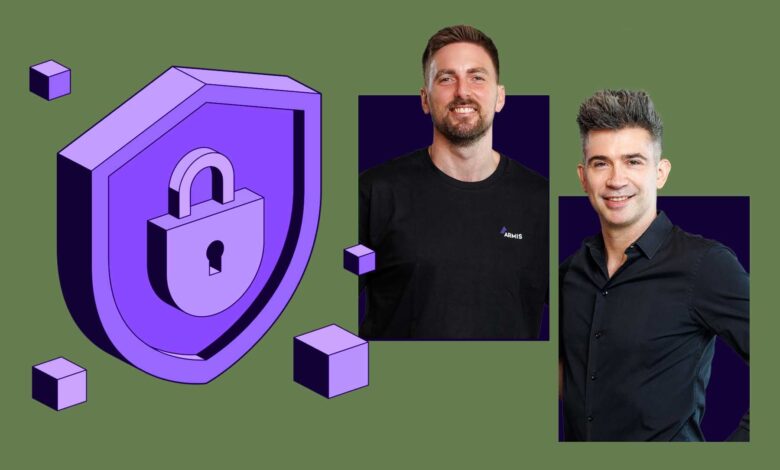
Two ex-soldiers are building a billion-dollar startup called Armis – and are using it to protect devices that no one has previously noticed.

Yevgeny Dibrov and Nadir Izrael met not in a startup incubator, but in an elite unit of the Israeli army. Years later, they build a company that solves a problem that even large corporations have long overlooked: the safety of their most important machines.
Factory robots, infusion pumps, surveillance cameras – the very devices on which entire companies depend are often poorly protected. With Armis Security, Dibrov and Izrael want to change that. It’s going so well that ServiceNow, a cloud platform for automating business and IT processes, has now acquired Armis Security for $7.75 billion.
How a military friendship turned into a billion-dollar company
During their time in the army, the two founders worked on a secret project that was awarded the Israeli Defense Prize. “That was the first moment we discovered our strengths in teamwork under extreme pressure,” says Izrael. After their military service, they met again at the Technion, Israel’s MIT, where they studied computer science together.
Read too

After graduating, Dibrov first worked at Adallom, a cloud security company that was later sold to Microsoft. While talking to potential customers here in 2015, he came up with the idea: “We sat for hours with chief security officers, IT managers and factory engineers from all industries – from tech to manufacturing to airlines,” remembers Dybrov. “We didn’t want to invent the coolest tech, we wanted to understand the biggest problem.”
The biggest gap is not in the server – but in the machine
What did he notice? Laptops and servers can be protected with antivirus software. But everything else – factory robots, infusion pumps or surveillance cameras – remained unprotected. Many CEOs are not aware of this, and these devices in particular are often very critical. “What is more important in a hospital than an infusion pump? Or in a factory than a robot arm?” say Izrael and Dibrov to Gründerszene.
This blindness in critical environments is also known to hackers. State actors from Russia, Iran, North Korea or China in particular would exploit and digitally attack important infrastructure. “Attacks on utilities, industry and airports are increasing sharply,” warns Dibrov. “And it’s worth it for hackers: these environments make money.”
Read too

Armis Security was born from these findings. The founders think they are betting on a huge market with difficult technology. The advantage: This is a far cry from what competitors from Silicon Valley could quickly copy. “We love challenges that can’t be solved with 20 developers,” says Dibrov.
The “Shazam for machines”
Armis wants to solve the problem without having to install software on every device. To do this, you first have to identify the individual weak points: “Imagine Shazam for machines,” explains Izrael. Shazam is an app that recognizes music tracks by listening.
The Armis system positions itself as an observer in the network of companies – similar to Shazam with music. It would analyze the traffic from protocols, behavior patterns and timing. These signals then create a digital imprint of each device. From this you can determine which software is running and whether it has known vulnerabilities. Anomalies, such as contacts with Russian servers, would then be checked by the system.
“Within minutes, customers see more than they ever knew,” says Izrael to Gründerszene. “Suddenly they discover devices that no one knew about before.”
Why the world situation is accelerating your business
But Armis doesn’t just stop at the diagnosis, but also becomes a therapist. The system can trace the paths that hackers would actually use. Instead of many isolated vulnerabilities, it prioritizes: “For example, we can close the three most critical vulnerabilities that would cause 80 percent of attacks.” The founders say: “The best attacks are the ones that never happen.”
The geopolitical situation has strengthened their business model: In 2017, NotPetya, a Russian cyber weapon from the Ukraine war, hit Mondelez – an early Armis customer and confectionery company. “Back then, the chief security officers still said: ‘States aren’t interested in us.’ But today they know: Everyone is a target.”