
Founder Mearg from Ethiopia lost his startup in the war – and then rebuilt everything again.

A call in the middle of the night and Mearg finds himself standing in front of his burning workshop in Tigray, Ethiopia. He sees his company, Mearg Machinery (MG), go up in flames. “I got the news that there was a fire. When I arrived it was already too late,” he says to Gründerszene.
Mearg is the founder of MG, a company that produces machines for the bakery business. The company is based in Tigray, Ethiopia – a region torn by war. Located directly on the border with Eritrea, there has been an armed border conflict in Tigray for years. This not only affects the local people, but also their companies and everyday lives.

This also applies to the Ethiopian founder Mearg, who once lost his company completely due to the war. He talks to Gründerszene about the destruction and reconstruction of his startup.
Read too

Starting a business with YouTube tutorials
Mearg is originally an economist. He worked at Ethio-Telecom, Ethiopia’s largest telecommunications provider. He also ran a small bakery with his wife. What he noticed was that the company’s machines were constantly breaking down. So he thought about how he could make them better and generally simplify his wife’s work.
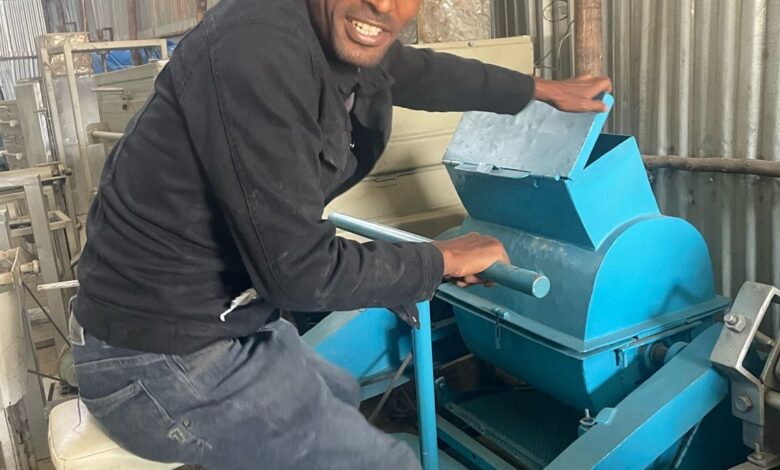
He began building his own prototypes of machines through YouTube tutorials and learning-by-doing. Including a dough mixer, a dough divider and a dough sheeter. These worked so well that the bakery grew from 4 to 19 employees. And Mearg suddenly saw the machines as their own business area: “Many bakers had this problem and there was a real market for locally built machines,” he says to Gründerszene.
Because so far there are hardly any machines in use in Ethiopian industry. Imported devices are expensive, difficult to maintain and are rarely adapted to local conditions. That’s why Mearg thought ahead and began producing machines for other producers and farmers. Because the demand was so high, he quit his job in 2017. “The hardest decision of my life – but without it MG would not have been created,” he says. During this time, his company grew to three employees who produced two to four machines per month.
Read too

The fateful night
But then the war came to Tigray – and it did not pass MG by without consequences. One night it hit his place with an attack. The entire production hall for his machines burned down, his team scattered and many employees disappeared. Mearg was left with nothing – but he didn’t give up. “We started over with almost zero staff and no security.” Because: “The company was now our family’s only source of income.”
So he borrowed tools from previous customers and continued building his machines from home – while the war raged outside. Mearg fought back. Today MG again has 14 employees who produce seven to ten machines a month. On average, each machine creates three new jobs – “in production, handling, sales,” he says.
Pragmatism as a survival strategy
Would the situation have improved today? Not really, says Mearg about the start-up scene. Although the war has calmed down, “people are hesitant to invest, financing is tight, many are leaving the region.” The reason for this is the uncertainty, which is still great. The situation in the region could escalate again at any time. Planning for the long term? Hardly possible.
Read too

That’s why Mearg tries to keep his company’s processes simple. Specifically, this means: In the event of power outages, he builds machines without electrics; in the event of delivery bottlenecks, he focuses on products with a long shelf life. “Responding quickly to local needs is our biggest advantage,” he says to Gründerszene.
A good example of this: During Covid, MG spontaneously became a soap mixer manufacturer because a customer asked if they could build machines for sanitary products.

Supporting Impacc and big goals
MG didn’t just finance itself. During the war and Covid it also received financial help from the German VC Impacc. The investor, founded by Till Wahnbaeck, collects donations for high-growth startups in Africa – with a focus on companies that create jobs and strengthen local value chains. Without Impacc, growth and stabilization would not have been possible, Mearg tells Gründerszene today.
His goal for the next five years? Mearg wants to employ more than 100 people with his work and reach markets throughout the Horn of Africa. “I want to prove that local mechanical engineering can drive sustainable growth in fragile regions.”
His journey so far has taught him one thing above all: “With the right partners, a company that has been pushed to the brink can be rebuilt, grow and create hope.”