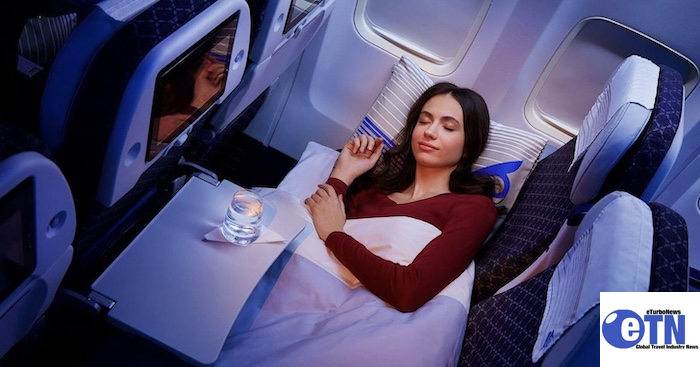
Air Astana is testing a simple but disruptive idea: turning three economy seats into a flat sleeping space. As airlines search for affordable comfort upgrades, this “economy sleeper” concept could reshape long-haul travel by offering passengers a middle ground between cramped economy and costly business class.
ASTANA, Kazakhstan — In an industry long defined by shrinking seat space and incremental upgrades, an unexpected idea is gaining attention: turning economy class into a place where passengers can actually lie down.
At the center of this shift is Air Astana, the flag carrier of Kazakhstan, whose “Economy Sleeper” product is prompting fresh debate about how airlines might rethink long-haul comfort — without the high costs of redesigning cabins.
Rather than installing new seats, the airline offers passengers the option to reserve an entire row of three economy seats, which are then converted into a flat sleeping surface with a mattress topper, pillow and blanket. The concept is simple, even improvised. But its implications could be far-reaching.
A Practical Innovation in a Cost-Constrained Industry
For decades, airlines have wrestled with a core dilemma: how to improve passenger comfort without sacrificing revenue per square meter. Fully flat beds, once a novelty, are now standard in business class — but remain prohibitively expensive to install more broadly.
Air Astana’s approach sidesteps that problem.
“It’s not a new seat,” said a European aviation analyst. “It’s a new way of selling space.”
By monetizing unused or low-demand seats — especially on routes that are not always full — the airline creates a middle ground between economy and business class. The result is a product that costs significantly less than premium cabins while offering something economy has largely lacked: the ability to sleep horizontally.
A Growing Category of “Hybrid Comfort”
Air Astana is not alone in experimenting with this middle tier.
Airlines like Air New Zealand have introduced products like the Skycouch, while European carriers, including Lufthansa, have tested “sleeper rows” on long-haul routes. Each reflects a broader shift toward modular comfort, giving passengers more control over how much space they buy.
What distinguishes Air Astana’s version is its simplicity. There is no mechanical transformation, no new seat architecture. Instead, the airline relies on soft furnishings and pricing flexibility.
That simplicity could make the model easier to replicate.
Passengers as a new market segment
The emergence of sleeper-style economy options points to a subtle but important change in how airlines think about their customers.
Traditionally, cabins have been divided into rigid classes: economy, premium economy, business and first. But products like Economy Sleeper suggest a more fluid approach, where passengers can “assemble” their experience.
For travelers unwilling to pay for business class but increasingly reluctant to endure long-haul flights upright, the appeal is clear.
“It’s not luxury,” said one frequent flyer who recently used the service on a Europe-to-Asia route. “But it’s the first time economy felt humane on an overnight flight.”
Limitations and Skepticism
Still, the model has constraints.
The sleeping surface, formed by standard economy seats, is shorter and narrower than a true lie-flat bed. Taller passengers may find it cramped, and the experience remains subject to the noise and activity of the main cabin.
There is also the question of scalability. On high-demand routes where flights routinely sell out, dedicating three seats to one passenger may not make financial sense.
And some industry observers question whether such offerings are a stopgap rather than a long-term solution.
“This works best in specific markets and aircraft types,” said the analyst. “It’s clever, but it’s not a universal answer.”
A Glimpse of Aviation’s Future?
Yet even its limitations may point to a broader truth: the future of air travel may lie less in sweeping redesigns and more in adaptable, layered products.
As airlines recover from years of disruption and face renewed pressure to differentiate, relatively low-cost innovations like sleeper rows could become more attractive. They require little capital investment, can be deployed selectively and appeal to a growing segment of comfort-conscious travelers.
Whether Air Astana has started a trend or simply refined an existing idea remains to be seen. But in an industry where meaningful change is rare and expensive, even small shifts can signal larger transformations.
For now, one thing is clear: the boundary between economy and premium travel is becoming less fixed — and passengers are being invited to redraw it.