The Fraunhofer Institute for Solar Energy Systems has set a new record for the efficiency of solar modules. Through optimized interconnection of individual solar cells, a further developed system achieves an efficiency of 34.4 percent. The shingle matrix technology used was adapted for use on Earth and originally comes from space technology.
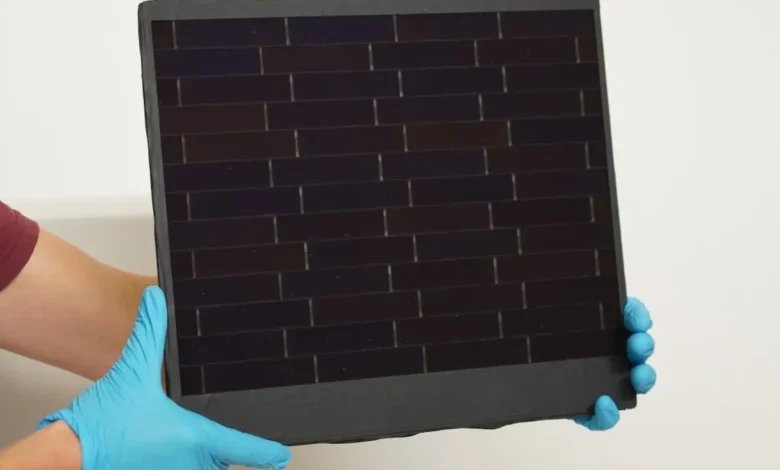
A team of researchers from the Fraunhofer Institute has developed a solar module with a total area of 833 square centimeters as part of the “Right of Way” research project. The system achieved an efficiency of 34.2 percent at the beginning of 2026. The technical basis for this is formed by triple III-V germanium cells. However, the project coordinator AZUR SPACE Solar Power further developed these special solar cells for the module.
The manufacturer adapted the triple solar cell technology optimized for space use to the terrestrial solar spectrum. This development step means that production can take place in comparable quantities. In addition, AZUR SPACE Solar Power uses the same wafer format for production as in space travel. A few months after this record, the team increased the efficiency to 34.4 percent.
34.4 instead of 34.2 percent: The most efficient solar module in the world
To achieve this increase, the research team used the so-called shingle matrix technology to connect the solar cells. The Fraunhofer Institute developed this method a few years ago together with a German partner from mechanical engineering. The process is already used in commercial modules manufactured in Germany. The approach represents a fundamental departure from the traditional construction of photovoltaic modules.
Using shingle matrix technology, the researchers cut the solar cells into narrow strips. These segments were then arranged in a shingle-like manner, overlapping and offset from one another. The individual strips are connected using electrically conductive adhesives. This architecture enables direct cell-to-cell contact.
No more copper strips: Why this increases efficiency
This eliminates the need for traditional solder-coated copper tapes throughout the module structure. By eliminating these cell connectors, active cell surfaces no longer need to be shaded. The resulting particularly high level of space utilization was a key success factor for the record efficiency achieved. In addition to the solar cells, special anti-reflective structures were used on the front glass.
The structures on the front glass were developed by the company temicon. The finished module will be presented at the Intersolar trade fair or The Smarter E im event. The institute is showing the development at its own exhibition stand called A1.440.
Also interesting: