Germany should become an AI nation. To achieve this, the federal government wants to significantly relax the environmental requirements for data centers. A new draft law postpones the obligation to use green electricity, extends transition periods and removes the obligation to use waste heat. This is not only a kowtow to Big Tech, but also a waste of resources and additional climate pollution. A commentary analysis.
The federal government wants to relax environmental regulations for data centers
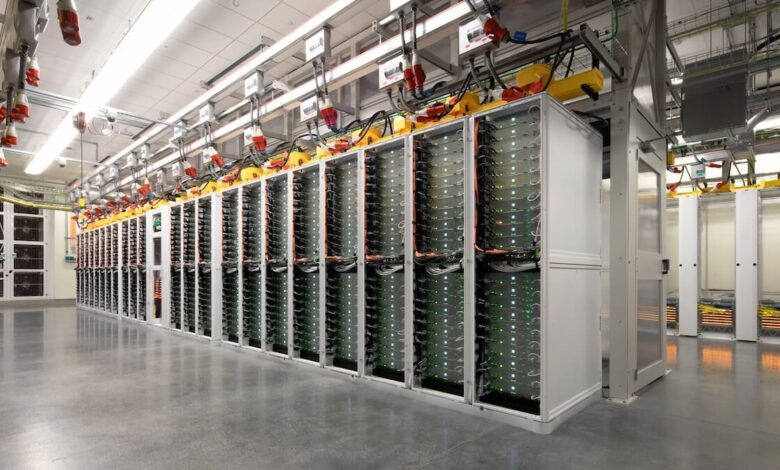
- The federal government wants to make Germany an AI nation. In order to achieve this, more data centers should be built. The plan: to quadruple AI computing capacity by 2030. The government wants this to succeed change the energy efficiency law without further ado. A draft law passed by the Federal Cabinet provides for a relaxation of environmental requirements for data centers.
- According to the draft, Data centers have three years more timein order to convert their electricity consumption to 100 percent renewable energy in their balance sheet. This means: The federal government wants to extend the previous deadline from January 1, 2027 to January 1, 2030. For data centers that have already been built, the current transition period for compliance with the efficiency requirements (PUE) is to be extended from two to four years.
- According to the plans, data center operators will no longer be required to use waste heat in the future if there is no suitable heating network on site. Especially in many rural regions where data centers are already being built, there are no corresponding networks for using waste heat. In other words: The Any heat generated by servers should simply escape there and warm the surrounding air.
A gift to Big Tech?
The federal government’s draft law does not just provide for a small adjustment. It marks a change in policy and is a nicely packaged gift to Big Tech. Because Climate protection and digitalization should no longer go hand in hand. Instead, data centers should be built as quickly as possible.
Of course, environmental regulations are slowing down expansion somewhat. But they don’t necessarily stand in his way. Instead of looking for solutions that guarantee climate protection and more speed, the federal government wants to Short-sightedly relax important and sensible rules.
Or in short: Politicians want to turn Germany into an AI nation without rhyme or reason at the expense of the already stressed climate. The topic of waste heat is particularly piquant. Because if you want to simply blow millions of kilowatt hours of heat into the air, simply wastes resources and at the same time accepts higher consumption of other resources through additional data centers under relaxed conditions.
Another sticking point: data centers have to have their own Electricity should only be covered by renewable energy sources. So on paper everything can look green if operators buy green electricity certificates. However, you do not have to prove that the electricity used on site actually comes from renewable sources.
The problem: The new draft does not close this gap. He even makes them bigger. The federal government’s motto: more data centers for whatever – regardless of the price and accepting the waste of resources additional burdens on the environment. And now someone explains to me again the social benefit under these conditions.
Voices
- Economics Minister Katherina Reiche (CDU) on the new Energy Efficiency Act: “Energy efficiency reduces costs, strengthens security of supply and increases the competitiveness of our companies. That’s why we rely on targeted rather than blanket requirements and concentrate binding requirements on particularly energy-intensive operations. (…) With practical rules for data centers, we create the conditions for digital sovereignty and economic growth. Among other things, the transition period for new data centers will be extended from two to four years.”
- Bernhard Rohleder, general manager of the digital association Bitkomin a statement: “Data centers are the basis for AI, cloud and digitalization. Without them, Germany will lose out in international competition. That’s why it is right that the amendment to the Energy Efficiency Act passed today at least partially corrects impractical requirements of the past few years and is more closely oriented towards European rules. Nevertheless, we would have liked significantly more ambition. The requirements for the energy efficiency of data centers were made worse in the course of the departmental coordination and are now no longer practical.”
- Kilian Vieth-Ditlmann, Head of Policy at the non-profit non-governmental organization AlgorithmWatchcriticizes: “The cabinet decision on the EnEfG reform is a kowtow to Big Tech – and at the worst possible time. Because the forecast expansion of ever larger data centers is gigantic. Undermining the basic rules for efficiency and transparency right now is not only absurd, but also politically short-sighted and irresponsible. Because we are cementing dependencies instead of finally overcoming them. If Reich’s anti-efficiency law is passed in this way, Google, Microsoft and Co. could lose theirs in the future Data centers that run on fossil fuels would no longer have to provide their customers with energy consumption data and would be allowed to keep elementary environmental data under wraps as business secrets. This harms both the environment and the economy.”
More data centers – but for what actually?
The planned relaxation of the Energy Efficiency Act send a fatal signal. At a time when heat waves are becoming more and more frequent and many regions are longing for every degree less, the federal government wants to accept that additional heat from data centers will increase the ambient air.
On top of that, with every new AI data center Electricity and water requirements are increasing. Since consumption will rise massively in the coming years due to the expansion alone, stricter environmental regulations would actually have been the obvious answer – not weaker ones!
In addition a fundamental question moves into the background. What should data centers actually be built for? Clearly: a digital society needs an efficient infrastructure. For research, medicine, weather models, industry and for critical IT systems such as cloud storage to ensure energy, transport and administration.
But the current boom is primarily driven by language models. That means: Although the social one The added value of chatbots in the private sector is extremely controversial the federal government wants to provide enormous amounts of energy. But feeding more electricity into AI when environmental regulations are relaxed, while the consumption of resources is enormous and at the same time there is a lack of electricity elsewhere for decarbonization, is at least a questionable exchange.
But perhaps that is exactly where the problem lies. Because the debate revolves almost exclusively around the question of how Germany can keep up in the AI race. But hardly anyone seems to ask themselves, which actually makes sense. Yes: data centers are necessary. Without them, no modern economy can function. But there is a world of difference between digital sovereignty and the automated production of AI content for every everyday application, no matter how insignificant.
Also interesting: