

Thailand’s tourism sector has no shortage of ideas—it has a shortage of connections. Drawing on six recent industry events, this commentary argues that greater collaboration among cultural, tourism, technology, wellness and community organizations could unlock innovative, low-cost solutions to strengthen the country’s tourism competitiveness and long-term resilience.
What do the Siam Society, the Association of Thai Travel Agents, the Tourism Authority of Thailand, the Thai-Muslim Trade Association, the OTOP Fair, and a TravelTech event have in common?
On the surface, very little.
Look a little deeper, however, and they have far more in common than most people realize.
Over the past two weeks, I attended six events, each of which reflected a different facet of Thai travel and tourism:
- 24 June: The annual general meeting of the Siam Society, Thailand’s pre-eminent cultural institution, of which I am a life member.
- 25-27 June: The One Tambon One Product (OTOP) Fair, Thailand’s largest biannual showcase of 100% indigenous, community-based products from every region of the country. (A tambon is a Thai subdistrict.)
- 29 June: The monthly meeting of the Association of Thai Travel Agents (ATTA), representing inbound tour operators and one of Thailand’s most influential private-sector tourism associations.
- 30 June: The launch of Thailand Health Excellencea Tourism Authority of Thailand (TAT)-supported initiative bringing together medical institutions, academic organizations and wellness providers around the campaign theme, “Healing is the New Luxury.”
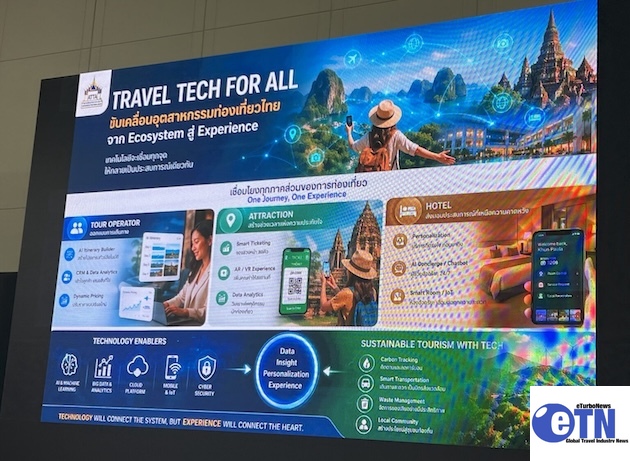
- 1–2 July: Travel & Tech Asiaorganized by VNU Asia Pacific with support from PATA, an annual gathering of TravelTech suppliers and innovators.
- July 4th: The annual general meeting of the Thai-Muslim Trade Association, a fast-growing organization representing a new generation of entrepreneurs in tourism services, halal products and related industries.
At first glance, these events appear unrelated. In reality, they are all pieces of the same puzzle.
Each showcased creativity, innovation, and commitment within its own sphere. Their real value, however, would emerge only if these ideas, networks, and capabilities were connected to help address the deep structural challenges confronting Thailand’s tourism industry.
That immediately raises a number of possibilities.

To Reinvent Thai Tourism, Remove and Reset the Communications Silos
Bangkok – What do the Siam Society, the Association of Thai Travel Agents, Tourism Authority of Thailand, Thai-Muslim Trade Association, the OTOP Fair and…
Could the Siam Society organize programs on Thai traditional medicine, one of the country’s richest cultural assets? Such initiatives could reinforce TAT’s Thailand Health Excellence campaign.
Could ATTA work with the Thai-Muslim Trade Association to improve Muslim-friendly tourism while promoting exports of Thai halal products and services? Joint research, product development, and marketing would create benefits for both organizations.
Could TravelTech companies help OTOP entrepreneurs modernize their marketing, logistics, and distribution? The commercial opportunities would be virtually limitless.
Could PATA become the convenor, bringing these diverse sectors together not only within Thailand but across the wider Asia-Pacific region?
The answer to every one of those questions is almost certainly yes.
This is the true meaning of Unity in diversity—a phrase adopted by countless countries, regions and communities, but too rarely translated into practical action.
These organizations are natural partners. Their work overlaps. Their interests intersect. Many of the problems confronting one group already have potential solutions in another.
Yet they continue to operate largely in institutional silos.
The left hand still has little idea what the right hand is doing.
Thailand has hundreds of organizations, associations and institutions contributing—directly or indirectly—to tourism. Today, tourism is no longer simply an engine of employment and economic growth. It has also become an increasingly important pillar of national resilience and security.
Every organization faces problems that another organization may already know how to solve.
The missing ingredient is communication.
As I walked through the vast halls of the OTOP Fair, listened to TravelTech presentations, followed the strategies of ATTA, and observed the priorities of the other organizations, connecting the dots became almost effortless.
Ideas flowed continuously.
The examples above represent only a small sample.
Far too much taxpayer money, time and effort continue to be spent on what I would describe as superficial “nip-and-tuck” strategies—initiatives that treat symptoms rather than underlying causes.
I am not a business management expert. But after more than four decades covering Asia-Pacific travel and tourism, I have learned that the simplest solutions often emerge from open communication, respectful listening, and the willingness to look beyond institutional boundaries.
Building stronger channels of cooperation between business and non-business sectors that are already closely interconnected would be one of the most cost-effective steps Thailand could take to help its tourism industry reinvent itself for an era of intense competition, constant disruption and growing uncertainty.
Ultimately, it is about connecting problems with solutions.
It’s about matching strengths with weaknesses.
And, above all, it is about redefining the meaning of value—not just as “Value over Volume,” but as the value of creating new thinking.