
Iran is using a newly circulated embassy statement not only to condemn U.S. and Israeli military action, but to widen the audience for its warning far beyond diplomats and legal forums. The text, published by Iranian diplomatic missions abroad under the title “Aggression Against Iran: The Collapse of International Order and a Decisive Test for the World,” argues that the attacks on Iran are not just a bilateral or regional confrontation, but evidence of a broader breakdown in the international system. An official version appeared on Iran’s diplomatic website in Thailand on March 8, 2026, and similar language has been circulated through Iranian missions overseas. (
The statement’s public argument is blunt: Washington and Israel, Tehran says, have violated Iran’s sovereignty and turned regional security and energy security into hostages. It accuses the United States of repeatedly acting outside international law, cites decades of U.S. military interventions, and says the idea of America as a “guarantor of the international order” is no longer credible. The text repeatedly insists that what is happening to Iran today could happen elsewhere tomorrow.
That line is the article’s real hinge. Read plainly, the statement is a denunciation of military action. Read strategically, it is also a pressure campaign aimed at countries that still hope to stay commercially engaged with the region while remaining politically quiet. Iran’s wording that “no country can be a safe oasis” and that the crisis could spread to “other countries around the world, particularly those at the core of the global economy” is less a narrow legal complaint than a warning to governments, airlines, insurers, investors, conference organizers, shipping firms and, by extension, tourists: neutrality will not necessarily shield you from the fallout.
The hidden tourism message is not “come to Iran,” but almost the reverse: do not assume ordinary travel, aviation, hospitality and business movement can be insulated from war. Tehran’s text links military escalation to inflation, food pressure, tariffs, economic instability and collapsing strategic trust. For the travel sector, that reads as a signal that even travelers not directly involved in the conflict should expect disruption, higher risk pricing, route volatility and a region where leisure travel can rapidly become geopolitically exposed. That is an inference from the statement’s language, but it is strongly supported by its repeated emphasis on energy security, worst-case scenarios and the impossibility of any “safe oasis.”
Current events make that subtext more than rhetorical. Reuters reported this week that Iran told the United Nations and the International Maritime Organization that “non-hostile” ships may continue transiting the Strait of Hormuz, while vessels tied to the U.S., Israel or “aggressors” would not qualify for innocent passage. That message matters well beyond shipping: when Tehran conditions movement through one of the world’s most important choke points on political alignment, it tells international markets and travelers alike that access, insurance and security are no longer assumed to be neutral.
The United States, for its part, is sending a very different but equally tourism-relevant message. The State Department’s current Iran Travel Advisory remains Level 4: Do Not Travel, warning of terrorism, unrest, kidnapping, arbitrary arrest and wrongful detention, and stating that U.S. citizens in Iran should leave immediately. The advisory also notes there is no U.S. embassy in Iran and says the Swiss protecting power arrangement in Tehran is temporarily closed due to the security situation.
Washington has also broadened its warning beyond Iran itself. In a March 22, 2026 worldwide caution notice, the State Department told Americans globally, “especially in the Middle East,” to exercise increased caution, warning that periodic airspace closures may disrupt travel and that U.S. diplomatic facilities have been targeted. It added that groups supportive of Iran may target U.S. interests outside the region as well. For travelers, that is a signal that this is no longer being treated as a destination-specific problem, but as a wider mobility and security risk with possible spillover effects.
The White House has framed the conflict in security terms rather than legal ones, describing Iran as a source of “malign influence,” nuclear danger and regional destabilization. In recent statements, the administration has portrayed U.S. pressure as necessary to counter threats to American interests and allies. That language is important because it shows the gap between the two narratives now confronting foreign governments and travelers: Iran is telling the world that U.S. action is shredding the rules of order, while Washington is telling the world that pressure on Iran is part of restoring deterrence and protecting security.
The practical implication for tourism is that both sides are, in effect, telling people the same operational truth even as they blame each other for it: the region is no longer predictable. Iran’s statement is trying to convert that instability into diplomatic leverage by warning silent states that economic pain and insecurity will spread. The U.S. is trying to convert the same instability into a security case for caution, evacuation and isolation of Iran. Either way, the message reaching the travel market is grim: this is not a season for casual assumptions about safe corridors, routine city breaks, cruise routing, conference travel or energy-linked business visits.
In that sense, the embassy-circulated Iranian statement is doing more than protesting military action. It is telling the world that silence carries a price, and telling the tourism and business community that distance is no guarantee of protection. The American response does not dispute the danger; it disputes who caused it. For travelers, investors and governments, that leaves the same conclusion from two opposing capitals: the geopolitical risk is real, broadening, and no longer easy to fence off from everyday movement.
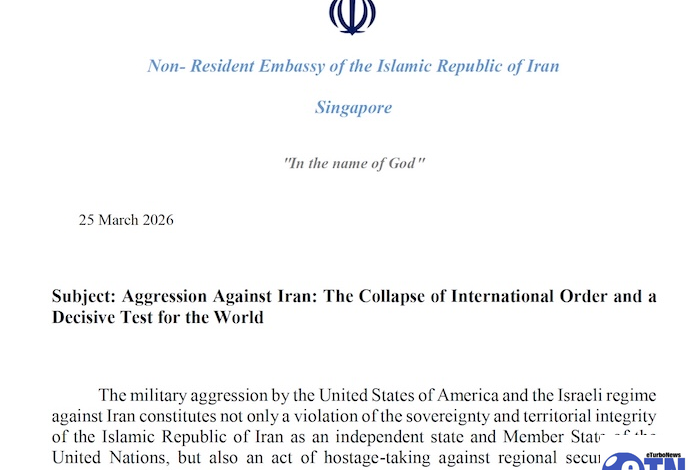
The full unedited Statement by Iran:
Non- Resident Embassy of the Islamic Republic of Iran, Singapore
The military aggression by the United States of America and the Israeli regime against Iran constitutes not only a violation of the sovereignty and territorial integrity of the Islamic Republic of Iran as an independent state and Member State of the United Nations, but also an act of hostage-taking against regional security and energy security by these two aggressor regimes.
Although the Islamic Republic of Iran regards the actions of the aggressors as a clear endeavor to undermine global security—not merely regional or Asian security—even if this aggression is viewed merely as an “Asian crisis” rather than a global one, and setting aside legal analyses, it has undoubtedly precipitated a full-blown crisis.
Throughout its history since the Second World War, the United States has not only failed to serve as a guarantor of any aspect of the international order, but has also engaged in over eighty military interventions beyond its borders, many of which were undertaken without authorization from the Security Council and in contravention of Article 2(4) of the United Nations Charter, which prohibits the threat or use of force against the territorial integrity or political independence of states. From the Vietnam War (1955–1975), which claimed the lives of over three million civilians, to the invasion of Grenada (1983), the bombing of Libya (1986), and the Iraq War (2003), which was launched on the basis of false information and in violation of Security Council resolutions, along with dozens of other cases, these 2
actions collectively portray a power that has defined the international order not by rules but by its own unilateral interests.
The narrative of being a “guarantor of the international order” has never aligned with the legal and historical realities of the United States’ conduct as the true agent of global instability. Rather, the actions of this country depict a global power that has defined the international order not on the basis of rules, but according to its unilateral interests and the plundering of the resources of independent nations.
Therefore, the narrative of being the “guarantor of the international order”—propagated for decades by the United States as a hollow posture—no longer corresponds to the legal and historical realities of our world. What we are witnessing today as “aggression against Iran” is a link in a long chain in which the United States, consistently relying on its military arrogance and disregard for international institutions, has prioritized its own interests over principles and norms. The United States’ strategy of posing as a “stability-exporting power” is no longer credible to the world today; rather, it is nothing more than the unmasking of the stark truth of America’s bloody, barbed fists hidden beneath elegant, velvet gloves.
Today, this process merely unveils what has always been concealed from many of America’s own allies. A country that has never adhered to its commitments to international institutions and has withdrawn from numerous global regulatory conventions now plays its role more openly as an agent of instability and plunder across various regions of the world.
The discord between the actors and the victims of the global economy lies at the heart of today’s crisis, not only in the Middle East region but throughout Asia and even the world. The consequence of this trend is a decline in strategic trust and an increase in suspicion among international actors. All are compelled to anticipate worst-case scenarios. This climate of mistrust also explains the silence of some states and international institutions in the face of this illegal aggression against Iran. In a world where international norms have lost their effectiveness, war crimes are met with general statements and an absence of condemnation.
However, this situation will not remain confined to the Middle East indefinitely; rather, the current crisis will engulf other countries around the world, particularly those at the core of the global economy. The states that today remain silent in the face of aggression against the Islamic Republic of Iran will tomorrow confront the wave of American terrorism, inflationary pressures, arbitrary and unjust tariffs, food crises, and economic instability resulting from Washington’s executive actions and strategies—the genesis of which will be this very aggression. The lesson of the aggression against Iran is that no country can be a “safe oasis” in the face of unilateralism and hegemony. Sustainable security and prosperity can only be 3
achieved through regional cooperation, adherence to the principles of the United Nations Charter, collective defense, and steadfastness against unilateralism and the alignment that stems from a rules-based order.
What has rendered the current crisis a decisive test for other nations is the imperative to reassess the dominant narratives of the international order. Eight decades of United States military intervention across the globe, its violations of treaty obligations, and its persistent disregard for the spirit of the United Nations Charter and Security Council resolutions, paint a clear picture of a country that has never been a guarantor of international stability and now, with greater candor, plays—and openly proclaims—its role as the primary agent of instability.
The Islamic Republic of Iran, at the forefront of this development and as an active actor in exposing the true nature of the United States, has borne heavy costs since its inception. Yet, this is not the end of the matter. The United States is now imposing the economic and security costs of this aggression on other parts of the world, particularly Asian nations. This crisis must serve as a lesson, and proactive engagement must be enhanced.
The ultimate question for those countries that still hope to remain safe from the harm of unilateralism by remaining silent in its face is this: will the eight-decade-long history of United States violations of the sovereignty of independent states not serve as a serious warning for the days to come? Is there any guarantee that, after its aggression against the Islamic Republic of Iran—especially in the midst of two rounds of negotiations—the United States will not turn to other countries, particularly those active in the global economic chain? Will the collapse of international norms, the cost of which is being borne today by the Islamic Republic of Iran through its resilience, not eventually ensnare the silent actors tomorrow?
The answer is clear. In a world where strategic trust has eroded and a so-called global power deems itself above the law, all are compelled to anticipate the worst-case scenarios. Now is the time for other countries to heed this warning and take action to restore the credibility of international norms and halt the aggression against Iran, before the crisis reaches their own shores. History will judge which countries, in this decisive test, stood alongside a rules-based order, and which, through their silence, lent legitimacy to those who undermine it