
The EU Commission has presented plans to promote mini-nuclear power plants in Europe. In the USA, Bill Gates’ company Terrapower received the green light to build its first reactors almost at the same time. This has reignited the nuclear power debate in Germany. Problem: Many give the impression that mini-nuclear power plants would be a game changer. But so-called small modular reactors would have to be financed with taxpayers’ money and are only partially worthwhile. A commentary analysis
What are mini nuclear power plants?
- In recent years there has been Hardly anything has changed in the arguments for and against nuclear power plants. The advantage: Nuclear energy is constant and causes hardly any greenhouse gases. The disadvantage: Nuclear power plants are expensive and the disposal of nuclear waste remains an unsolved problem. But although these facts are still stagnating, a nuclear power debate continues to arise in Germany.
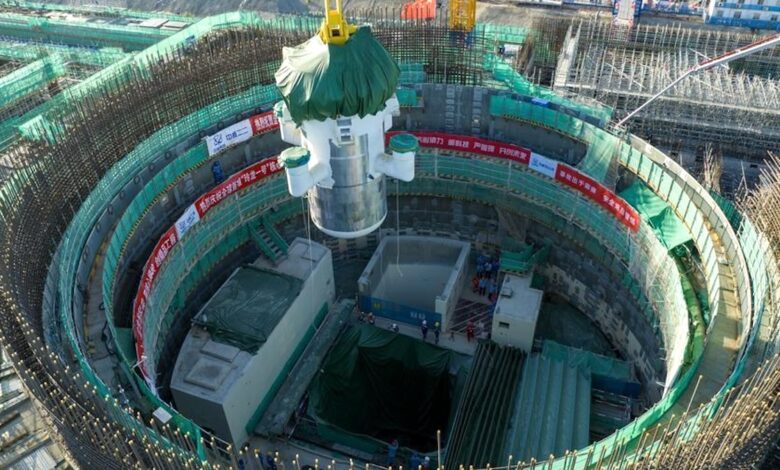
- At the beginning of March 2026, the US nuclear regulator gave the green light to Bill Gates’ energy company Terrapower to build the first commercial mini-nuclear reactors. However, it is still unclear whether these will be allowed to begin operations in the 2030s. Just a few days later, the EU Commission presented a plan that would promote such mini-nuclear power plants in Europe. The brought numerous top German politicians to the scene. While Prime Minister Markus Söder (CSU) campaigned for a pilot project in Bavaria, Federal Environment Minister Carsten Schneider (SPD) firmly opposed the plans.
- There is so far no uniform definition for mini-nuclear power plants. The name Small Modular Reactor (SMR) comes from overseas and emphasizes the modular design of the plants. German authorities define SMRs as small nuclear power plants with an output of 300 megawatts (600,000 households). For comparison: Classic nuclear power plants have around 1,400 megawatts (three million households). The modular series construction of mini nuclear power plants promises shorter production times and lower production costs in the long term. However, they have to do it like their great role models be financed by the statein order to make a profit – with tax money.
Small modular reactors would make electricity more expensive
The planned mini-heaters are intended to cure the two biggest weaknesses of traditional nuclear power: Investor flight and high-priced electricity. But what at first glance sounds like a technological breakthrough turns out to be a small marketing reactor. Because: Mini nuclear power plants are not automatically cheaper, they are just packaged differently.
They could perhaps be worthwhile in the long term for certain industrial sectors, but for the whole Debate is deceptive over the fact that consumers would not benefit from it. On the contrary: Large reactors were once economically more efficient in the long term because they spread fixed costs over a lot of electricity. If the system shrinks, this effect also shrinks.
The result: Electricity tends to become more expensive – and needs even more government start-up help. In addition, building new large nuclear power plants is no longer worthwhile, as there are much more sensible and cheaper alternatives. Of course: the energy transition was initially expensive, but in the long term it will have a positive impact on everyone’s wallet.
The basic logic of mini nuclear power plants therefore remains surprisingly familiar: It doesn’t work without subsidies and with subsidies it becomes political. The fact that the debate still flares up again and again says less about technical progress than about political longings – for predictable energy that is not dependent on the weather.
However, investments in renewables in combination with energy storage and grid expansion appear to make much more sense. Because: They do not cause a final storage problem and ensure cheaper electricity in the long term.
Voices
- EU Commission President Ursula von der Leyen at the second international summit on nuclear energy in Boulogne-Billancourt near Paris: “I believe it was a strategic mistake for Europe to turn its back on a reliable, affordable and low-emission energy source. In recent years we have been experiencing a global renaissance in nuclear energy. And Europe wants to be part of this renaissance. That is why today we are presenting a new European strategy for small modular reactors.” The aim is “for this new technology to be ready for use in Europe by the early 2030s,” she explained.
- Federal Environment Minister Carsten Schneider (SPD) described the EU’s plans as a “backward-looking strategy”. He explained: “If a risky technology is still dependent on government support after three quarters of a century and better alternatives have long been available, one should draw conclusions from that. I refuse to spend even more tax money on new risky reactors. In addition, these small nuclear power plants have been announced for decades, but they do not achieve a breakthrough and instead struggle for subsidies.”
- The SPD parliamentary group in the Bavarian state parliament defends itself against “Söder’s nuclear mumbo-jumbo” and “fairy tale reactor”. SPD energy expert Florian von Brunn about this: “In the entire Western world, not a single one of these small nuclear power plants is in commercial operation. There are some in China and Russia – i.e. in two countries that are not exactly known for a critical public and good safety standards. None of these small reactors are running in Canada – even if Markus Söder made untruthful claims.”
Mini nuclear power plants are not worth it
The great SMR hope rests on a bet: less risk, less security effort and lower costs. But how much security a society is willing to price in is not an engineering question, but a political one and, experience has shown, a very expensive one.
But the learning curve will be crucial. This means: Only if SMRs are mass-produced like airplanes could the costs actually fall. Critics counter that this would require hundreds or thousands of orders. One like that But the market doesn’t existas most countries have now recognized the advantages of renewables.
An unspectacular scenario is therefore more likely. Mini nuclear power plants will come, but slowly and exclusively in niches such as remote industrial sites, for special applications or perhaps even process heat. That could make sense, but it does not a game changerbut rather another building block. Problem: The entire debate hides the fact that nuclear power – whether small or large – is simply no longer worthwhile on a large scale.
And anyone who wants to argue with France, China or the USA should be told that France can only supply nuclear power because it is subsidized with 60 billion euros in tax money. That the USA does operate nuclear power plants, but due to the high costs of new construction and one climate change denying government prefer to pollute the air and atmosphere with oil. And: That China only uses SMRs to a limited extent and is now a leader in the expansion of renewables.
Why does the debate still exist? Because politicians want to deceive in order to win elections. Because large corporations want to assert their lobbying interests. And: Because it is often no longer about the common good, but about power.
Also interesting: