

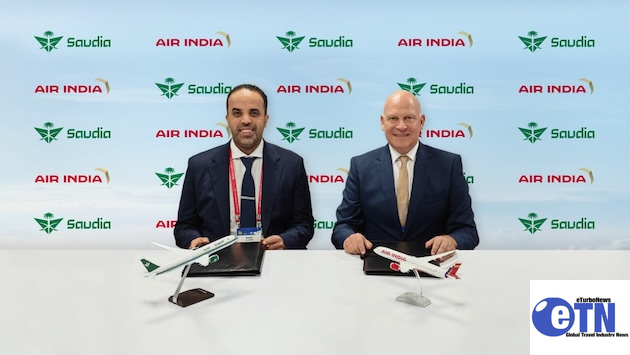
RIYADH, Saudi Arabia – In an aviation industry where global alliances have long defined partnerships, Saudi Arabia’s national carrier, Saudiaetc Star Alliance member Air India are demonstrating that commercial opportunity increasingly outweighs alliance boundaries.
The two airlines signed a Memorandum of Understanding (MoU) to significantly expand their existing relationship, strengthening air connectivity between Saudi Arabia and India—one of the world’s fastest-growing international aviation markets.
The agreement was signed by HE Engr. Ibrahim Al OmarDirector General of Saudia Group, and Campbell WilsonChief Executive Officer and Managing Director of Air India.
While the partnership builds on an existing codeshare agreement, it also signals a broader shift in international aviation: airlines are becoming more willing to cooperate with carriers belonging to competing global alliances when passenger demand and commercial opportunities justify it.
Beyond a code share
The agreement establishes a roadmap for expanded cooperation that includes increasing codeshare destinations, improving network connectivity, exploring terminal co-location, examining closer operational and commercial cooperation, and potentially linking the airlines’ frequent flyer programs.
Perhaps even more significant, both airlines will study extending cooperation to their low-cost subsidiaries—flyadeal and Air India Express—creating opportunities to serve one of the world’s largest price-sensitive travel markets.
“India is an important market for Saudia, and Air India is a valued partner in strengthening travel links between our two countries,” said Ibrahim Al-Omar.
Campbell Wilson emphasizes that strengthening political and economic relations between India and Saudi Arabia naturally create opportunities for aviation to play a much larger role in connecting both nations.
More Than an Airline Agreement
Few international aviation markets are as strategically important as the Saudi Arabia-India corridor.
More than that 2.5 million Indians live and work in Saudi Arabiamaking the Indian community one of the Kingdom’s largest expatriate populations. Their year-round travel supports dozens of daily flights connecting Riyadh, Jeddah, Dammam and Medina with major Indian cities including Delhi, Mumbai, Hyderabad, Kochi, Chennai, Bengaluru and Lucknow.
Religious travel remains another cornerstone of the relationship.
India consistently ranks among the largest source markets for Hajj and Umrahwith hundreds of thousands of Indian Muslim pilgrims traveling annually to Islam’s holiest sites. During pilgrimage seasons, airlines significantly increase capacity to accommodate demand.
Business travel is expanding just as rapidly.
Saudi Arabia’s Vision 2030 economic transformation has increased cooperation in construction, technology, healthcare, energy, logistics, education and investment, creating growing demand for premium business travel between the two countries.
Can India Become Saudi Arabia’s Next Tourism Market?
Historically, traffic between the two nations has been dominated by Indian workers returning home and religious pilgrims traveling to Saudi Arabia.
That balance may gradually change.
As Saudi Arabia develops one of the Middle East’s fastest-growing outbound tourism markets, India is increasingly positioned to attract Saudi leisure travelers.
Luxury hotels, heritage palaces, wellness resorts, world-class medical tourism, shopping, wildlife experiences, Himalayan mountain destinations and beach resorts in Goa and Kerala offer attractive alternatives to traditional European vacations—often at significantly lower costs and with much shorter flying times.
Improved air connectivity and easier visa procedures could further stimulate outbound Saudi tourism to India in the coming years.
Alliances No Longer Dictate Every Partnership
Perhaps the most interesting aspect of the agreement is that it joins airlines belonging to rival global alliances.
Saudia represents SkyTeamwhile Air India belongs to Star Alliance.
India-Saudi Bilateral Relations | Embassy of India, Riyadh, Saudi Arabia
Twenty years ago, such cooperation would have been unusual. Today, airlines increasingly recognize that alliances alone cannot meet every commercial objective.
Several high-profile partnerships have already demonstrated this changing philosophy.
Qantasa founding member of oneworld, maintains one of the aviation industry’s most successful strategic partnerships with Emiratesdespite Emirates remaining outside every global alliance.
Air France-KLM and Etihad Airways have expanded cooperation despite belonging to different strategic networks.
Before joining oneworld, Alaska Airlines successfully partnered with airlines across all three global alliances, while several European carriers have maintained codeshare agreements with competitors whenever market conditions made commercial sense.
The Saudia-Air India agreement follows this increasingly pragmatic model.
Competing for One of Aviation’s Fastest-Growing Markets
India is expected to become one of the world’s largest aviation markets over the next decade, while Saudi Arabia is investing billions of dollars to transform itself into a global tourism, business and logistics hub.
For both airlines, stronger cooperation creates immediate opportunities to capture growing demand from expatriate workers, religious pilgrims, corporate travelers, visiting families and, increasingly, leisure tourists traveling in both directions.
For passengers, the benefits could eventually include expanded destination choices, better flight schedules, coordinated airport operations and reciprocal loyalty benefits.
For the aviation industry, the message is equally clear.
Global alliances remain important, but they are no longer the only framework for international cooperation.
As airlines pursue growth in rapidly expanding markets such as India and Saudi Arabia, commercial strategy is increasingly replacing alliance loyalty.
The Saudia-Air India partnership may therefore represent more than another codeshare expansion—it reflects the evolving reality of international aviation, where serving passengers and accessing high-growth markets matter more than the alliance logo painted on the aircraft.