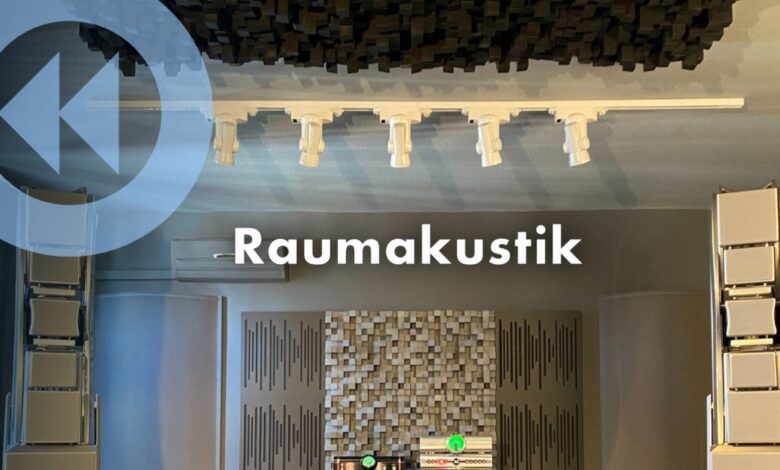


The topic of room acoustics optimization has long been a shadowy existence in hi-fi. It is infinitely important if the goal is to get the best possible sound from speakers. REWIND would like to (once again) raise awareness of the topic.
–––––––––––––––––––––––––––––––
Of course the headline is extremely provocative. This is how clickbait works. If you’re reading these lines, it obviously worked, even though I’ve already revealed what it’s really about in the teaser. But please don’t click away straight away, because anyone who is seriously interested in breathing new life into their hi-fi system should take the following to heart.
All of us here in the unique MTN community are gearheads of some sort. We love Macs, iPhones, iPads, smartwatches, but many of us also love more “traditional” hardware, like components and speakers for music playback. HiFi magazines all over the world and also REWIND constantly report on the latest and greatest technology toys ever, as the manufacturers would have us believe. In fact, a lot has happened technically in hi-fi over the years, even if you don’t always see it straight away. Although there are also old loudspeakers whose concept still works well today, thanks to greatly improved material and manufacturing technology, optimized computer calculations, greater knowledge of the pitfalls of construction and other factors, the sound/price ratio of loudspeakers has improved significantly today.
But all of this is of little use, because what was only ever a peripheral issue and is therefore hardly on the to-fix list for end users is the acoustics of the rooms in which the hi-fi systems are operated. This has improved somewhat recently. HiFi testers and manufacturers point out this topic more frequently and more aggressively. I have already addressed the topic more than once (such as here), but I would like to remind you of it again. This is necessary because room acoustics play a significant role in the sound experience at home. Loudspeakers and room acoustics go hand in hand, are inextricably intertwined and interdependent.
 The (rare) ideal case: The room is acoustically optimized, the speakers are in a stereo triangle and the listening position is in the sweet spot. That’s how it should be. But the reality usually looks different. Living spaces are rarely so consistently optimized for stereo music playback. But at least part of it should be implemented. The picture shows the Vicoustic VicAudiophile VMT Kit (approx. 1,500 euros), a complete solution consisting of various room acoustic modules.
If you feel like your system needs an upgrade because you somehow want more bass power, finer resolution and a more spacious experience, you can’t just do that by buying the newest, highest-rated speakers. Even if you spend two or three times as much on them as you did on the old speakers, that doesn’t automatically lead to a real improvement. In the worst case, it can even sound worse than before if the new speakers don’t fit into the room acoustically. – Or if you are absolutely not prepared to give the speakers more distance from the walls, even though this is the only way they can really play freely.
The topic becomes even more sensitive when we talk about topics such as lossless or even HiRes streaming. The differences in sound are only a tiny fraction of what can happen by moving the speakers slightly. This does not mean that these topics should be completely neglected. They just come at the very end of the optimization chain.
Anyone who thinks that all of these problems can now be easily dealt with using DSP-supported measurement and room correction software is seriously mistaken. It’s like in medicine: You can relieve pain, but it’s always better to find the cause, eliminate it and make the medication unnecessary. DSP corrections only address the symptoms. They can help with simpler problems, but they are not without pitfalls. It’s better to get to the root of the problem and tear it out.
A little note in between: This is not intended to be a seminar on room acoustics. The following explanations only serve to highlight the problem.