Only 18 percent of the world’s plastic waste is recycled. The rest puts a strain on ecosystems. A team of researchers at the University of Cambridge has now presented a process that breaks down plastic residue into hydrogen and valuable chemicals using sunlight and old battery acid.
The global production of plastic is increasing rapidly. In 2023 it reached over 400,000,000 tons. However, so far only 18 percent of waste is recycled. Large mountains of waste are therefore putting a strain on ecosystems worldwide.
Chemical processes such as photoreforming promise a way out. Light energy breaks down plastics such as PET, nylon or polyurethane into hydrogen and chemicals. A team from the University of Cambridge has now published a new method in the journal Joule.
Sulfuric acid from old car batteries
The necessary acid comes from used lead-acid car batteries. These batteries are waste worldwide and contain large amounts of sulfuric acid. The researchers use this to break down plastic into its individual parts.
The process does not require any new chemicals because the acid acts as a catalyst. It is not consumed in the reaction. This allows two different waste problems to be addressed at the same time.
The scientists also used PET bottles from local cafes for the experiments. However, these were not simply added to the reactor. First, the researchers chopped the material into small pieces.
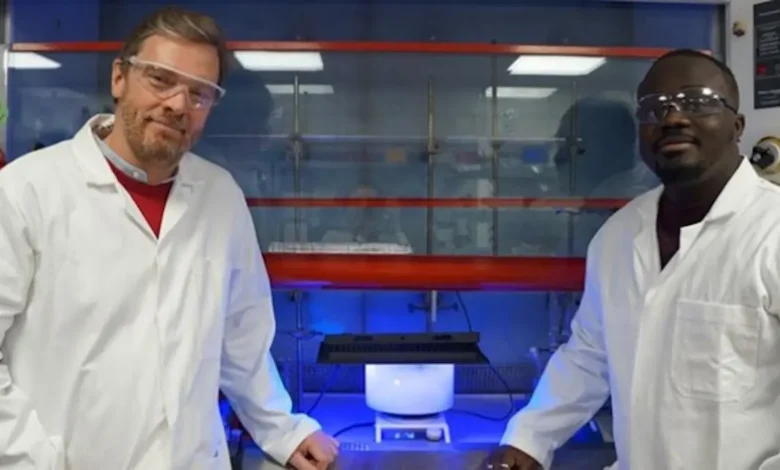
They then froze the leftovers with liquid nitrogen and ground them into powder in a coffee grinder. Only in this fine form could the plastic residues react efficiently with the acid. During this step, 75 percent of the terephthalic acid contained is produced as a solid. Lead author Kay Kwarteng, a doctoral student in the research group that developed the photocatalyst, says:
Acids have long been used to break down plastics, but until now we have not had a cost-effective and scalable photocatalyst that could withstand these acids. Once we solved this problem, the benefits of this type of system became apparent.
Nylon and polyurethane provide this much hydrogen
The catalyst also processes nylon 66 and polyurethane. The component consists of carbon nitride and molybdenum disulfide. Experts refer to it as CoMoS2-CNx. The catalyst works like a small solar system on a molecular level.
Nylon 66 delivered 1.0 millimoles of hydrogen per gram of catalyst in the tests. Pentanoic acid can be formed as an oxidation product. For polyurethane, the hydrogen value was as high as 4.2 millimoles.
The efficiency of light use for ground PET bottles was 9.0 percent. This is one of the highest values ever measured for this process. In long-term tests, the system remained stable for eleven days.
In addition to hydrogen, acetic acid in particular was produced. The selectivity for this product was 89 percent. The researchers attribute this to a so-called 1,2-hydride shift on the catalyst.
Can the procedure be economically worthwhile?
An economic analysis compared different operating methods. A combination of solar cells and LEDs performed best. These allow operation around the clock with consistent light quality.
The process could generate profit through the sale of terephthalic acid and acetic acid. The costs for the hydrogen would then be mathematically negative. However, the costs for separating the chemical substances are still missing from this calculation.
Integration into existing recovery technologies is therefore crucial for practice. This is the only way the process can be used on an industrial scale. Future work should now investigate special reactors for this process.
Also interesting: