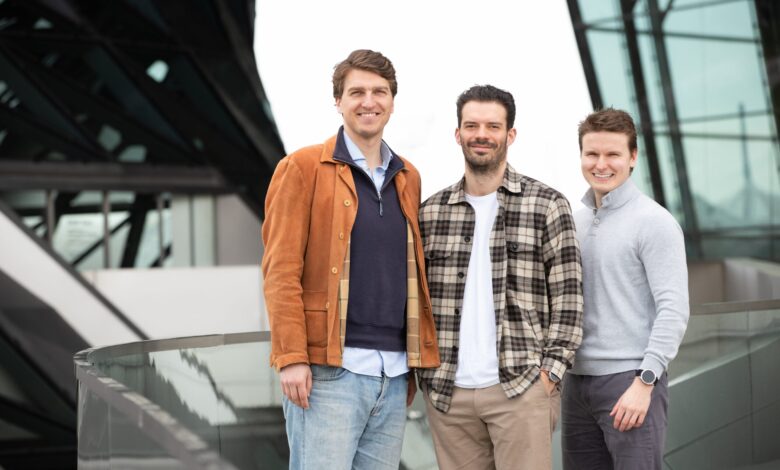

The startup Linexa from Munich is planning to make Europe’s factories AI-capable. For this purpose, the deep tech has now completed pre-seed financing worth two million euros. The round was led by Berlin-based VC Project A. Business angels also took part. Among them: Celonis founder Bastian Nominacher, Thomas Böck, CEO of the industrial company Festo and Christian Schlögel, former CTO/CDO of the tech companies Kuka & Körber.
Read too

The idea of Linexa
Viktor Stryczek, Alexandros Vassiliadis and Tobias Drees founded the startup at the end of 2025. The three met during their time at Celonis.
According to Vassiliadis, the founders had a lot to do with production companies both there and in previous professional positions. This is how they came up with the idea for their startup. “The same denominator always came up in the discussions: production lines have grown so much over decades that no one person has an overview anymore,” says Vassiliadis. “Systems from a dozen manufacturers are standing side by side, some installed forty years ago, some last month. The documentation is partly in Excel lists, partly in the heads of individual maintenance workers.”
Read too

With Linexa, the founders want to help factories gain a holistic overview and understanding of their production processes. To do this, Linexa collects the data from the various programs that the systems run and uses it to build a uniform data model that maps the functionality of all machines. “The AI agents can then adapt, optimize or secure production,” says Vassiliadis.
This means: If factories want to change their production, adapt systems or secure machines to protect employees, they can do this more quickly with Linexa, according to the founders – without long downtimes and expensive service contracts.
AI is not allowed to make mistakes
According to Stryczek, the biggest challenge in developing Linexa’s AI was the structuring of the data – and the AI itself. A lot of research work was necessary for this.
Read too

The AI agents generate a code to adapt the systems. And it has to be completely error-free. “Errors can cause production downtimes, damage systems or even endanger people,” says Stryczek. “Every change suggestion must therefore be simulated virtually in an intermediate step. It is only released when the behavior corresponds exactly to what is expected.”
Linexa is already being used by a German food producer. The startup does not disclose the name. The fresh capital will now flow into expanding the team and the platform.
Click here for the pitch deck
Linexa provided founders with the pitch deck with which they were able to convince investors. You can find more pitch decks from other startups here.