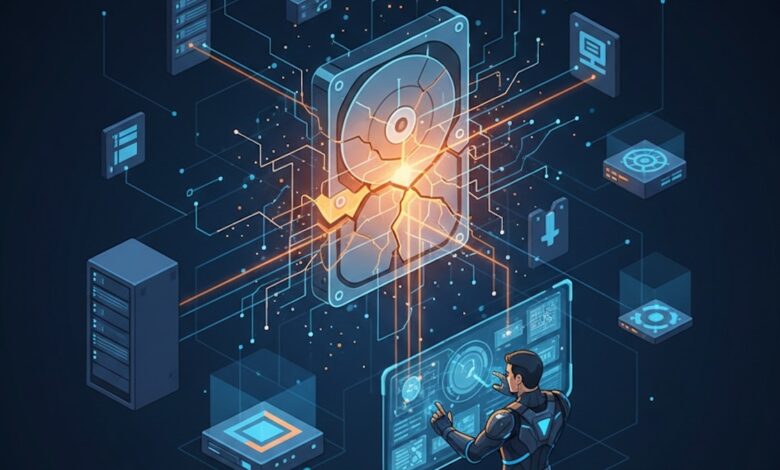
Anyone who has ever experienced how a NAS system simply stops responding at three in the morning knows: data loss doesn’t happen when you have time and peace. The Stellar Toolkit for Data Recovery was developed for exactly such moments and it goes much further than the usual data recovery tools we know.
Because while tools like Recuva are limited to deleted files, the Stellar Toolkit plays in a different league: reconstructing RAID arrays, integrating VM images, reading out NAS volumes. All this in a single software, without having to switch between three different special tools.
What you really need it for
In many IT environments, a colorful collection of systems has accumulated over the years: Windows servers here, a few Mac workstations in the creative area, Linux machines in the infrastructure, NAS systems from Synology or QNAP and a few virtual machines somewhere. And if one of these systems fails, things quickly become uncomfortable.
The problem with most data recovery tools: They’re good at one thing and you need something new for everything else. The Stellar Toolkit wants to do this differently. It combines powerful scanning engines with specialized features for RAID, NAS and virtual machines, covering file systems that others fail: NTFS, FAT, exFAT, APFS, HFS+, Ext2/3/4 and even BitLocker encrypted drives if you have the password or boot key handy.
Supported storage media range from classic HDDs and SSDs to USB sticks and memory cards to optical storage media, Synology, QNAP and ASUSTOR NAS as well as virtual hard drives in VMDK, VDI, VHD and VHDX format.
Try Stellar Toolkit for Data Recovery now
What the software can specifically do
The scan runs in two modes: A quick scan is sufficient for the most common cases, i.e. deleted files and accidentally formatted drives. If the file system is damaged or the directory tree is no longer readable, you use deep search, which searches based on file signatures. This takes several hours for large hard drives, but it also finds files that other software would have long since given up on.
Practically all common file types are supported: Office documents, PDFs, emails, database files, photos, videos, compressed archives. Before the actual restoration, content can be checked in the preview. So you can see whether the file you find is actually still usable before you pay for the license.
Speaking of license: The scan itself is free. A license is only required for the restoration. This is an honest approach; you know in advance whether the effort is worth it.
RAID Rescue: The Complicated Part
RAID systems are considered fail-safe. In practice, this is true until more drives fail than the redundancy level covers. Then it becomes critical and then you need a tool that understands how RAID works internally.
The Stellar Toolkit can reconstruct inaccessible RAID 0, RAID 5 and RAID 6 arrays based on parameters such as disk order, boot sector and block size. If individual parameters are unknown (which happens quickly in a chaotic failure), the software suggests likely configurations. If the RAID can no longer be reconstructed consistently, there is also the option of a virtual RAID for a RAW scan, in which file signatures are searched directly in the volume image.
Important first: Before each RAID data restore intervention in a RAID system, check whether an automatic rebuild is still running. Many NAS systems start this in the background as soon as a drive fails and a spare is available. Anyone who interrupts this risks further data loss. So first open the management interface of the NAS, check the status, wait for the rebuild and only then decide whether the toolkit is needed.
NAS systems: online and offline
NAS systems from Synology, QNAP or ASUSTOR are the central data hub in many companies. Controller failure, defective hard drives, configuration errors – the causes of failure are diverse. The toolkit covers both scenarios: If the NAS is still accessible via the IP address, access is carried out directly via the network via a secured SSL connection. If not, remove the drives, connect them to a Windows PC and scan them sector by sector.
What helps: The software recognizes the typical NAS file systems and can independently reconstruct RAID structures that a NAS uses internally, without first having to know the exact RAID level or configuration.
Save virtual machines
Anyone who works with VMware, Hyper-V or VirtualBox knows the problem: a VM no longer boots, a virtual drive is suddenly no longer accessible, and the next step is usually a long evening. The toolkit directly integrates virtual hard drives (VMDK, VDI, VHD, VHDX) and treats them like physical drives. Including detection of lost partitions via the “Can’t Find Drive” function.

In many cases this saves having to completely rebuild a VM. The time advantage is significant, especially when critical applications or development environments are affected.
Bootable rescue media for crashed systems
If a Windows or macOS system no longer starts, you obviously won’t get very far with software that has to run on the damaged system itself. The toolkit can therefore create a bootable medium that gives you access to the crashed system. From there, drives and partitions can be scanned and files can be backed up to an external medium or a network drive without putting any further strain on the damaged system.
Disk images: backup first, then scan
A key risk in data recovery is overwriting recoverable sectors, especially if a drive is already showing signs of hardware damage. The toolkit therefore makes it possible to create a sector-by-sector image of the drive in advance. You then work on the image, not on the weakened original. The success rate increases and the source drive is not put under unnecessary strain.
Limits that you should know
Data recovery is not a guarantee, and that also applies here. Overwritten data is usually lost; with SSDs, TRIM ensures that deleted cells are actively emptied, which significantly reduces the chances of success. Physical damage such as a read/write head crash is a case for a clean room laboratory, not for software. Stellar runs such labs itself in case the software reaches its limits, but that’s a different story and a different budget.
License and system requirements
The current version is 12.6.0.0, available as a toolkit edition with a single user license. The software runs on 64-bit Windows systems: Windows 11, 10, 8.1, 8 as well as Windows Server 2016, 2019 and 2022. At least 4 GB of RAM (8 GB is better for large amounts of data) and around 250 MB of storage space are recommended for installation.
If you are unsure whether the toolkit will solve your case: simply download the test version, have it scanned and check the preview. Only when the data you are looking for has actually been found is it worth purchasing a license.
Conclusion
The Stellar Toolkit for Data Recovery is not a tool for the casual user who has accidentally deleted a file; there are cheaper alternatives. It is serious software for anyone who regularly works with heterogeneous IT environments and does not want to have to find four different tools in an emergency. RAID reconstruction, NAS recovery, VM recovery and bootable media in one solution: that’s the strength of the toolkit. The fact that the scan is free and the license is only due upon restoration also makes the decision much easier.
Get Stellar Toolkit for Data Recovery now